Replacing Float, Basecamp, Leave Dates and a pile of spreadsheets with Conduit, an AI-enabled Mac app for Synthesis Health
Synthesis Health's resourcing, projects, timesheets, leave, CRM and house style lived in separate subscriptions. We brought them into Conduit, one Mac app built around a medical communications agency, then added Conni, an AI colleague that works from the same picture. The team now saves around 10 hours each a week.
- Client
- Synthesis Health
- Sector
- Medical communications
- Services
- Discovery and workflow mapping, Product design, Mac app development, AI integration
- Stack
- macOS (Apple silicon), Amazon Bedrock
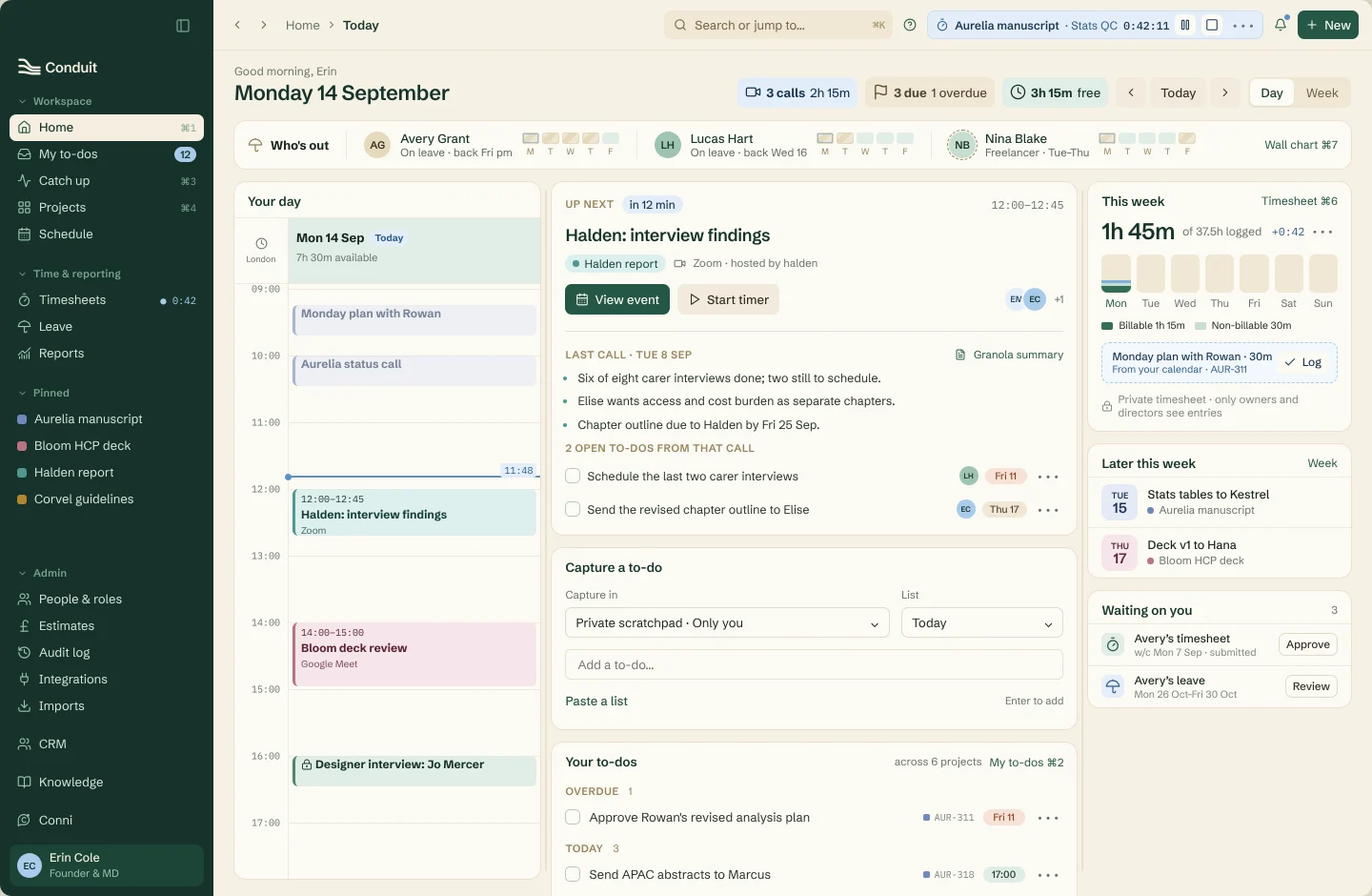
Synthesis Health is a medical communications agency. Its medical writers, statisticians, designers, account leads and freelance specialists produce publications, congress materials, HCP decks and advisory boards for pharmaceutical and healthcare clients. As the agency grew, running it had spread across a stack of subscriptions and spreadsheets. Antler Digital built Conduit, one Mac app that brings that work in-house, shaped around how a med comms agency actually runs. Then we built AI into it.
The challenge
The manuscript is in review, the congress is next week, and you need the whole picture. At Synthesis Health that picture was split across tools:
- Float knew who was booked.
- Basecamp held the project thread.
- Leave Dates knew who was away.
- Spreadsheets held the pipeline and the Friday timesheets, and the house style lived in PDFs and in people’s heads.
Each tool made sense when it was added. Together they cost thousands of dollars a year, a bill that grew with every starter and freelancer, and the team spent hours every week reconciling them: re-keying bookings, chasing timesheets, checking leave against the schedule and pulling numbers together to see whether a project was on budget.
Key stats
~10hrs
saved per team member per week
$1000s
in subscriptions replaced
Requirements
- One app for the whole agency day: winning work, resourcing, delivery, time, budgets, leave and house style
- Built around med comms work: manuscripts, author review rounds, congress deadlines, statistics QC and freelance specialists
- Bring years of history across from Float, Basecamp and Leave Dates without losing anything
- Keep the tools the team talks and thinks in: Microsoft Teams, Google Workspace and Granola
- Private by design for confidential client work: UK data storage and role-based access to clients, projects, finance and CRM
- AI that knows the work and the house style, and never changes anything without a person’s say-so
Our approach
Discovery: following the work
We started with how work moves through the agency, not with a feature list. How does a symposium brief become a price, a team and a start date? Where do author comments land, and who acts on them? How does a freelance statistician’s QC time end up against the budget? Mapping those journeys gave us the shape of the product: win, plan, deliver, record, understand.
One Mac app for the agency’s day
We designed and built Conduit for Mac, with each part replacing a tool or a spreadsheet:
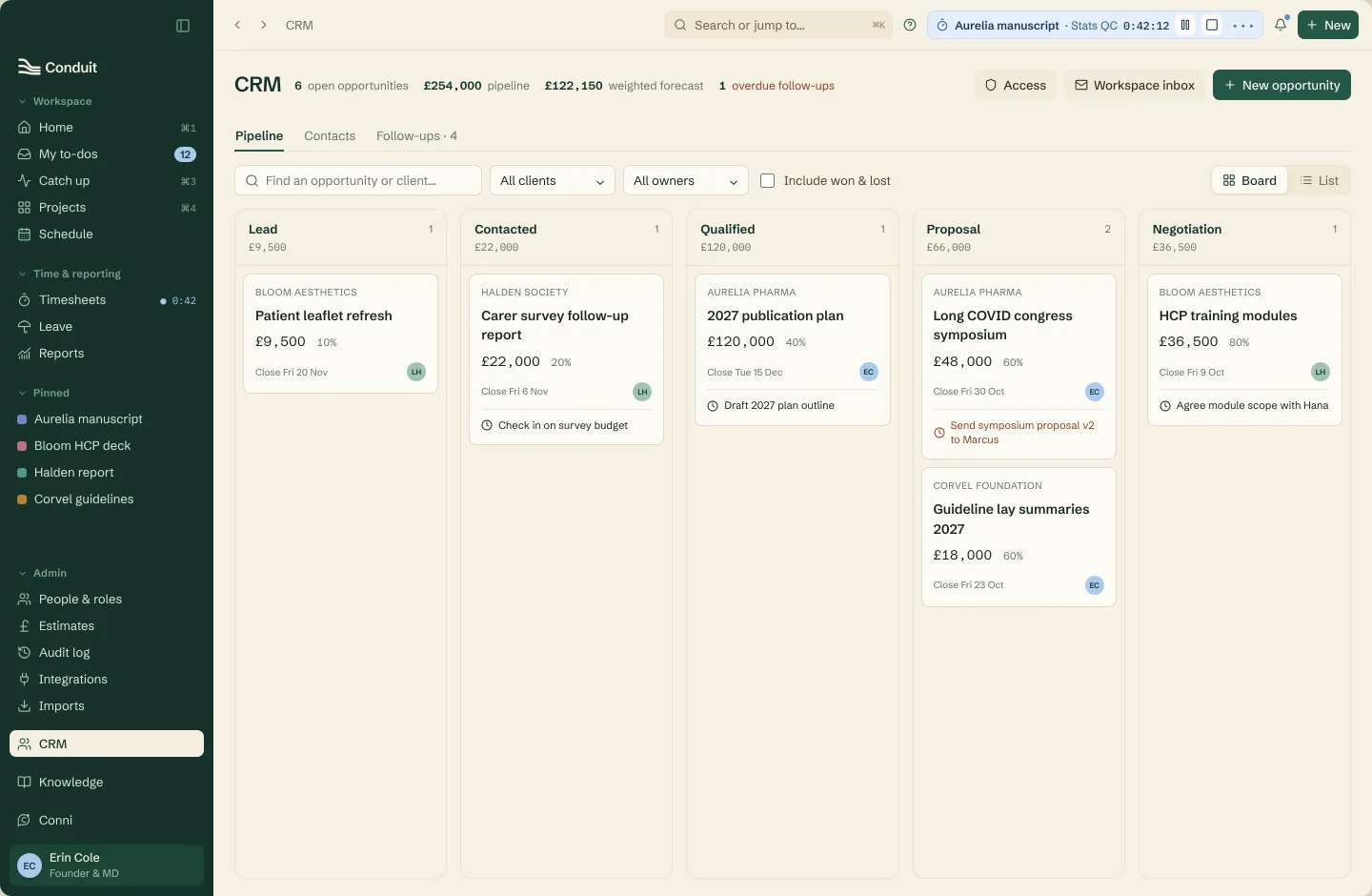
- CRM and estimates. The pipeline by stage with a weighted forecast, client email forwarded straight to the deal, and estimates priced on real roles and rates with availability checked before they go out. An accepted estimate becomes a project with its phases and tentative bookings.
- Resourcing. The team’s week in one view, with medical writers, designers and freelancers planned around real capacity. Freelancer capacity is kept separate from staff utilisation.
- Project delivery. Briefs, author comments, files, messages and the next action stay with the deliverable, so a statistician checks the science instead of searching for the latest request.
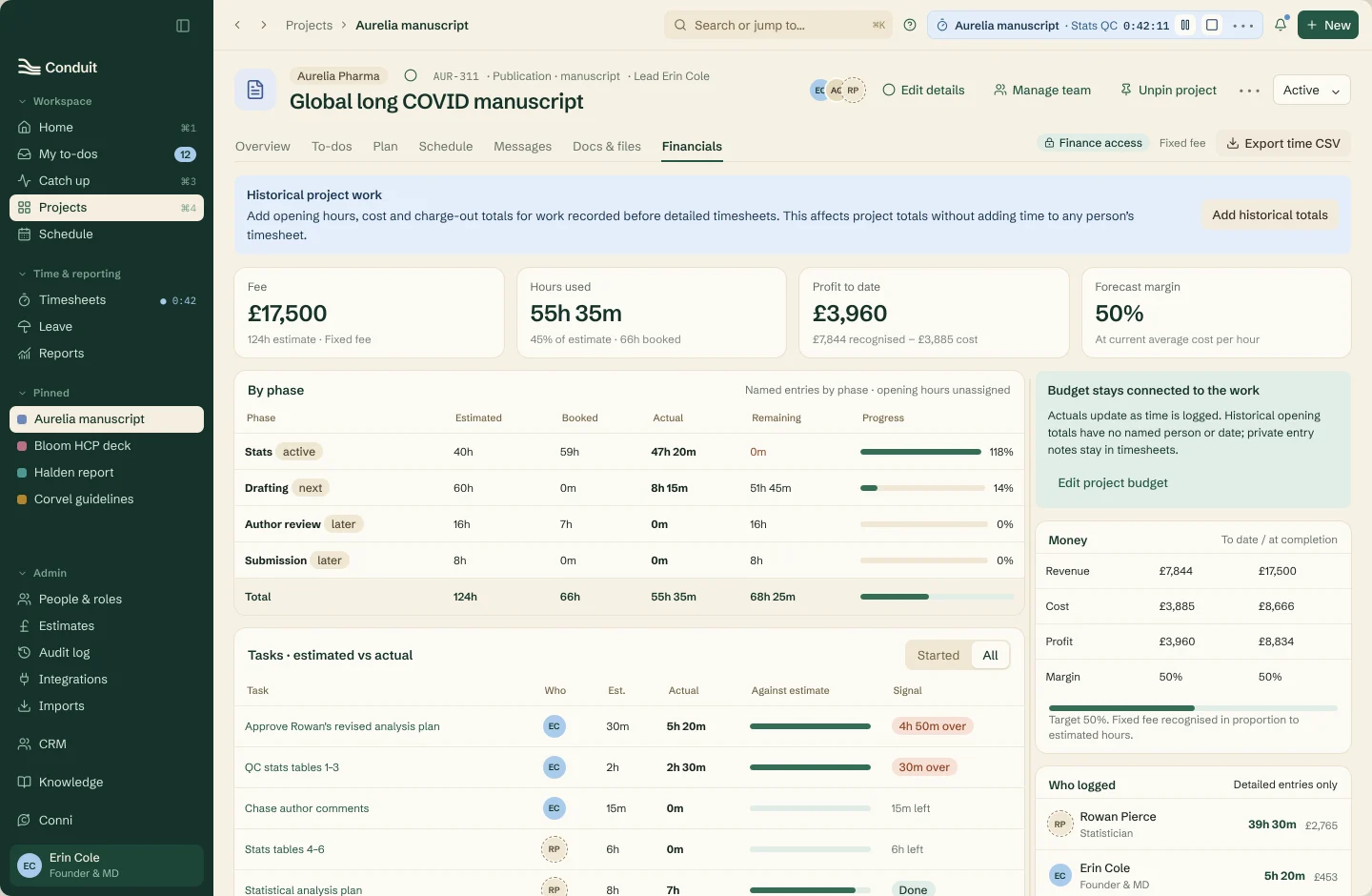
- Time and budgets. Task timers in the app and the Mac menu bar, weekly approval, and project financials showing fee, cost, profit to date and forecast margin phase by phase.
- Leave and capacity. Requests, policies, allowances and approvals sit alongside the bookings, so cover is planned before the out-of-office goes on.
- Notes, memory, guides and skills. House, client and project style guides written as reviewed rules with examples, private and shared notes, and skills that save the agency’s repeat processes, such as reviewing a draft against the brief.
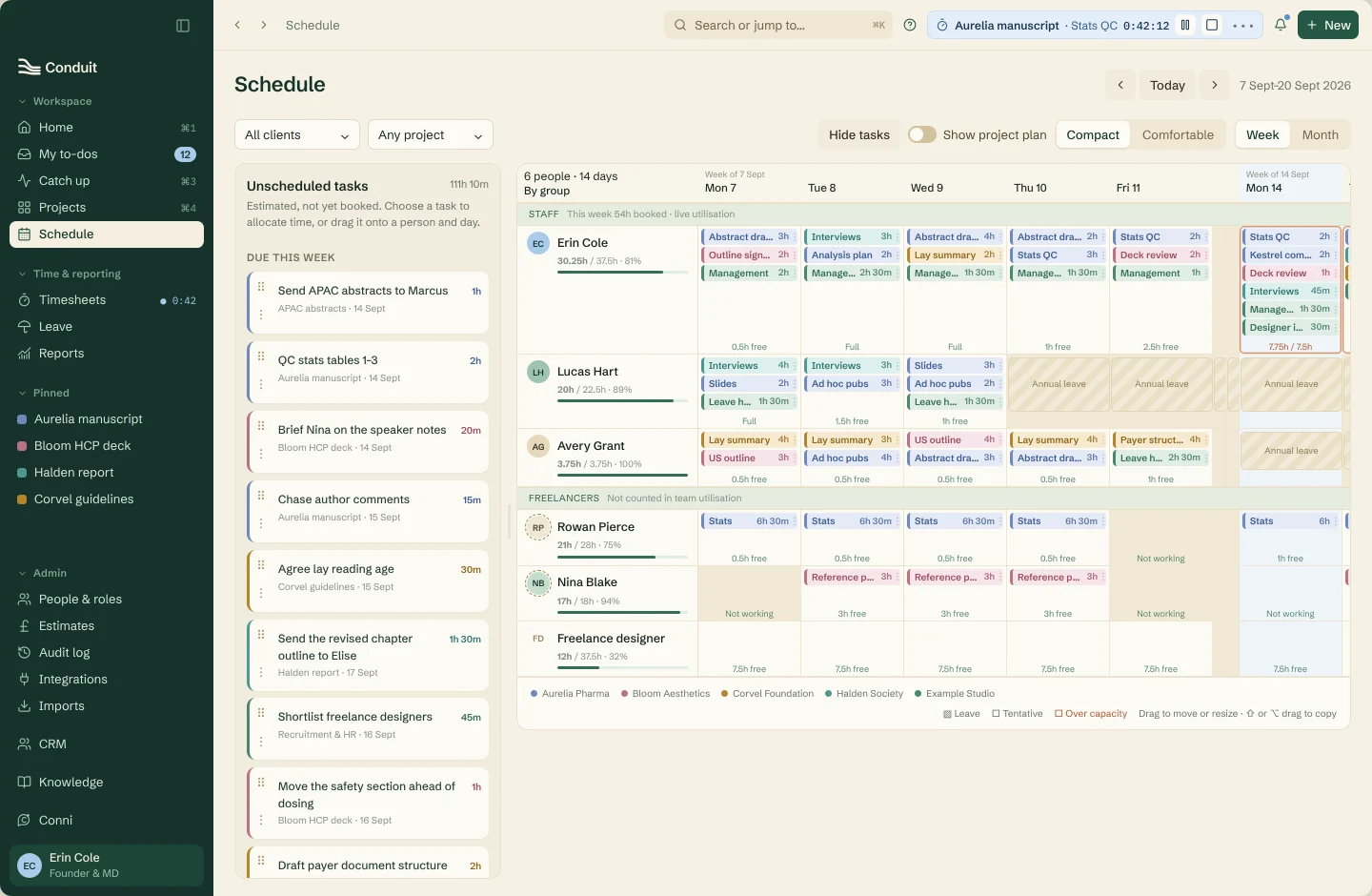
Because everything shares one model of people, projects and time, a leave approval updates capacity, a timer updates the budget and an accepted estimate creates the project. Nobody rebuilds the picture by hand.
Bringing the history across
Switching only works if the past comes too. Conduit imports Basecamp folders, Float reports and Leave Dates spreadsheets together in one review: it matches people, clients and projects first, then brings in the work that belongs to them, attachments included. Every import can be undone and run again. The tools the team still relies on stay connected: project updates post to Microsoft Teams, Google Calendar and approved leave stay in sync, and Granola meeting summaries land in the right project.
Conni: an AI colleague that knows the work
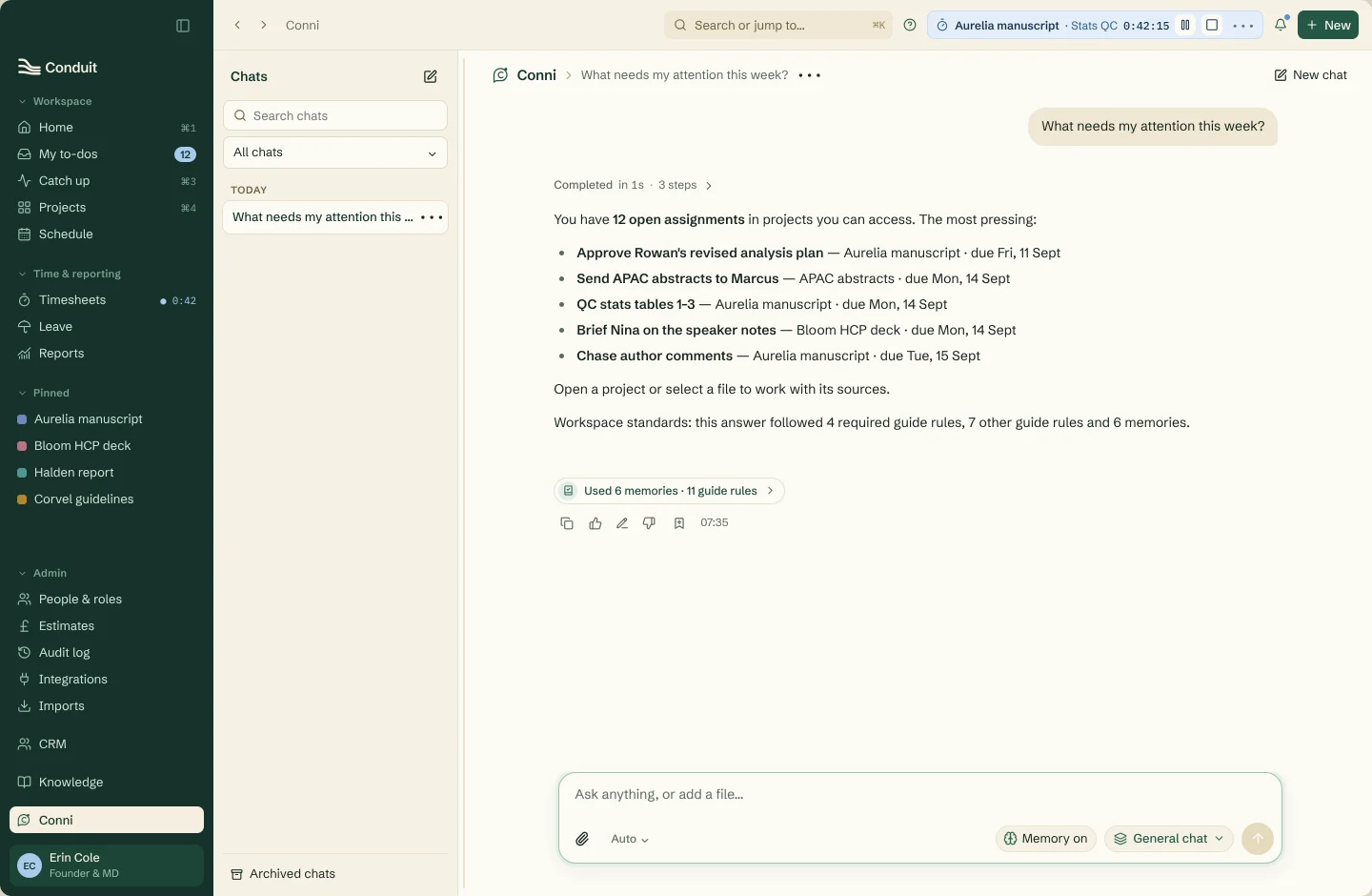
With the agency’s data in one place, AI could do useful work. Rather than bolting on a chatbot, we built Conni into Conduit. It works from the projects, people, files and calendars each person can already see:
- Ask about the work. “What needs my attention before Thursday’s call?” Conni answers from the workspace, shows the sources it used and says when information is missing instead of guessing.
- Write in the house style. Drafts follow approved memory and published style guides, and every answer shows exactly which rules and memories shaped it.
- Skills for bespoke workflows. The agency’s own processes, such as reviewing a draft or preparing a brief, are saved as versioned skills, so Conni and new starters do repeat work the same careful way.
- Meeting to task. Granola call summaries arrive in the project with their open to-dos, ready to assign.
- Timesheet automation. Calls from the calendar appear as suggestions to log against the right project, and timers attach hours to the task, so nobody reconstructs the week on Friday.
- Budget forecasting. Logged hours are compared with the estimate as the work happens, and forecast margin shows a project heading over budget before another review round, not after.
- Changes only with a person’s say-so. To-dos, drafts and meetings arrive as an exact preview. Nothing is saved until someone confirms it.
Protected AI for confidential client work
Medical communications work is confidential, so privacy was designed in from the start. Workspace data and Conni’s service and chat history are stored in London. Models run on Amazon Bedrock with zero data retention and no access for model providers, and client work is never used to train them. Conni only reads what the person asking can access, chats stay private to their author, and a project’s processing policy can keep it out of AI altogether. Owners decide who can use Conni and set monthly allowances. Conduit for Mac itself is signed and notarised by Apple, with sign-in kept in the Mac Keychain.
The outcome
Conduit now runs Synthesis Health’s day, from the first brief to the final review round. Float, Basecamp, Leave Dates, the pipeline and timesheet spreadsheets and the style guide PDFs have been replaced, along with thousands of dollars a year in subscriptions. The agency has one picture of its people, projects, time and money.
With Conni and automation built into everyday workflows, team members save around 10 hours a week on average on manual tasks. Across the team, that is a substantial amount of capacity recovered without hiring.
We were paying thousands of dollars a year for tools that didn't talk to each other, and our team spent hours moving information between them. Conduit gave us one place for everything, built around how we actually work. With AI now part of our day-to-day, the team gets around ten hours a week back for the work that matters.”
What's next
Memory, guides and skills are being extended in the next update, so Conni can take on more of the agency’s repeat work. Conduit is also now in private beta for other medical communications agencies, by invitation, at conduitspace.com.
Tell us what you're trying to fix.
In 15 minutes you'll speak to a senior engineer, get a straight answer on whether we can help, and leave with a clear next step, even if that step isn't us.
Free · 15 minutes · with a senior engineer, not a salesperson
Not ready to talk? See our services and pricesWe’d recommend the team to others looking for talent to take their product to the next level.”