Ultimate Guide to Ethical AI Risk Assessment
Framework to identify, prioritise and mitigate ethical harms from AI - bias, opacity, governance and regulatory compliance.

Ethical AI risk assessment is about identifying and addressing potential harms caused by AI systems, even when they function as intended. These harms can include bias, lack of transparency, or social exclusion. Unlike general risk assessments, this approach focuses on societal and moral consequences, ensuring AI systems operate responsibly and align with ethical standards.
Key highlights:
- Why it matters: Ethical AI risk assessments help businesses comply with regulations like UK GDPR and the Data (Use and Access) Act (effective 19 June 2025), while avoiding reputational and legal risks.
- Principles: Transparency, accountability, and human oversight are central to ethical AI. Frameworks like the SAFE-D model and global standards (e.g., OECD AI Principles) guide organisations in managing risks.
- Process: Ethical risk assessment involves scoping, identifying risks (e.g., bias, algorithmic opacity), and implementing mitigation strategies like bias testing, monitoring, and robust governance.
- Tools: Methods like Data Protection Impact Assessments (DPIAs), Equality Impact Assessments (EIAs), and tools like Microsoft's Responsible AI Toolbox simplify risk evaluation.
- Governance: Strong accountability structures, clear roles (e.g., Senior Responsible Owners), and thorough documentation (e.g., model cards, audit trails) ensure long-term compliance and trust.
Ethical AI risk assessments are not just about compliance - they build trust, reduce risks, and support sustainable business practices.
Core Principles and Frameworks for Ethical AI
Key Ethical Principles for AI
Ethical AI frameworks often revolve around shared principles, even if their wording varies. Grasping these principles is crucial to identifying potential harms your AI systems might cause, even unintentionally.
Transparency plays a central role, allowing for the examination of actions, decisions, and processes. This means explaining how systems work, the data they rely on, and their limitations in a clear and accessible way.
Beyond transparency, other principles like fairness, privacy, accountability, sustainability, and human agency tackle different areas of risk. These include avoiding bias, protecting data, clarifying responsibility for AI outputs, addressing environmental concerns, and ensuring humans remain central to decision-making.
The UK Ministry of Justice employs these principles through the SAFE-D framework - developed by The Alan Turing Institute. SAFE-D stands for Sustainability, Accountability, Fairness, Explainability, and Data Responsibility. This framework demonstrates how abstract principles can be turned into a practical governance model.
However, these principles don’t always align. For instance, using more demographic data might improve fairness but could compromise privacy. Addressing such trade-offs systematically, rather than on the fly, is critical.
These principles form the foundation of global standards that guide ethical AI practices.
Global Standards and Guidelines
| Framework | Primary Focus | Key Tools |
|---|---|---|
| OECD AI Principles | Trustworthy AI & policy interoperability | Due Diligence Guidance, Policy Observatory |
| NIST AI RMF | Technical risk management | Playbook, GenAI Profile (July 2024), Critical Infrastructure Profile |
| UNESCO Recommendation | Human rights & environmental flourishing | Ethical Impact Assessment (EIA), Readiness Assessment (RAM) |
| UK Data & AI Ethics Framework | Public sector governance | ATRS, Self-Assessment Tool, Equality Impact Assessment |
The OECD AI Principles, introduced as the first intergovernmental standard and updated in 2024, have shaped over 1,000 policy initiatives in more than 70 jurisdictions by May 2023. The UNESCO Recommendation, adopted by all 194 member states, focuses on human dignity and environmental concerns. For UK organisations, the UK Data and AI Ethics Framework is particularly relevant, aligning with the Equality Act 2010 and the Public Sector Equality Duty.
A notable update came on 19 February 2026, when the OECD released its Due Diligence Guidance for Responsible AI, providing actionable steps for organisations to move from principles to implementation.
Adopting these standards effectively requires strong governance, as outlined below.
Building Governance Structures
The Information Commissioner’s Office (ICO) emphasises:
"You cannot delegate these issues to data scientists or engineering teams. Your senior management, including DPOs, are also accountable for understanding and addressing them appropriately."
Strong governance structures typically assign four key roles: Senior Responsible Owner (SRO), Data Owner, Data Steward, and AI Asset Owner. Ethical risk assessment should be integrated into your existing Enterprise Risk Management (ERM) processes rather than treated as a separate task. Tools like Data Protection Impact Assessments (DPIAs) and Equality Impact Assessments (EIAs) offer natural entry points for this integration.
Ongoing monitoring is equally critical, as AI systems can change over time due to shifting data patterns - a phenomenon known as concept drift. Addressing this isn’t just a best practice; it’s a governance necessity.
sbb-itb-1051aa0
Steps in the Ethical AI Risk Assessment Process
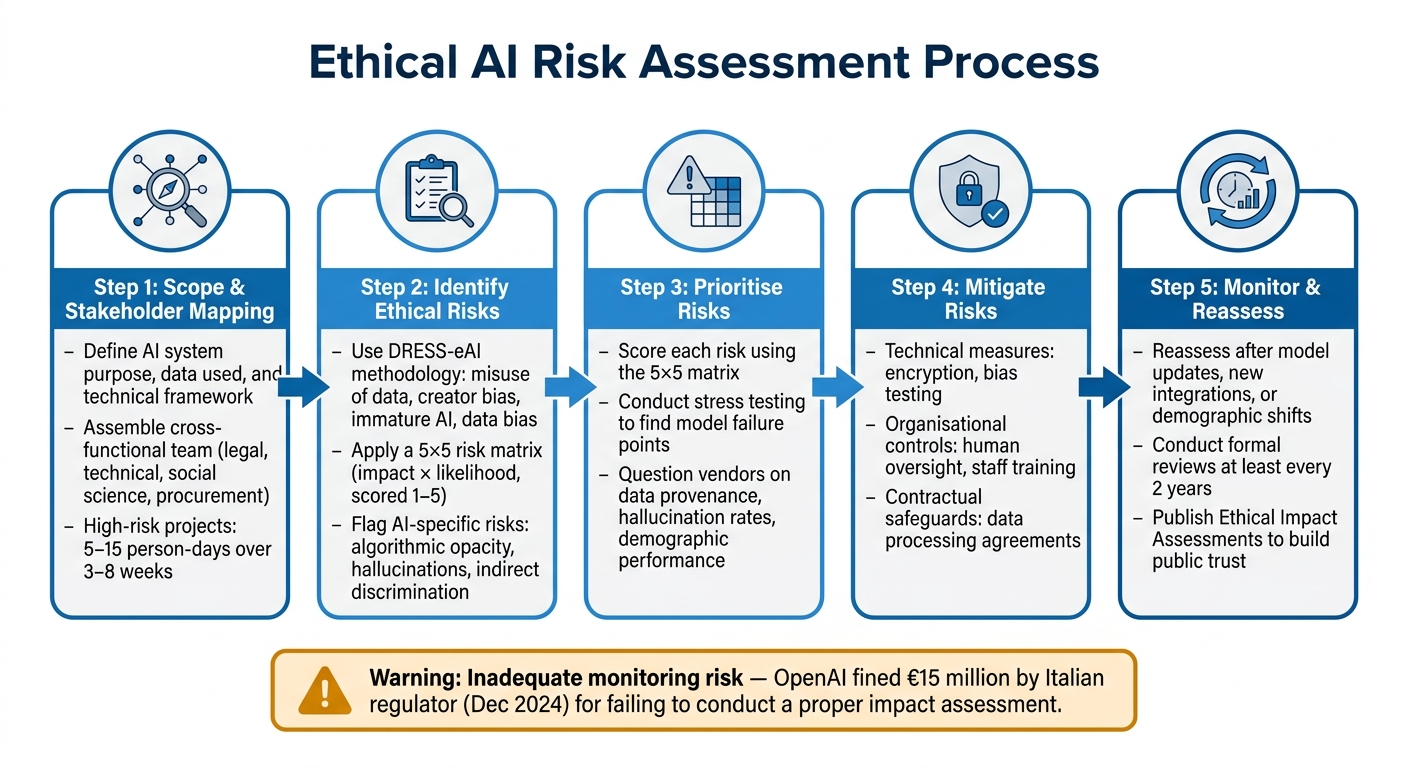
Ethical AI Risk Assessment Process: 5 Key Steps
Scoping and Stakeholder Mapping
To start, define the AI system's purpose, the data it processes, and its technical framework. For high-risk AI projects, assessments typically require 5 to 15 person-days of effort over a period of 3 to 8 weeks. Getting the scope right from the beginning can save a lot of time and effort later.
Bring together a cross-functional team that includes experts from legal, technical, social science, and procurement fields. This diversity helps uncover potential blind spots during the research and procurement phases, rather than after deployment. As UNESCO aptly notes:
"Technologies are not neutral: they reflect the values and interests of those who design and deploy them."
A clear scope and a diverse team create a solid foundation for identifying ethical risks effectively.
Identifying Ethical Risks
With a well-defined scope and input from stakeholders, the next step is to systematically identify potential ethical risks. This ensures no critical areas are overlooked. Start by pinpointing possible failure points. The DRESS-eAI methodology outlines four key causes of ethical failures: misuse or overuse of data, creator bias, immature AI systems, and data bias. Additionally, other AI-specific risks, such as algorithmic opacity, hallucinations, and indirect discrimination, require close attention.
Prioritising these risks is essential. A 5×5 risk matrix - which scores both the impact and likelihood of risks on a scale from 1 to 5 - can help focus efforts on the most pressing threats. Stress testing is another valuable tool:
"Accurate assignment of risk is built on the understanding of the point of model failure. Stress testing is the technical capability that brings integrity to any effective risk assessment of AI." - Advai
It's also important to directly question vendors about data provenance, hallucination rates, and how their systems perform across different demographic groups.
By using structured tools like the 5×5 matrix, teams can prioritise risks and move forward with targeted mitigation strategies.
Addressing Ethical Risks
Each identified risk must be addressed with a clear mitigation plan and an accountable owner. Mitigation can involve three key approaches: technical measures (like encryption or bias testing), organisational controls (such as human oversight and staff training), and contractual safeguards (e.g., robust data processing agreements) . As IIENSTITU cautions, "a risk without an owner is a risk that will be ignored".
Risk monitoring doesn’t end at deployment. AI systems evolve, and so do the risks they pose. Reassess systems after major changes - such as model updates, new integrations, shifts in user demographics, or data updates - and conduct reviews at least every two years . A stark example of the consequences of inadequate monitoring is the €15 million fine imposed on OpenAI by the Italian data protection authority (Garante) in December 2024 for failing to conduct a proper impact assessment.
Finally, publishing completed Ethical Impact Assessments where possible can help build public trust. It shows a commitment to accountability beyond mere regulatory compliance .
Tools and Methods for Ethical AI Risk Assessment
To turn ethical risk management into a consistent and accountable practice, effective assessment methods and automation tools play a crucial role. Building on earlier steps to identify and address risks, the following approaches formalise the process of evaluating ethical AI systems.
Structured Assessment Methods
After identifying and mitigating risks, structured methods help formalise ethical evaluations. In the UK, frameworks like Data Protection Impact Assessments (DPIAs) and Equality Impact Assessments (EIAs), mandated under UK GDPR, ensure accountability and transparency in AI projects. Additionally, the UK public sector uses Algorithmic Transparency Recording Standard (ATRS) documentation to enhance accountability.
For a broader perspective, the UNESCO Ethical Impact Assessment (EIA) provides a six-step framework. This free tool guides teams through scoping, implementing ethical principles, and mapping impacts. Typically, it’s completed in one or two collaborative workshops lasting half a day.
"Transparency means that information about your project, actions, processes and data are communicated to relevant parties in an understandable, easily accessible and free way." - GOV.UK
With these structured methods in place, defining clear metrics becomes the next step to measure how ethical principles translate into practical outcomes.
Key Metrics for Ethical AI Evaluation
Metrics are essential for turning abstract ethical principles into measurable, actionable outcomes. The OECD's VCIO model (Values, Criteria, Indicators, and Observables) is a helpful framework for tracking these outcomes. Ethical AI metrics typically cover several key areas:
- Fairness: Measured by assessing performance differences across demographic groups and ensuring data is representative.
- Transparency: Evaluated through explainability of outputs and the frequency of audit logs.
- Safety: Tracked via system reliability, hallucination rates, and identification of trigger conditions.
- Privacy: Measured through data minimisation efforts and the effectiveness of anonymisation techniques.
- Sustainability: Assessed by monitoring energy consumption per inference and the overall environmental impact.
| Ethical Dimension | Key Metrics | Methods |
|---|---|---|
| Fairness | Differential performance by demographic; data representativeness | Equality Impact Assessment (EIA) |
| Transparency | Explainability of outputs; audit log frequency | Algorithmic Transparency Recording Standard (ATRS) |
| Safety | Hallucination rates; system uptime; security vulnerabilities | Robustness testing; AI assurance techniques |
| Privacy | Data minimisation levels; anonymisation effectiveness | Data Protection Impact Assessment (DPIA) |
| Sustainability | Energy per inference; biospheric impact | Environmental impact mapping |
These metrics provide the foundation for leveraging specialised tools that simplify the evaluation process.
Tools and Automation for Ethical AI
Algorithmic Impact Assessments (AIA) are valuable for identifying and addressing risks early in the development process. One prominent example is Microsoft's Responsible AI Toolbox, an open-source suite available under the MIT Licence on GitHub. This toolbox supports models built with PyTorch, TensorFlow, and Keras, and includes several key tools:
- Fairlearn: Assesses fairness metrics across demographic groups.
- InterpretML: Provides insights into model interpretability.
- Error Analysis: Highlights areas where models underperform for specific data subsets.
- DiCE: Conducts counterfactual analysis to show how changes in input data affect outcomes.
For organisations requiring a simpler approach, the GSMA AI Ethics Self-Assessment Questionnaire adjusts its depth based on the assessed risk level, making it ideal for lower-risk scenarios. Widely used tools like SHAP (SHapley Additive exPlanations) and LIME (Local Interpretable Model-Agnostic Explanations) are effective for interpreting traditional machine learning models, although they may not perform as well for large language models.
Integrating Ethical AI Risk Assessment into Business Practices
Aligning Ethical AI with Business Strategy
To truly integrate ethical AI risk assessment into daily operations, businesses need collaboration across departments like legal, HR, data, security, and sustainability. A practical way to achieve this is by embedding a triple-gate architecture within development pipelines. This approach includes:
- A Metric gate to evaluate performance and safety.
- A Governance gate to ensure legal compliance.
- An Eco gate to assess environmental impact.
Rather than treating ethical AI as a simple checklist, this structure turns commitments into actionable and testable measures.
However, focusing solely on legal compliance is not enough. Jakub Szarmach, AI Governance Lead, emphasises this point:
"Ethicists are not moral arbiters but facilitators of structured ethical decision-making, risk clarification, and accountability."
Adopting established frameworks like ISO 31000 can also help, as it aligns with enterprise risk management (ERM) systems that business leaders are already familiar with. This approach lays the foundation for governance models that ensure ethical practices are maintained over time.
Models for Sustaining Ethical AI Practices
Maintaining ethical AI practices calls for dedicated structures. For example, internal ethics committees, like Microsoft's AETHER Committee, provide leadership with valuable guidance. External oversight bodies, such as Meta's Oversight Board, offer an independent perspective, making binding decisions on critical issues. This board operates as a separate legal entity, funded by a purpose trust.
A hybrid model that combines internal oversight with external advisory boards can create a balanced governance system. Additionally, embedding risk champions within product and data teams ensures that ethical concerns are addressed early in the development process, rather than being identified only at the release stage.
Documentation and Reporting for Accountability
Strong governance depends on thorough documentation and transparent reporting. Throughout the AI lifecycle, organisations should maintain auditable records like DPIAs, EIAs, and model cards, which outline a system's purpose, data origins, and limitations.
Accountability also requires clear ownership. Assigning a Senior Responsible Owner (SRO), along with specific data and AI asset owners, ensures that someone is directly responsible for a system's outcomes. Publishing these assessments can build trust among users and regulators alike.
"Accountability means that data and AI projects have appropriate and effective governance, oversight, and routes to challenge decisions in place." - GOV.UK
Here’s a quick overview of key documentation and their roles:
| Document | Primary Purpose |
|---|---|
| DPIA | Evaluates privacy risks before processing personal data |
| EIA | Ensures systems are fair and legally compliant |
| Model Card | Details limitations, training data, and intended use |
| ATRS Record | Provides transparency on the use of algorithmic tools |
| Audit Trail | Tracks data access, design decisions, and assumptions |
Don’t forget about third-party suppliers. Requiring external vendors to provide documentation on training data, biases, and assumptions can significantly enhance an organisation's accountability.
Conclusion and Key Takeaways
How Ethical AI Drives Business Success
As highlighted earlier, ethical risk assessment is at the heart of managing AI responsibly and effectively. By 2026, organisations will increasingly face scrutiny from clients and partners who will demand transparency about AI governance during procurement and due diligence. Colin, Managing Director at Dr Logic, sums it up well:
"Good AI governance does not slow innovation. It makes it safer, more credible and more sustainable."
Failing to prioritise ethical assessment could lead to operational disruptions and damage to reputation. Taking a proactive approach is not just about compliance - it's a smart business move that builds trust and ensures long-term resilience.
Tips for Getting Started
For SMEs, a structured 30/60/90 day plan can simplify the process of embedding ethical AI practices:
- First 30 days: Conduct a full audit of all AI tools in use, including unofficial ones adopted by employees without IT's approval. Develop a straightforward AI policy that outlines its purpose, how data is managed, and a clear process for escalating issues.
- By day 60: Shift focus to vendor due diligence. Ask suppliers critical questions about their use of customer data, data retention policies, and methods for bias testing.
- By day 90: Complete your first formal AI audit and present the findings to leadership. Incorporate AI-related risks into your organisation's existing risk register, avoiding the need for a separate, isolated process.
How Antler Digital Can Help

If you're looking to take these steps further, Antler Digital offers tailored support to help SMEs integrate ethical AI practices into their operations. Rather than adding governance measures as an afterthought, Antler Digital embeds ethical AI risk assessment directly into the design and development of scalable web applications and workflows. This ensures that governance structures, automated audit trails, and explainability features are part of the system from the outset, aligning with frameworks such as the EU AI Act and ISO 42001.
Whether you need a robust risk assessment framework, human-in-the-loop controls for critical decisions, or the documentation required to meet regulatory standards, Antler Digital provides the technical and strategic expertise needed to make ethical AI a practical and effective part of your business operations.
FAQs
When do we need an ethical AI risk assessment?
An ethical AI risk assessment plays a key role in ensuring that AI systems are developed and deployed responsibly. Its purpose is to identify and address potential harms that could affect individuals, groups, or society as a whole. This is especially important in areas involving high-risk applications, such as automated decision-making in human resources, credit scoring, biometric identification, or decisions that significantly impact lives.
What makes these assessments even more critical is the fact that AI systems can continue to evolve after being deployed. Because of this, a single review at the start isn't enough - regular evaluations are necessary to keep up with any changes and ensure ongoing accountability.
How do we balance fairness and privacy in practice?
Balancing fairness and privacy requires a careful and well-documented trade-off analysis as part of your risk assessment process. To ensure fairness, assess the representativeness of your data and identify potential biases that could impact outcomes. At the same time, adhere to key data protection principles such as data minimisation, purpose limitation, and ensuring a lawful basis for processing (which might include obtaining consent where necessary).
For processing activities that carry higher risks, it's essential to conduct a Data Protection Impact Assessment (DPIA). If fairness risks are also a concern, a Fairness Risk Impact Assessment (FRIA) might be required. Safeguards should be put in place, including access controls, encryption or pseudonymisation of data, and regular bias testing. For decisions that are particularly critical, ensure there is human oversight to maintain accountability and transparency.
What evidence should we keep to prove AI accountability?
To ensure AI accountability, it's crucial to keep an audit-ready evidence trail throughout the AI's lifecycle. This means having detailed documentation and records that can stand up to scrutiny. Here's what that involves:
- Risk management records: Clearly document identified risks, the steps taken to address them, and any remaining risks.
- Comprehensive audit logs: Track every use of the AI system, including decision IDs, timestamps, system versions, inputs and outputs, as well as any human oversight involved.
- Detailed system documentation: Include the system's purpose, training details, known limitations, vendor instructions, monitoring data, and procedures for handling serious incidents.
Regulators don't want vague explanations or after-the-fact claims - they need solid evidence that the AI system operates responsibly and transparently.
if (valuable) then share();