Ultimate Guide to AI Vulnerability Assessments
Scope AI assets, map trust boundaries, red-team prompt and RAG risks, prioritise fixes by business impact, and monitor for drift.

If I deploy AI without testing it for prompt attacks, data leaks, tool misuse, and weak logging, I leave gaps that normal app testing may miss.
This guide boils the job down to five parts: scope the AI estate, map trust boundaries, test model and agent behaviour, rank findings by business risk, and monitor after release. It also makes one thing clear: AI risk is not just a dev issue. It can hit customer data, revenue, and regulatory exposure at the same time.
Here’s the short version:
- I start by listing every AI component in scope: models, prompts, datasets, RAG stores, APIs, agents, plugins, logs, and third-party tools.
- I mark where trusted inputs end and external inputs begin, because that is where prompt injection and data leakage often show up.
- I test the highest-risk workflows first, such as:
- customer-facing chatbots
- agents that can send emails or edit records
- RAG systems linked to HR, legal, finance, or other sensitive data
- I look for the main AI weakness types:
- prompt injection
- data poisoning
- model extraction
- unsafe output handling
- denial of service
- supply-chain issues
- I treat results as business problems, not just lab findings. For example, a flaw that works only 30% of the time can still be a top-priority issue if it can leak PII or trigger payments.
- I turn manual attack patterns into regression tests with tools such as PyRIT and Garak, then rerun them after any model, prompt, or tool change.
- I keep a risk register with an owner, score, and KPI for each issue, then retest fixes and watch for drift in production.
A few numbers stand out:
- The average global data breach cost reached US$4.44 million in 2025.
- Prompt injection ranked No. 1 in the OWASP LLM Top 10 across 2024–2025.
- One cited figure says 68% of enterprise AI assessments found RAG access control failures.
- EU AI Act penalties can reach €35 million or 7% of worldwide turnover.
| Area | What I check first | Main risk |
|---|---|---|
| Scope | Models, agents, RAG, tools, data flows | Missing part of the attack surface |
| Trust boundaries | External inputs, retrieved content, tool calls | Injection and data leaks |
| Red teaming | High-impact workflows | Harm to customers, systems, or revenue |
| Scoring | Likelihood + impact + data sensitivity | Poor fix order |
| Monitoring | Regression tests, logs, drift | Old flaws coming back |
Bottom line: I should treat AI vulnerability assessment as a repeat cycle, triggered by system changes, not as a once-a-year task.
Scope AI Assets and Risk Boundaries
Scoping tends to go wrong in two ways: teams miss parts of the system, or they pull in too much noise. So before any testing starts, pin down what is in scope and where the boundary sits. After that, map the assets and data flows that create risk.
Build an inventory of AI components
Your inventory should cover each layer of the AI stack. That includes base models and any fine-tuned versions, training and retrieval datasets, vector stores used in RAG setups, system prompts and orchestration logic, inference APIs, file upload paths, and any agent workflows linked to external tools such as email, CRM systems, or databases.
Put the most attention on workflows that handle:
- customer data
- financial impact
- PII leakage
- IP exposure
Shadow AI makes the attack surface bigger because it sits outside formal controls. Track Shadow AI: unapproved tools employees already use.
Define trust boundaries and sensitive data flows
A trust boundary is any point where data or control passes between different systems, users or environments. Once the inventory is done, trace exactly where customer data, financial records, credentials, and intellectual property move through the system, from ingestion to storage, processing, and output.
The main distinction to record is controlled versus external inputs. A system prompt you control is trusted. A customer’s free-text message is not. A RAG system that pulls from internal HR documentation and shows it in a chatbot creates a data leakage risk right at a trust boundary. Map where authenticated inputs end and unauthenticated ones begin, and note which environments stay separate.
This is where your test cases start to take shape. Trust boundaries show where prompt injection, data leakage, and unsafe actions are most likely to appear.
Set risk criteria before testing begins
Agreeing severity criteria upfront saves time later. It stops the usual back-and-forth over what matters and what does not. Before testing begins, define what counts as a critical finding for your business.
The most useful factors are:
- whether the AI can trigger actions such as sending emails, changing records, or approving transactions
- whether it handles personal data covered by UK GDPR
- whether it has a direct effect on revenue
Use these tiers to set test depth and reporting urgency:
| Priority Tier | Asset Type | Key Risk Factors |
|---|---|---|
| Tier 1: Critical | Customer-facing AI applications, AI agents with write access, RAG systems connected to sensitive internal data stores | Regulatory exposure (UK GDPR/FCA), autonomous action capability, direct revenue impact |
| Tier 2: High | Internal productivity tools, decision-support systems, AI coding assistants | IP theft, internal data leakage, biased business outcomes |
| Tier 3: Medium | Embedded SaaS AI features, third-party summarisation tools | Supply chain risk, vendor-managed data handling |
Use these tiers to decide how deep to test each system in the next stage. Document the criteria in a one-page assessment charter so everyone works from the same severity scale.
sbb-itb-1051aa0
Map AI Threats and the Attack Surface
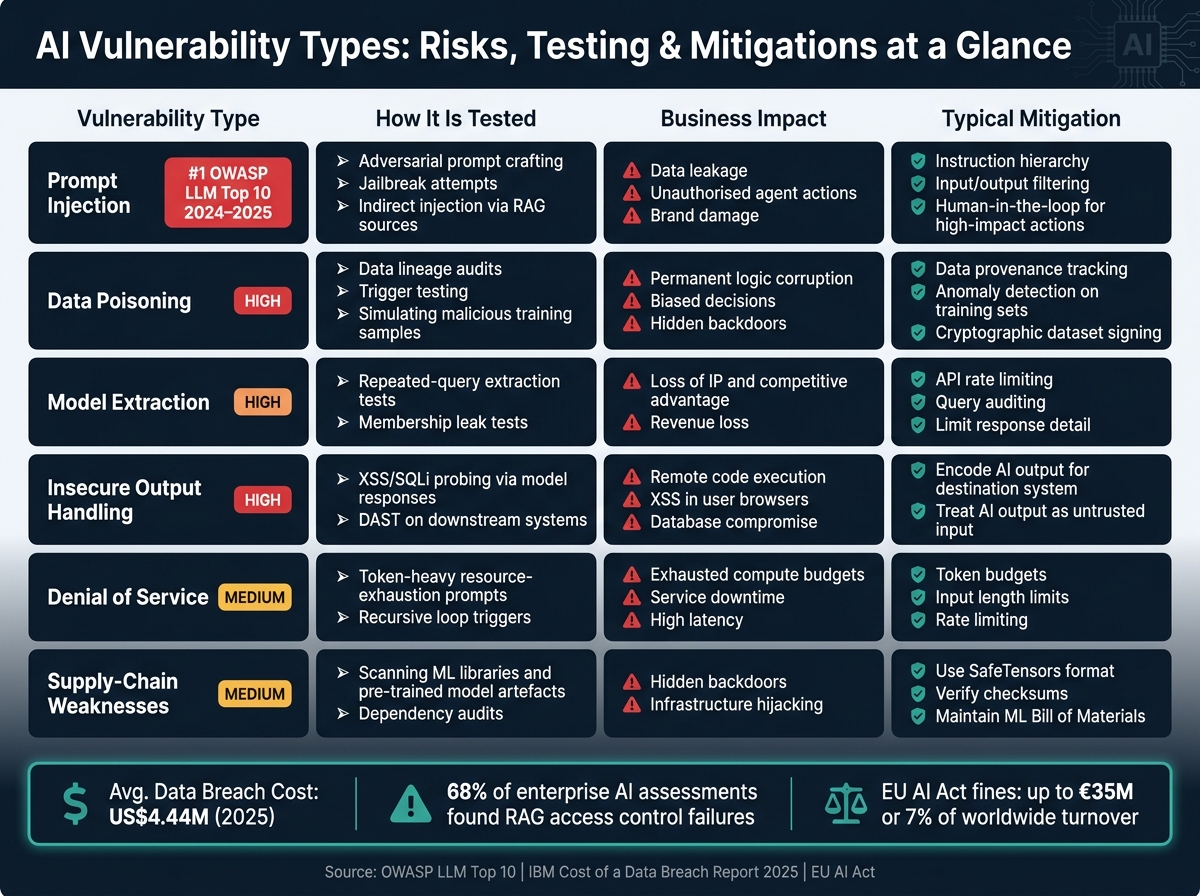
AI Vulnerability Types: Risks, Testing & Mitigations at a Glance
Once you’ve mapped your assets and trust boundaries, the next step is to shape the threat model around AI-specific weak points, not just standard IT risk.
That matters because AI systems don’t behave like normal software. They’re stochastic, which means the same input can lead to different outputs as context shifts. A normal scanner works best on deterministic systems, where the same action should lead to the same result every time. AI doesn’t play by those rules. It can also fail quietly, with no obvious error message. So AI threat modelling needs its own pass, separate from routine IT vulnerability scanning.
Common AI vulnerability types
AI risk spans three layers:
- the data layer: training sets and RAG sources
- the model layer: inference logic and parameters
- the agentic layer: autonomous actions and tool use
Each one brings a different set of problems.
Prompt injection is the most common risk. It ranked first in the OWASP LLM Top 10 for two years in a row, across 2024–2025. In plain terms, attackers use natural language to push the model into ignoring or overruling its system instructions. Direct injection comes straight from the user. Indirect injection is trickier: the harmful instruction is buried inside outside content the model retrieves, like an email or webpage.
Data poisoning hits earlier in the lifecycle, during training or fine-tuning. Malicious samples can plant hidden backdoors that sit dormant until a specific trigger appears. One example is a model that looks normal in testing but approves a fraudulent transaction when the right prompt or pattern shows up. Model extraction works differently. Here, attackers make repeated API calls to map the model’s decision boundaries, which can let them steal proprietary intellectual property without ever touching the source code.
Output can also become the problem. If a downstream system trusts model output without sanitising it, that can lead to cross-site scripting (XSS), SQL injection, or remote code execution. Then there’s resource exhaustion: inputs designed to maximise token use or kick off recursive agent loops, draining compute budget and hurting availability.
How each threat maps to real business scenarios
The practical way to use this is simple: map each weakness to the workflow that would break first.
A customer support chatbot tied into internal systems is an obvious indirect injection target. An attacker hides instructions inside retrieved content, and the model may leak data or take an unauthorised action. A finance process built on a poisoned model could approve fraudulent payments when a trigger appears. An internal knowledge assistant that pulls from HR or legal document stores creates leakage risk at every RAG trust boundary.
The agentic layer makes all of this more serious. If an agent can write to email, databases, or outside APIs, one successful injection may set off a chain of actions across several systems. AI coding assistants add supply-chain risk too, especially when a compromised model or library is part of the stack.
Vulnerability types compared: test method, business impact and mitigation
| Vulnerability Type | How It Is Tested | Business Impact | Typical Mitigation |
|---|---|---|---|
| Prompt Injection | Adversarial prompt crafting; jailbreak attempts; indirect injection via RAG sources | Data leakage; unauthorised agent actions; brand damage | Instruction hierarchy; input/output filtering; human-in-the-loop for high-impact actions |
| Data Poisoning | Data lineage audits; trigger testing; simulating malicious training samples | Permanent logic corruption; biased decisions; hidden backdoors | Data provenance tracking; anomaly detection on training sets; cryptographic dataset signing |
| Model Extraction | Repeated-query extraction tests; membership leak tests | Loss of IP and competitive advantage; revenue loss | API rate limiting; query auditing; rate-limit queries and limit response detail |
| Insecure Output Handling | XSS/SQLi probing via model responses; DAST on downstream systems | Remote code execution; XSS in user browsers; database compromise | Encode AI output for the destination system; treat AI output as untrusted input |
| Denial of Service | Token-heavy resource-exhaustion prompts; recursive loop triggers | Exhausted compute budgets; service downtime; high latency | Token budgets; input length limits; rate limiting |
| Supply-chain weaknesses | Scanning ML libraries and pre-trained model artefacts; dependency audits | Hidden backdoors; infrastructure hijacking | Use SafeTensors format; verify checksums; maintain an ML Bill of Materials |
The rows with the highest business risk should become your first red-team targets. Use the table to decide where to start.
Test Vulnerabilities with Red Teaming
Once your threat model is in place and you've picked out the highest-risk flows, the next step is simple: start testing them under pressure. AI red teaming takes classic penetration testing and pushes it into model behaviour, prompts, RAG pipelines, tools and outputs. Start with the Tier 1 flows from your risk assessment.
Run manual red-team exercises against high-risk flows
The strongest AI red teams usually combine a senior penetration tester with an LLM specialist. That pairing matters. One brings deep security instincts, the other sees model failure modes that a standard pentest can miss. Put together, they can spot gaps that either person on their own might gloss over.
Start with the flows that could do the most damage, especially anything tied to money movement, sensitive data exposure or unauthorised actions. A customer payment journey is an obvious target. So is an agent with write access to outside systems.
For each flow, run structured probing. Try jailbreaks through role-playing personas, hypothetical framing and multi-turn state manipulation. Test whether RAG responses surface restricted documents a user should not be able to access. That exact failure appears in 68% of enterprise AI assessments. The point here isn't just to show a technical flaw. It's to show where the system can be pushed into causing business harm.
Report findings as attack success rates, not simple pass/fail results. If a flaw works 30% of the time, that's still a critical risk.
Automate attack simulation and regression testing
Manual testing is where you'll find odd, app-specific flaws. Automation does the heavy lifting after that. It handles scale and helps you catch regressions before they slip through. Once you've found attack patterns that work, turn them into automated regression tests with PyRIT or Garak.
Your regression suite should cover:
- prompt injection
- jailbreaks
- sensitive information disclosure
- tool-call abuse
- resource exhaustion
Any change to the foundation model version, system prompt or tool integrations should trigger a full automated regression run. If you're using LLM-based attack generators, fix the random seed and record temperature settings so results can be reproduced across runs.
Use clear thresholds so you can track security posture over time:
| Metric | Suggested threshold |
|---|---|
| Jailbreak success rate | <5% for consumer-facing systems |
| Indirect injection success rate | 0% for high-value agents |
| Critical unmitigated findings | 0 before deployment |
| Threat category coverage | 100% of threat model categories tested |
Record the attack success rate, the controls that failed and the business impact. That gives you what you need to rank findings properly in the next step.
Review outputs, logs and downstream actions
Review outputs, logs and downstream actions to confirm impact. If you can't trace what happened, you're left guessing. Traceability helps prove what happened, who was affected and which control broke.
Start with the raw model outputs. Check for policy violations, leaked credentials, PII and exposed system prompt content. Small, occasional failures still count. If a harmful output appears even now and then, log it as a persistent vulnerability rather than brushing it off.
Then go into the logs. Tag prompts, retrieved context, tool calls and outputs with a correlation ID so you can rebuild the full attack chain. For agents, look at how separate steps join up. A single action may look harmless on its own, but chained together it can become dangerous, like reading an email, following up and then sending a Slack message.
Pay close attention to approval bypasses. Can the agent send an email, change a database record or trigger a payment without human approval? If yes, that's a critical architecture gap, not just a prompt issue. Output handling and approval gates matter just as much as model-level controls. That evidence should feed into scoring and remediation planning.
Rank Findings, Fix Gaps and Monitor Continuously
Use the attack results to rank each finding by business risk.
Score and prioritise findings by business risk
Don't rank findings on raw severity alone. Rank them by business risk. A simple likelihood-impact matrix works well, but it should reflect business context, exploitability, data sensitivity and downstream impact. For example, a guardrail bypass in an agentic system that can execute code or send emails is far riskier than the same issue in a standalone chatbot.
Set up a risk register for every finding. Give each one:
- a unique Risk ID
- affected assets
- a threat scenario
- a likelihood-impact score
- an owner
- a monitoring KPI
Score exploitability based on the attack prerequisites. In plain terms: does the attacker only need basic query access, or do they need higher-privilege write access to training pipelines or vector stores? Then map each finding to the OWASP LLM Top 10 or MITRE ATLAS so boards and regulators can view the issue through a standard frame they already know.
| Risk Factor | What to Evaluate | Priority Indicator |
|---|---|---|
| Exploitability | Does it require sophisticated payloads or a basic prompt? | High if a basic prompt triggers failure |
| Downstream Impact | Does the failure cascade into classic application stacks? | High if it enables XSS or SQL injection |
Non-compliance with the EU AI Act can result in fines of up to €35 million or 7% of worldwide turnover. That means regulatory exposure belongs in every scoring discussion, not as an afterthought.
Use the final score to decide both the fix order and how closely each issue needs to be watched.
Apply mitigations and verify fixes
Sort fixes by implementation effort. Some controls can cut exposure fast: prompt validation, API rate limiting and structured logging are often the quickest place to start. Other controls take longer. Role-based access controls and automated data lineage tracking may take weeks, but they can reduce risk by a lot more. For high-risk agentic flows, put a human approval step in front of financial transactions or database writes.
Then retest every fix against the original attack scenarios. The goal is simple: confirm the attack success rate has dropped below your defined risk threshold. Use purple-team exercises - where your red team and defenders work side by side - to check that the controls still hold up under pressure. Pin model versions to cryptographic hashes so an unnoticed model swap in production can't quietly bring back a flaw you've already closed.
After deployment, keep an eye on:
- shifts in attack success rate
- unusual tool calls
- model-output drift
Once fixes are live, the job isn't done. Keep watching for drift, new attack paths and regression.
Conclusion
Treat AI vulnerability assessment as a continuous cycle: prioritise by business risk, fix the highest-impact gaps first, retest controls, and monitor as models and threats evolve. Set trigger-based reassessments instead of relying on a fixed annual schedule. Any major model update, new data source or architecture change should trigger an immediate regression run.
FAQs
How often should I assess AI vulnerabilities?
AI vulnerability assessment shouldn’t be limited to a once-a-year audit. Models change through fine-tuning, shifts in user behaviour, and changes in the data they rely on. That means a point-in-time assessment can go out of date fast.
A better approach is to use two layers. Start with thorough pre-deployment testing to set a security baseline. Then keep monitoring and testing after launch to spot drift and new attack vectors as they appear.
Which AI systems should I test first?
Prioritise your external attack surface first, with extra attention on AI systems that are easiest to exploit, such as AI agents with tool access.
Put early focus on systems behind AI chatbots or copilots, AI integrations inside enterprise tools, and RAG connected to sensitive data. These setups carry the highest risk of data leakage or unauthorised access, so they need security testing that goes beyond standard web application checks.
What tools automate AI security testing?
Tools such as Garak, Giskard, Krait, AegisRT, and llm-audit can help automate AI security testing. They give teams a practical way to spot weak points in agentic workflows and LLM integrations without doing every check by hand.
In practice, they can automate jobs like prompt injection scanning, secret detection, and adversarial red teaming. Some can also run more advanced multi-turn attack simulations, which matters because many failures don’t show up in a single prompt - they appear after a back-and-forth exchange.
if (valuable) then share();