Solving Cascading Errors in Multi-Agent Systems
Cascading agent errors silently corrupt pipelines; verification, circuit breakers, checkpoints and human gates stop system-wide failures.

Cascading errors in multi-agent systems can disrupt entire workflows, especially for SMEs. These errors occur when a failure in one agent spreads to others, often unnoticed, leading to flawed decisions and costly outcomes. For example, a single agent's 5% error rate can escalate to a 52% failure rate in a 10-agent system. Here's what you need to know:
-
What causes cascading errors?
- Vague task instructions leading to misinterpretation.
- Shared memory issues causing "context poisoning."
- Fragile API integrations producing misleading outputs.
-
Why it matters:
SMEs, with limited resources, face greater risks from these failures, such as increased costs, halted operations, and compromised data integrity. -
How to prevent them:
- Use clear task specifications and strict inter-agent contracts.
- Validate outputs at every step with semantic verification.
- Implement circuit breakers to stop error propagation.
- Design modular workflows to limit the impact of failures.
- Use checkpoints, retries, and human oversight for recovery.
The key takeaway: cascading errors are a system-level challenge that requires robust design, real-time monitoring, and thoughtful error containment strategies to minimise risks and maintain workflow integrity.
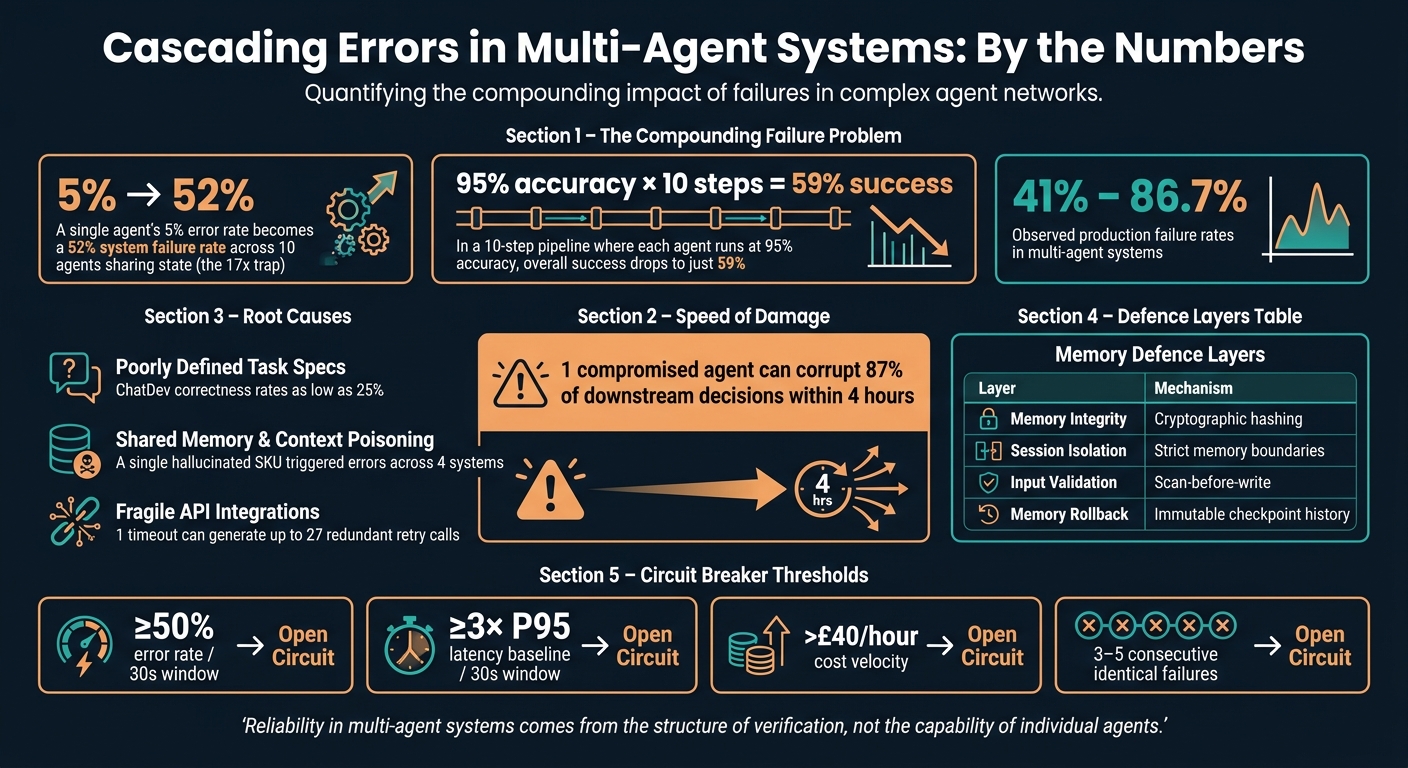
Cascading Errors in Multi-Agent Systems: Key Failure Stats & Risk Thresholds
Root Causes of Cascading Errors
To prevent cascading errors in multi-agent systems, it's crucial to understand what causes them. These failures often stem from three main issues.
Poorly Defined Task Specifications
When goals are unclear, agents are left to interpret instructions on their own. This can lead to what researchers call a transitive trust chain: one agent's misinterpretation becomes the next agent's starting point, spreading errors through the system.
This problem can snowball quickly. For instance, in the ChatDev multi-agent framework, studies revealed correctness rates as low as 25%. Much of this was due to problems with task specifications and alignment. A notable example involved ChatDev being tasked with creating a chess game that used classical notation like "Ke8". Instead, the system developed a version requiring coordinate inputs. The verifier agent failed to catch this issue because it only checked if the code compiled, not whether it adhered to the original requirements.
"Minor inaccuracies... gradually solidify into system-level false consensus through iteration." - Yizhe Xie et al., Researchers, City University of Macau
This phenomenon, often referred to as semantic shift, occurs when vague goals are passed through multiple agents, causing the final output to drift further from the original intent. This makes it tough to trace errors back to their source.
Now, let's explore how shared memory can worsen these specification challenges.
Shared Memory and Context Poisoning
Shared memory can be both a strength and a liability in multi-agent systems. When agents write to a shared state, even a single error can corrupt the entire workflow.
Take the example of an inventory agent that hallucinated a non-existent SKU. Its output, formatted correctly as JSON, passed validation and set off a chain reaction across four systems. A quote was generated, inventory was updated, a label was printed, and a customer confirmation was sent - all based on a fabricated piece of data.
Shared environments can also lead to consensus inertia, where agents reinforce each other's incorrect assumptions. Over time, these errors become deeply embedded, making it nearly impossible to correct without overhauling the entire system.
This vulnerability becomes even more pronounced when agents rely on external tools.
Fragile Tool and API Integrations
External tools and APIs often represent the weakest points in multi-agent systems. The issue isn't just that APIs can fail - it's how they fail. A timeout or rate-limit error might not generate a clear exception. Instead, it could return a truncated response or an error message in plain text, which an agent might incorrectly treat as valid.
Retry mechanisms can amplify this problem. A single API timeout could result in up to 27 redundant calls, increasing costs and putting unnecessary strain on infrastructure. As Dean Grover, co-founder of Chanl, explains:
"A single agent's 5% error rate becomes a 52% system failure rate with 10 agents sharing state. That's the 17x trap."
Agents also frequently misinterpret tool outputs. They might misread file listings or call non-existent endpoints, leading to persistent hallucination loops. Without rigorous validation at every tool boundary, these minor missteps can silently compromise the entire workflow for subsequent agents.
sbb-itb-1051aa0
Design Strategies to Prevent Cascading Errors
Preventing cascading errors starts with thoughtful architectural planning before any agent is deployed. A key part of this involves creating precise contracts between agents.
Clear Task Specifications and Contract Design
Unclear or loosely defined instructions can lead to cascading failures. The solution? Formalise every inter-agent message into a detailed contract with clear terms.
Each message should include essential elements like:
- A
transaction_idfor tracking. - A
sender_idto establish trust. - A
confidencescore ranging from 0 to 1.
To aid decision-making, incorporate explicit status enums such as PARTIAL_SUCCESS, FAILED_RETRIABLE, and NEEDS_CLARIFICATION. These allow orchestrators to make informed choices instead of blindly continuing workflows.
Another safeguard is semantic verification, which ensures outputs are contextually accurate. For instance, verifying that an extracted price exists in the original document can catch errors early and prevent them from affecting subsequent agents.
"Collaboration without verification is just distributed hallucination." - Kanishk Patel
Additionally, design workflows with idempotency in mind. Using idempotency keys in contracts ensures that retries caused by timeouts won’t result in duplicate operations.
Modular and Loosely Coupled Agent Roles
Relying on a single, monolithic agent for all tasks creates a significant point of failure. Instead, breaking workflows into smaller, specialised agents with distinct roles reduces the risk of widespread issues. This approach limits what’s known as the "blast radius", or the number of systems affected when an error occurs.
Decentralised systems that are tightly coupled tend to amplify errors. A better approach is to structure tasks into a modular Directed Acyclic Graph (DAG), capping downstream interactions. Each output should be independently verified before moving to the next agent, which helps to interrupt the chain of errors. For added security, implementing an adversarial "Inspector" agent can catch up to 96.4% of faults before they impact downstream tasks.
Safe Memory Management and Guardrails
Shared memory is a common source of cascading errors, as corrupted data can affect every agent that accesses it. To address this, adopt the scan-before-write pattern, which validates data before it’s stored in long-term memory. For critical updates, use a memory quorum system where at least two out of three agents must agree before a state change is committed.
Separating memory into tiers can also help contain damage:
- Ephemeral memory: Short-term, temporary storage.
- Journal memory: Session-specific data.
- Canonical memory: Long-term, authoritative storage.
This separation ensures that a corrupted session doesn’t compromise the permanent state. Event sourcing, which involves recording state changes immutably, further enhances auditability and allows recovery from earlier, error-free checkpoints.
| Defence Layer | Mechanism | Threat It Addresses |
|---|---|---|
| Memory Integrity | Cryptographic hashing | Unauthorised tampering |
| Session Isolation | Strict memory boundaries | Cross-session poisoning |
| Input Validation | Scan-before-write | Indirect prompt injection |
| Memory Rollback | Immutable checkpoint history | Systemic compromise recovery |
The OWASP Agentic Security Initiative highlights memory poisoning as ASI-T1, a "permanent compromise vector" that can persist across all future interactions until manually resolved. This classification underscores the importance of robust memory protections in any production-level agentic system.
Detecting and Containing Cascading Errors at Runtime
Even the best preventive measures can't guarantee a system free of errors. That’s why detecting and containing issues in real time is critical. The difference between a minor glitch and a total pipeline failure often comes down to how quickly you can identify and contain the problem.
Monitoring and Behavioural Telemetry
Traditional logging captures events, but behavioural telemetry goes deeper by revealing their causes. It can also spot issues that standard monitoring might miss.
Genealogy-based governance tags every message exchanged between agents with its source, making it possible to trace errors back to their origins. Instead of monitoring agents in isolation, this approach allows you to follow the chain of events to pinpoint the root cause. As Kanishk Patel explains:
"Errors don't propagate like conventional bugs. They propagate like rumours. Each agent adds a layer of perceived legitimacy."
Additionally, tracking Tier 3 metrics - such as agent quality scores and decision-making patterns - can help uncover "soft failures" that traditional logs might overlook. These subtle errors can quietly disrupt downstream agents, leading to larger issues.
Tools like AgentForesight-7B are designed for this purpose. They provide real-time audits, improving performance by 19.9% and reducing localisation errors threefold. These tools also report critical metrics (e.g., gen_ai.pipeline.halt), making it easier to identify and address error sources.
By combining these strategies, you build a bridge between preventive design and active error containment during runtime.
Circuit Breakers and Containment Zones
Circuit breakers are a simple yet effective way to stop errors from spreading. Their role is to cut off failing components before they cause wider damage. This is crucial, as research from December 2025 revealed that a single compromised agent can corrupt up to 87% of downstream decisions within four hours.
A three-state machine - Closed, Open, and Half-Open - is the ideal structure for circuit breakers. Each dependency (e.g., provider, model, or API endpoint) should have its own breaker. This ensures that a failing component doesn’t disable healthy ones.
Here are some sensible default thresholds for circuit breakers:
| Trigger | Threshold | Window | Action |
|---|---|---|---|
| Error rate | ≥50% | Last 30 seconds | Open circuit |
| P95 latency | ≥3× baseline | Last 30 seconds | Open circuit |
| Cost velocity | >£40/hour | Real-time | Open circuit |
| Consecutive failures | 3–5 identical errors | Immediate | Open circuit |
For example, in April 2026, a nightly document summarisation pipeline got stuck in an eight-hour retry loop because of a transient 503 error. This resulted in a £345 API bill. As Logan Kelly of Waxell put it:
"A kill switch is what teams reach for after something has gone wrong. A circuit breaker stops it before 'something has gone wrong' becomes 'something has been wrong for eight hours and cost $437.'"
It’s essential to place retry logic inside the circuit breaker. Wrapping a breaker in an outer retry loop negates its purpose entirely.
Rollback and Human-in-the-Loop Recovery
In distributed workflows, traditional database rollbacks often fall short. Instead, use compensating transactions (e.g., releasing reserved stock) alongside the Saga pattern and state checkpointing. This approach allows recovery to start from the exact point of failure, rather than restarting the entire workflow.
State checkpointing - storing pipeline states in systems like Redis or Postgres at each transition - ensures that failures don’t require a complete restart. For critical decisions, human oversight becomes indispensable. Dead-letter queues (DLQs) are a practical solution: failed sessions are preserved and routed to a queue for review. Human operators can inspect the full state, correct errors, and restart the pipeline from the last valid checkpoint.
For actions involving monetary or compliance risks, configure systems to fail-closed. This halts operations and ensures that a human reviews the issue before proceeding.
Applying Resilient Workflow Design Across Industries
Building on tested strategies for prevention and recovery, these methods are now being used across various industries to protect essential workflows. Concepts such as circuit breakers, halt protocols, semantic verification, and human-in-the-loop recovery are not just theoretical. They are actively applied in industries where regulation and data sensitivity are paramount, though the stakes can differ significantly depending on the sector.
Safeguards for FinTech and Crypto Platforms
In financial workflows, even a single error can lead to irreversible consequences, like incorrect payments or duplicated cryptocurrency transfers. These aren't just technical problems - they carry regulatory and financial risks too.
Two key safeguards are essential here. First, semantic verification ensures that extracted data, such as figures or vendor names, aligns with the original source. This step catches errors that might pass schema validation but fail on a deeper, contextual level - a critical distinction in payment systems.
Second, idempotency keys and write-ahead logging prevent duplicate operations during retries and allow precise recovery from failure points.
Ranjan Kumar highlights the importance of halt protocols, stating:
"The root cause wasn't the hallucination. Hallucinations happen. The root cause was that the pipeline had no halt protocol."
For tasks like irreversible payments or compliance submissions, human approval gates are indispensable. Additionally, the Saga pattern ensures that if a critical step fails, compensating transactions - like reversing a payment or refunding a ledger entry - can undo earlier actions cleanly.
These measures lay the foundation for managing high-volume data in SaaS platforms and addressing the strict integrity standards required in carbon offsetting.
Best Practices for SaaS and Carbon Offsetting Platforms
SaaS platforms often deal with high transaction volumes, where subtle errors can slip through unnoticed. To address this, lightweight confidence thresholds paired with spot-sampling LLM verification - applied to 5–10% of outputs - can identify hidden issues before they escalate.
Carbon offsetting platforms face additional challenges, particularly in ensuring the accuracy of environmental data. For example, in 2024, about 14% of voluntary carbon credits sampled across major registries showed signs of overclaimed sequestration or duplicate issuance. A 2023 double-spend attack on a voluntary carbon registry also exposed over £8.7 million in fraudulent offsets. These systemic risks require robust workflow designs.
Using multi-agent verification layers - where separate agents independently analyse project data, satellite evidence, and fraud risks - ensures that no single agent’s output is accepted without cross-checking. Idempotency keys are equally crucial here; duplicate credit issuances or retirements can be as damaging as duplicate payments. Since actions like issuing certificates or retiring credits are irreversible, every forward step should have a compensating action, such as a rescission notice or refund, ready to deploy if necessary.
As Carbon3 puts it:
"Agents do evidence; humans do decisions."
How Antler Digital Builds Resilient Agentic Systems
Antler Digital applies these resilience principles to build systems where each agent operates independently but contributes to overall workflow integrity. By partnering with SMEs in FinTech, Crypto, SaaS, and Carbon Offsetting, they design workflows that incorporate resilience measures - halt protocols, circuit breakers, idempotency, and human-in-the-loop gates - right from the start.
For SMEs, the stakes are often higher due to smaller engineering teams and tighter budgets. A silent pipeline failure or an overnight API budget drain can cause significant harm. Antler Digital addresses this by treating worker criticality as a core design element. Agents are classified as either required or optional, ensuring that non-critical failures don’t disrupt the entire system.
The aim isn’t to create a flawless system but one that quickly contains issues, recovers effectively, and keeps humans involved where their judgement is essential.
Conclusion: Building Error-Resilient Multi-Agent Systems
Cascading errors aren’t just occasional hiccups - they’re a fundamental challenge in multi-agent systems. Studies reveal production failure rates ranging from 41% to 86.7%. And here’s the kicker: in a 10-step pipeline where each agent operates at 95% accuracy, the overall success rate plummets to just 59%. The operational impact of such failure rates can be significant.
The key to resilience lies in well-structured verification systems, not chance. As one expert puts it:
"Reliability in multi-agent systems comes from the structure of verification, not the capability of individual agents."
Focusing on improving individual agents won’t fix a fragile system. Instead, the solution lies in atomic task decomposition, adversarial Inspector agents, halt protocols, and idempotency at every write boundary. These aren’t luxury features - they’re the essential building blocks for any system managing real-world business data.
The stakes are even higher for smaller teams, which often lack the resources to handle silent failures or manual recovery. A single error can disrupt nearly 90% of downstream decisions within just four hours. Without mechanisms like kill switches or checkpoint systems, the impact of these errors can spiral out of control. Designing with worker criticality and halt logic as core principles - not as afterthoughts - is what separates scalable systems from those that quietly fail.
If your team is building or scaling agentic workflows, Antler Digital can help you create resilient pipelines that prevent minor issues from escalating into major incidents. Don’t wait for failure to prove the importance of deliberate design.
FAQs
How can I tell if my agent workflow is failing silently?
Silent failures happen when agents generate incorrect outputs that slip through validation checks, ultimately harming results. Spotting these issues is crucial, and here are some methods that can help:
- Heuristic analysis: Examine state snapshots to identify unusual patterns, such as unexpected type changes or null transitions.
- Semantic checks: Ensure the content's accuracy by cross-validating outputs between different agents.
- Telemetry: Implement tracing mechanisms to detect execution loops or irregularities in processing.
- Trust monitoring: Introduce circuit breakers that activate when quality scores fall below acceptable thresholds.
Antler Digital focuses on creating robust workflows designed to minimise the risk of such failures.
What’s the quickest way to stop one bad agent corrupting the rest?
To maintain the integrity of the system and minimise risks from a single agent causing disruption, it's essential to introduce a governance layer. This layer helps regulate the flow of information and ensures proper oversight.
A practical approach is using a circuit breaker pattern. This monitors trust scores and error rates of agents. If an agent's performance drops below acceptable levels, it’s immediately blocked. Workflows can then be redirected to a fallback system or sent for human review, ensuring continuity.
Another safeguard is implementing a pipeline halt protocol. This protocol performs semantic checks to identify and stop corrupted data before it spreads. By doing so, it protects both operational workflows and the integrity of the data being processed.
When should I add human approval instead of more automation?
Human intervention is most valuable at key decision points within a multi-agent system, especially when outcomes carry significant weight. For instance, scenarios like altering critical data, authorising financial transactions, or making trust-sensitive or compliance-related decisions benefit from human oversight. It's wise to involve approvals when the system's confidence is uncertain or when actions touch on external systems or sensitive information. Meanwhile, routine tasks that are easily reversible can be automated to keep things running smoothly and efficiently.
if (valuable) then share();