Modular AI for E-Commerce Platforms
Phase modular AI into commerce: separate services, APIs, event flows, observability and UK compliance.

Most e-commerce teams do not have an AI problem. They have a setup problem. Even though 65% of firms used generative AI regularly in 2024, fewer than 1 in 3 reported clear value from e-commerce AI work. From my reading, the fix is simple: keep each AI job in its own service, connect those services with APIs and event flows, and add the right controls from day one.
If I were planning this stack, I would keep the focus on four things:
- Start with high-impact use cases: search, recommendations, pricing, fraud, support, content, and churn or CLV analysis
- Keep services separate: one module per job, with versioned API contracts
- Use the right runtime: real-time for shopper-facing tasks, async for content and batch analysis
- Plan for control: logs, traces, fallbacks, deletion flows, OAuth 2.0, mTLS, and UK formatting such as £12,500.00 and 15 June 2026
This article shows how I would phase modular AI into a commerce stack without tying AI logic too tightly to the core platform. It also makes clear where teams usually go wrong: messy product data, weak service boundaries, missing observability, and no fallback when a module fails.
A few points stand out straight away:
- Search and recommendations depend on clean product attributes
- Pricing and fraud need tight rules because they affect margin and checkout
- GraphQL can help reduce payload and improve front-end speed
- API gateways matter when shopper context has to pass across services
- In the UK, data deletion, decision logs, VAT handling, 3-D Secure, and locale formatting should be built into the setup from the start
In short: modular AI works best when each service owns one job, shares state in a clean way, and can fail without breaking the whole shop.
Foundations of modular AI architecture for e-commerce
From monolithic features to independent AI services
Many e-commerce platforms bake AI logic straight into the core application. Recommendations, pricing and search all sit inside the main codebase. That sounds simple at first. But over time, every change gets slower and riskier because one update can affect the whole platform.
A modular setup works differently. Each AI capability runs as its own service with a clear domain boundary. If the recommendation service needs retraining, or the pricing model needs to change, you can update that part without rolling out changes across the entire platform.
Independent services also need orchestration, monitoring and versioned contracts. As Petter Johansson, Chief Marketing and Product Experience Officer at Brink Commerce, puts it:
"A microservice architecture only supports autonomous commerce systems if the boundaries match how you want to delegate responsibility."
A useful rule of thumb is simple: a boundary works when an AI agent can own it from start to finish. If it can't, the module probably won't scale cleanly on its own.
Once those boundaries are in place, the next step is making sure modules can stay in sync through APIs, events and shared data.
Core building blocks: APIs, event flows and shared data
Modules only scale if they share a consistent interface and state model. In practice, that comes down to three layers working together: APIs, event flows and shared data.
APIs define what each service exposes. The key is to expose business actions, not raw database-style endpoints. So instead of a generic data call, an endpoint like findGiftForOccasion gives agents something they can act on straight away, without forcing them to decode the full data model first.
Event flows deal with live state changes. Stock can drop below a threshold. A basket can be abandoned. A price can change in seconds. To handle that, modern agentic commerce stacks use real-time message streaming tools such as Kafka or AWS EventBridge, so dependent services update at once.
Shared data gives each module the context it needs to make good decisions. This is especially true for a feature store and an enriched product catalogue. Search and recommendation systems depend on structured, non-visual attributes like materials, use cases and compatibility. If the catalogue is messy, the AI layer will be messy too. Getting that catalogue right before deployment sets the base for everything that follows.
Design principles for modular AI
These building blocks only stay easy to run when contracts, ownership and monitoring are tightly defined.
Single responsibility matters most. Each module should do one job well, whether that's pricing, search or recommendations. Once a service starts doing too many jobs, you've simply rebuilt the monolith in smaller pieces.
Loose coupling means modules talk through versioned API contracts and events, not direct function calls or shared databases. That's what stops the stack from turning fragile again.
Clear domain ownership keeps responsibility inside domains such as product data, price control and stock management. That gives each agent or service a clean area to own.
Then there's observability from day one. Every module should emit structured logs, latency metrics and error rates. Without that, it becomes hard to tell whether a dip in conversion comes from the recommendation service, the pricing service or somewhere else in the stack. As Aleks Haugom, Senior Manager of GTM at Harper, captures it:
"Agents don't fail because APIs are missing - they fail because decisions are too far away from execution."
sbb-itb-1051aa0
Core modular AI components for e-commerce platforms
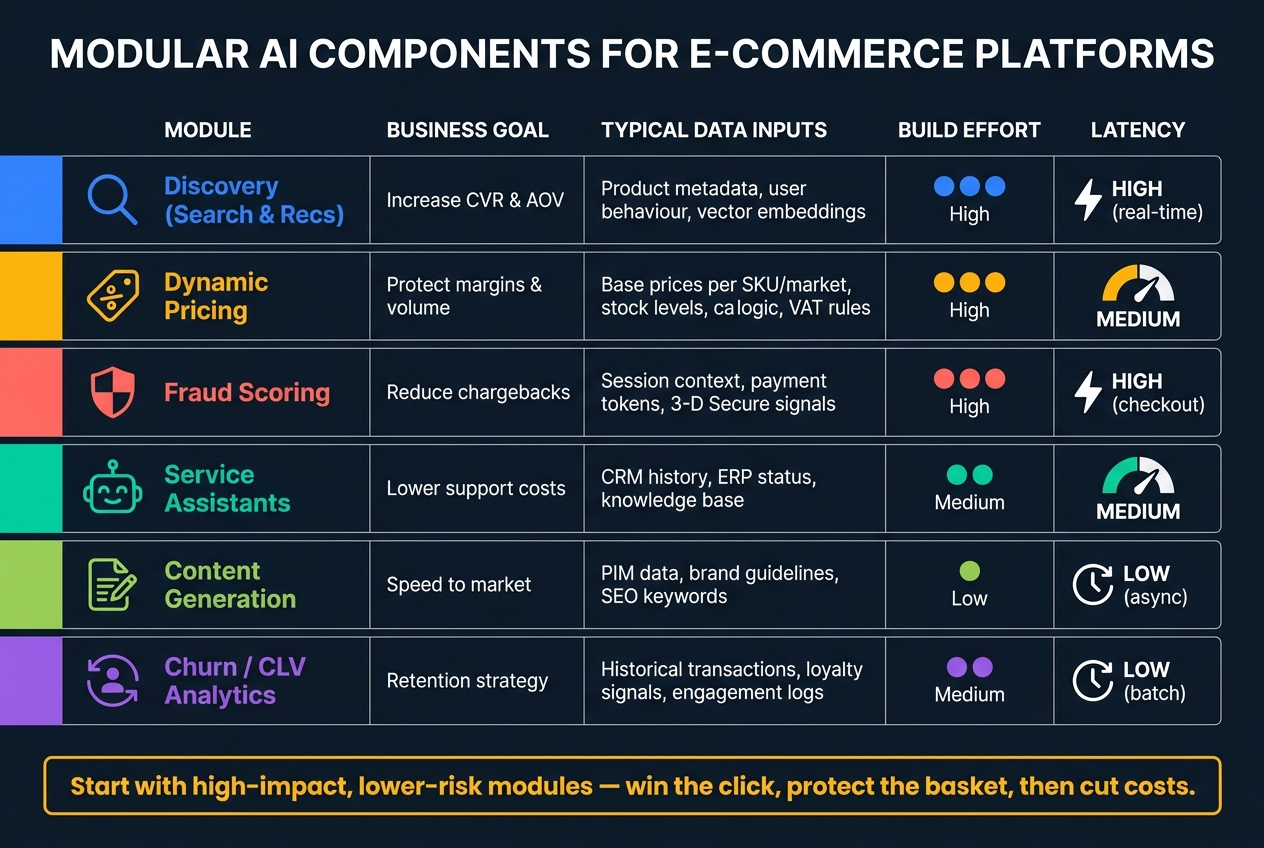
Modular AI Modules for E-Commerce: Goals, Inputs & Runtime at a Glance
Start with business impact. First, win the click. Then protect the basket. After that, look for ways to cut running costs.
Discovery and conversion modules
Discovery modules shape what shoppers see at the start of the journey, before they get anywhere near the basket. The main ones here are semantic search, personalised recommendations, and repeat-order journeys.
Semantic search looks at intent instead of relying on exact keyword matches. Recommendations use session signals, behaviour, and product metadata to rank items that are more likely to convert.
There’s a catch, though. These modules depend on a catalogue with well-structured attributes, such as materials, use cases, and compatibility. As Tauno Tinits, AI Engineer at Vaimo, puts it:
"AI agents are machine-first consumers that primarily ingest structured product feeds, metadata, and real-time inventory."
Once you improve discovery, the next step is to protect the basket with pricing and fraud controls.
Revenue and risk modules
Dynamic pricing and fraud scoring have a direct effect on margin and loss, so they need tight guardrails.
A pricing module should sit behind a centralised price service. That service manages base prices by SKU and market, along with discount logic. On top of that, a margin agent should enforce floor rules during peak trading periods. For UK flows, pricing also needs to be VAT-aware at the service level.
Fraud scoring sits at checkout and changes friction based on session context, device signals, and payment token data. For UK merchants, that links straight to 3-D Secure decision flows. Get the balance wrong and you pay for it either way: too much friction drives abandonment, too little drives chargebacks.
If you want an easier starting point, modules with less latency pressure are often the safest bet.
Service, content and analytics modules
These modules are usually simpler to phase in because they don’t sit directly in the checkout path. A customer support assistant can act as first-line support by pulling from CRM history, ERP status, and a knowledge base in real time. That means it can answer order questions, guide shoppers, and surface product advice using live CRM, ERP, and knowledge-base data.
The table below compares each module by business goal, data inputs, and runtime demand.
| Module | Business Goal | Typical Data Inputs | Build Effort | Latency |
|---|---|---|---|---|
| Discovery (Search/Recs) | Increase CVR & AOV | Product metadata, user behaviour, vector embeddings | Medium | High (real-time) |
| Dynamic Pricing | Protect margins & volume | Base prices per SKU/market, stock levels, campaign logic, VAT rules | High | Medium |
| Fraud Scoring | Reduce chargebacks | Session context, payment tokens, 3-D Secure signals | High | High (checkout) |
| Service Assistants | Lower support costs | CRM history, ERP status, knowledge base | Medium | Medium |
| Content Generation | Speed to market | PIM data, brand guidelines, SEO keywords | Low | Low (asynchronous) |
| Churn / CLV Analytics | Retention strategy | Historical transaction data, loyalty signals, engagement logs | Medium | Low (batch) |
Implementing modular AI on modern commerce stacks
Once the module boundaries are clear, the next job is plugging them into the commerce stack without creating new choke points.
Reference architecture for a modular AI stack
This is the point where modular AI stops being a diagram and starts becoming a working setup. In most cases, the best way to run it is through a headless architecture. The storefront sits apart from the backend commerce logic, and the two talk through APIs instead of direct calls.
For real-time AI interactions, GraphQL is often a strong fit. It lets each module ask for only the fields it needs in a single query. That matters when speed is tight and every extra payload adds drag. Stores using GraphQL for commerce APIs report rendering 2.4x faster than those using REST, while network payloads can fall by about 48%.
Pricing, recommendations, and stock allocation should sit in separate services with versioned API contracts. Each service needs a clear domain it can own from end to end. That keeps change local. It also makes testing and rollout far less messy.
Use synchronous inference only when the shopper experience depends on an instant response. If the task is content generation or analytics, run it asynchronously. That split keeps the front end snappy instead of making shoppers wait while background work finishes.
The main call at this stage is no longer what each module does. It’s how those modules pass data, stay aligned, and avoid drifting out of sync at runtime.
Data pipelines, deployment patterns and runtime choices
Ingestion needs to pull from web, mobile, and back-office systems, with quality checks in place before anything goes live. If the data comes in dirty or incomplete, the problems show up later in all the places you don’t want them: search gets weaker, pricing slips, and automation becomes shaky.
For deployment, the right pattern depends on how fast you need to move and how much control you want:
- Widget injection for speed
- SDK/component integration for a good mix of context and control
- API-only integration for maximum flexibility in an API-first stack
If the AI layer needs to keep shopper context across channels, an API gateway should manage token propagation. That helps keep state aligned across the storefront, commerce backend, and AI services. As Ashu Dubey, CEO of Alhena AI, notes:
"In a microservices architecture, the AI chat service, commerce backend, and frontend each manage state independently. Without proper token propagation through an API gateway, the chatbot loses context."
Working with a technical delivery partner
When internal teams are already stretched, outside delivery support can help keep the work moving without weakening the architecture. For SMEs and growing teams, Antler Digital can support architecture design, AI integrations, and delivery without stretching internal teams.
Scaling, governance and UK operational considerations
Once the modules are live, the job changes. It’s no longer just about getting systems connected. Now it’s about control: speed, resilience and compliance. Modularity only holds up when each service can be measured, governed and, if needed, switched off on its own.
Performance, observability and fallback planning
After launch, each module needs its own latency budget. Blocking paths should have short timeouts, while async jobs such as content generation can take longer.
A circuit breaker pattern stops one failing service from dragging the rest of the stack down with it. Add per-module logs, metrics and traces, and you can see exactly where requests are slowing down or failing.
Each module also needs a fallback that’s clearly defined. If the recommendation engine goes offline, the storefront should still serve a safe default experience instead of showing an empty shelf. That kind of backup works far better when it’s planned from day one, not patched in after the first outage.
Governance, compliance and localisation for the UK
Resilience is only one part of the picture. The same control layer also has to deal with customer data, decision logging and UK rules.
The UK’s data protection requirements need to be built into the architecture from the start, not left as an afterthought. A central customer-data service should handle erasure requests and push deletion across every module, with data residency kept within UK borders where needed.
For automated decisions that affect customers, explainability should sit at the orchestration layer. Log the model version, inputs, output and confidence for every automated decision. Service-to-service calls should use OAuth 2.0 and mTLS, with least-privilege access and a zero-trust approach.
For localisation, the orchestration layer should pass locale context to every module: British English, pound sterling, such as £12,500.00, and UK date formats like 15 June 2026. Keep that handling in the experience layer, separate from the AI intelligence layer, so formatting stays consistent without changing model logic.
How to phase modular AI without overbuilding
Start with the modules that offer the most commercial value and the lowest operational risk. A good first step is one or two bounded contexts, such as inventory or recommendations, and getting those right before expanding. Run the new module alongside the old path, send traffic through the API gateway, then switch over once it proves stable.
Run suggestion mode for two weeks or 500 decisions, then shadow-test updates against 1,000 recent orders before cutover.
The goal is coordination, not more agents.
Expand in phases based on commercial value and operational readiness.
FAQs
Where should we start with modular AI?
Start with an API-driven microservices architecture and clear domain boundaries. That gives AI agents defined areas to work in, whether that’s product data, pricing, or customer interactions, and it makes scaling far easier.
A strong product data foundation, a clear orchestration layer for customer journeys, and well-structured APIs give you a resilient base for AI-driven workflows and future development.
What data needs fixing before implementation?
Before implementation, the main data to fix is catalogue data. That includes product attributes, variants, relationships, and compliance information.
If that data is messy or inconsistent, AI has a much harder job. The output can slip, and the decisions built on top of it can go off course.
How do we stop one AI service breaking the shop?
Use a modular AI architecture so each service runs as its own component, linked through clear APIs. That setup helps contain problems. If one module breaks, it’s less likely to bring the rest of the platform down.
It also makes day-to-day work a lot easier. When you split jobs like data ingestion, model training, inference and monitoring into separate services, each part becomes simpler to maintain, swap out and scale without disrupting the whole shop.
if (valuable) then share();