How to Build AI Governance Capacity in SMEs
Proportionate AI governance with simple inventories, clear ownership and regular reviews to keep SMEs compliant and reduce costly breaches.

AI is everywhere, but most SMEs aren’t managing it properly. Over 93% of UK organisations use AI, yet only 7% have governance frameworks in place. This leaves businesses exposed to risks like data breaches, fines, and reputational harm. For SMEs, these risks can be devastating.
Here’s what you need to know:
- AI governance is about creating simple, effective rules to manage AI responsibly.
- Why it matters: New regulations (like the Data Use and Access Act 2025 and EU AI Act) demand compliance, especially for businesses handling sensitive data or making automated decisions.
- The risks: Shadow AI (tools used without approval) has caused data leaks in 44% of UK businesses, costing an average of £500,000 per breach.
- The solution: Start small. Create an AI tools inventory, define policies, assign accountability, and schedule regular reviews.
This guide breaks down how SMEs can build a governance framework that fits their size and resources. Simple steps, like appointing an AI lead or banning sensitive data from consumer-grade tools, can make a big difference. Let’s dive in.
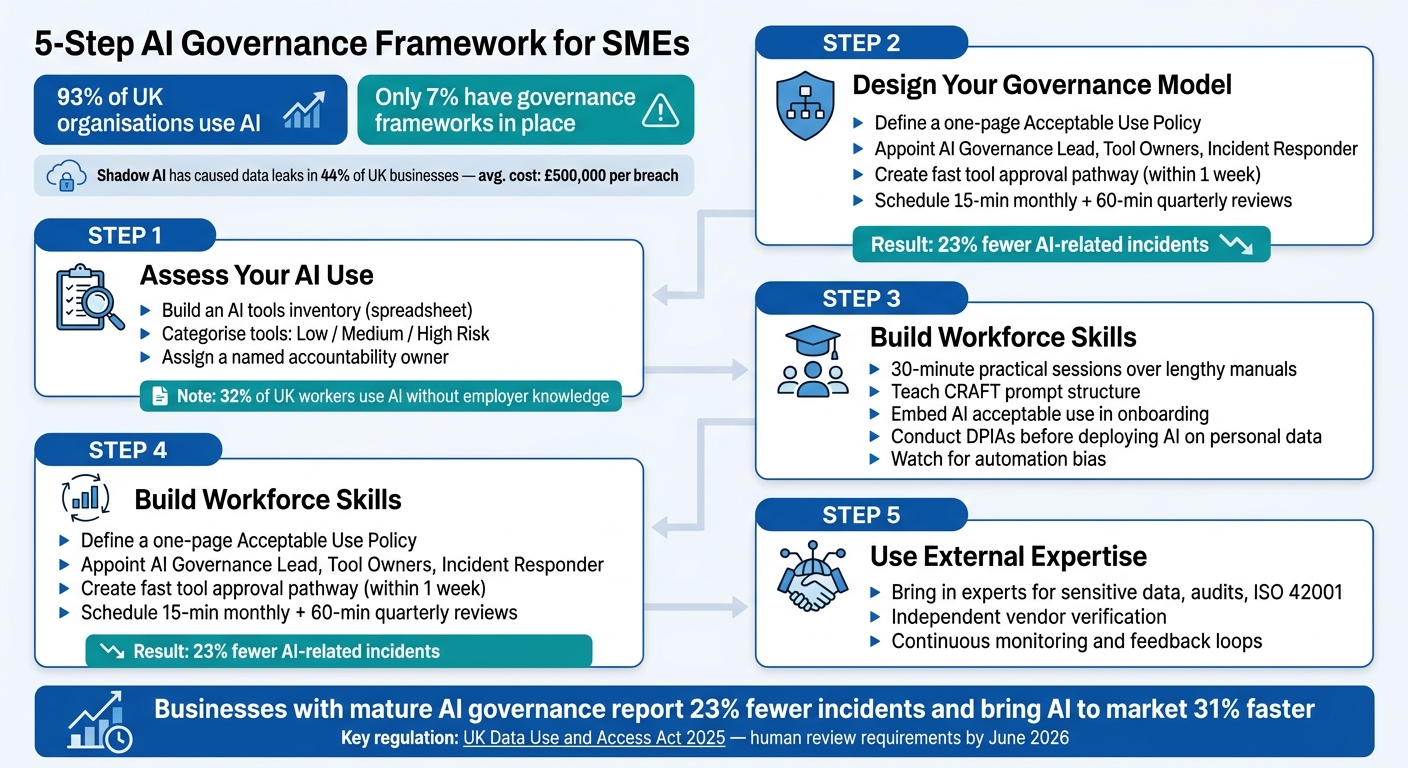
5-Step AI Governance Framework for SMEs
Step 1: Assess Your Current AI Use and Governance Maturity
Start by taking stock of all the AI tools operating within your business. Many small and medium-sized enterprises (SMEs) are often surprised to find just how many AI tools are already integrated into their workflows - sometimes without formal approval. This initial step is essential for developing a governance model that fits your specific needs.
Map Your Existing AI Use Cases
A simple spreadsheet is a good place to begin. List every AI tool your business uses, from third-party platforms like CRM systems and marketing automation tools to recruitment software and analytics platforms. Be sure to include any embedded AI features these tools may have. Don’t overlook "shadow AI" - tools employees use without formal approval. Research indicates that 32% of UK workers use AI without their employer's knowledge, so your actual AI usage may be higher than you think.
Once you’ve compiled your list, categorise each tool by its risk level:
- Low-risk tools: Embedded features with minimal data exposure and no decision-making roles.
- Medium-risk tools: Approved standalone platforms with strong data protections.
- High-risk tools: Applications handling sensitive or personal data, including free consumer-grade AI tools.
For each tool, document its decision-making impact and identify the stakeholders it affects. Also, note where human oversight is applied to review or override AI decisions. This is critical, as human-in-the-loop oversight is a requirement under the Data Use and Access Act 2025. With this detailed inventory, you can evaluate how well these tools are currently governed.
Assess Your Governance Maturity
After identifying your tools, take a hard look at how effectively they’re managed. Free resources like the UK Government’s AIME and the ICO AI and Data Protection Risk Toolkit can help you evaluate your governance practices. Conduct an internal survey to gauge employee awareness of approved AI tools and incident reporting protocols.
"AI governance for a small business is not a 200-page policy manual or a team of consultants sitting in your office for six months. It is a proportionate set of controls that match your size, your risk, and your regulatory environment." - LogiSam
The real risks often lie in the gap between your formal policies and what happens in practice. Check whether each tool contributes to measurable business outcomes or was simply adopted because it seemed helpful at the time. Use your findings to pinpoint areas that need attention.
Set Priorities Within Your Constraints
Focus on the tools and controls that address the biggest risks. As a general rule, 20% of your efforts will mitigate 80% of your risks. Start with tools that:
- Handle personal or sensitive data.
- Influence major decisions, like hiring or credit approvals.
- Operate without proper oversight.
Tailor your governance efforts to your business size. For instance, a micro-business with fewer than ten employees may only need a quick quarterly review, while a medium-sized company with up to 249 employees will require more structured processes, such as supplier assessments and Data Protection Impact Assessments (DPIAs) for high-risk tools. The table below offers a quick guide:
| Business Size | AI Governance Owner | Key Responsibilities | Review Cadence |
|---|---|---|---|
| Micro (1–9) | Founder or Ops Lead | Maintains inventory, approves new tools | Quarterly (30 mins) |
| Small (10–49) | Appointed AI Lead | Oversees training, manages approvals | Quarterly meeting |
| Medium (50–249) | Designated AI Officer | Conducts supplier reviews, coordinates DPIAs | Monthly review |
Finally, assign a specific person to oversee AI decisions. As the ICO emphasises: "Accountability requires a named senior role who can authorise or override AI decisions". Without this clear accountability, governance remains just a theoretical exercise, no matter how thorough your documentation might be.
sbb-itb-1051aa0
Step 2: Design a Practical AI Governance Model
Once you've assessed your current AI usage, the next step is to create a governance model that works smoothly in day-to-day operations. This involves setting clear rules, defining roles, and establishing straightforward processes that your team can follow without unnecessary hassle. Start by outlining your principles, assigning responsibilities, and creating processes that will keep your governance framework running effectively.
Define Your AI Principles and Policies
The UK Government’s five cross-sector AI principles offer a practical starting point: Safety, Security and Robustness; Transparency and Explainability; Fairness; Accountability and Governance; and Contestability and Redress. Don’t let these principles remain abstract - treat them as a checklist for evaluating how each AI tool in your organisation is used.
For small and medium-sized enterprises (SMEs), a simple one-page AI Acceptable Use Policy can often be more practical. This policy should cover four key areas:
- Approved tools
- Data usage guidelines (what can and cannot be entered)
- Instances requiring human review
- Procedures for reporting issues
Be explicit about data handling. For example, ban the entry of special-category personal data (e.g., health records, biometric data, or ethnic origin) and commercially sensitive information into consumer-grade AI tools. This one rule alone can significantly reduce your data-related risks.
Assign Roles and Responsibilities
One of the most effective steps is appointing an AI Governance Lead. For micro-businesses, this role typically falls to the founder. In a company with around 50 employees, a senior manager might take on this responsibility part-time, requiring five to ten hours per month. Beyond this, two additional roles help ensure smooth operations:
- Tool Owner: Responsible for ensuring their team adheres to tool-specific policies.
- Incident First Responder: The go-to person when an AI tool malfunctions or produces harmful outcomes.
| Role | Responsibilities | Typical Candidate |
|---|---|---|
| AI Governance Lead | Maintains policies, approves tools, oversees incident responses | COO, Head of Ops, or Founder |
| Tool Owner | Ensures team compliance with tool-specific rules and reports incidents | Department Lead or tool champion |
| Incident First Responder | First contact for issues related to AI system failures or harmful outputs | Named individual, often the Lead |
"Defining roles before something goes wrong is the highest-leverage governance action a small team can take." - AI Policy Desk
With these roles in place, your next step is to establish processes that reinforce accountability and ensure consistency.
Establish Core Processes and Controls
A practical governance model relies on three simple yet effective processes:
- Fast tool approval pathway: Aim to complete a security and data assessment for new tools within a week. This discourages the use of unsanctioned, or "shadow", AI tools.
- Risk register: Keep a record of each tool's purpose, the data it accesses, and its internal owner.
- Review calendar: Schedule a 15-minute monthly check for new tool requests and a 60-minute quarterly review to update your register and policies.
When it comes to human oversight, make it clear that AI outputs should always be treated as starting points, not final decisions. Any output that impacts customers or significant business decisions - such as hiring, pricing, or financial advice - must be reviewed by a human before being acted upon. As Sam Easton, AI Governance Lead at AutomateNow, explains:
"The risk from AI is not about how advanced the technology is. It is about impact and scale. A simple automated decision, applied thousands of times without oversight, can cause more harm than a sophisticated system used carefully with human review."
Document these processes immediately and refine them over time. Organisations with well-developed AI governance frameworks report 23% fewer AI-related incidents than those without. The next step? Equip your team with the skills and knowledge they need to work confidently within this framework.
Step 3: Build Workforce Skills and Awareness
Once you’ve established a practical governance framework, the next step is ensuring every team member has the knowledge and confidence to implement it. A policy that isn’t understood is as good as no policy at all. Recent research highlights a worrying gap between the use of AI tools and the availability of formal training, which can lead to governance failures.
Identify the Skills Each Role Needs
AI literacy isn’t a one-size-fits-all concept; it varies depending on the role. Developers, customer service teams, and managers all need different levels of understanding.
"AI literacy should not be understood as simple awareness of AI tools. It is an organisational capability that determines whether employees can use, oversee or challenge AI systems responsibly within their role." - Trilateral Research
Here’s a breakdown of the key governance skills required for different roles:
| Role | Key Governance Skills | Primary Focus |
|---|---|---|
| Leadership | Risk assessment, accountability assignment, regulatory alignment | Setting policy and approving AI investments |
| Technical Teams | System validation, audit logging, monitoring for model drift | Ensuring robustness and security |
| Managers | Workflow oversight, prompt standardisation, quality auditing | Turning policy into daily practice |
| General Staff | Data privacy awareness, output verification, escalation procedures | Safe, responsible day-to-day tool use |
One universal skill to develop across all teams is the CRAFT prompt structure (Context, Role, Action, Format, Tweaks). This method helps ensure more consistent and reliable AI outputs.
Once these role-specific skills are outlined, the next step is to create a training programme tailored to these needs.
Build a Training Programme and Integrate It Into Daily Work
For small and medium-sized enterprises (SMEs), short, practical training sessions are often more effective than lengthy manuals or courses. For example, a 30-minute session covering approved tools, data input limits, and escalation procedures can deliver better results than a comprehensive course that employees may not finish.
Here’s an effective rollout strategy for training:
- Start with leadership briefings to ensure decision-makers are aligned.
- Move on to line managers, equipping them to guide their teams.
- Finally, conduct team sessions to address specific day-to-day practices.
Only publish the written policy after all employees have had the opportunity to ask questions. For general staff, encourage simple habits like a "60-second quality check" before using AI outputs. This involves asking: Is it accurate? Is the tone appropriate? Could it be misleading?.
For roles requiring deeper expertise, such as compliance leads or technical staff working with regulated data, formal certification may be necessary. However, this is usually the exception rather than the rule for most SMEs.
To make governance part of daily routines, include AI acceptable use in your standard onboarding checklist. Provide all team members with a concise guide covering approved tools, prompt templates, and prohibited data types. Additionally, establish a "Red Button" protocol for immediate escalation if an AI tool produces biased, offensive, or factually incorrect outputs.
Finally, use quarterly surveys with targeted questions like "I know who to consult for AI use queries" to identify and address any training gaps quickly. This ensures that skills and awareness remain aligned with your governance goals.
Step 4: Monitor AI Systems and Keep Improving
Once your training programme is up and running, the next step is ensuring your AI tools continue to perform as intended. Policies and training lay the groundwork, but ongoing monitoring is what keeps your governance effective and relevant. This step ensures your framework adapts and evolves over time.
Monitor for Bias and Performance Issues
The first task for SMEs is understanding which AI tools are in use. A surprising 32% of UK employees use AI tools without their employer’s knowledge, making visibility your top priority. Begin by focusing on high-risk tools identified in your inventory.
When monitoring, prioritise systems with the greatest potential for harm. For example, the ICO suggests annual reviews for low-risk applications, but quarterly reviews for higher-risk systems, such as those used in recruitment or customer-facing decisions. Keep an eye out for automation bias, where employees may blindly trust AI outputs. This is where training practices like the "60-second quality check" become essential in day-to-day use.
It's also important to establish clear escalation routes. Employees should know exactly who to contact if something seems off. Assigning a dedicated "AI Lead" to handle incident reports and near-miss logs can help identify recurring issues before they escalate into major problems.
Protect Data Privacy and Security
AI governance is not separate from your existing data protection responsibilities - it’s an integral part of them. Before deploying any AI system that processes personal data, conduct a Data Protection Impact Assessment (DPIA) and update it whenever processing activities change.
Prohibit the entry of sensitive data, such as health information or ethnic origin, into consumer AI tools. With 44% of UK businesses reporting data leaks linked to shadow AI and the average cost of a breach reaching approximately £500,000, this is a critical control that costs little to implement but can prevent significant damage.
"AIME distils key principles from existing AI regulations, standards and frameworks to provide an accessible resource for organisations to assess – and improve – their AI management systems and practices." - Department for Science, Innovation and Technology (DSIT)
Set Up a Regular Review Process
Regular reviews keep your AI systems compliant with regulations and ensure your practices remain effective. Instead of relying on infrequent, intensive audits, adopt a consistent, lightweight review schedule. Here’s an example calendar:
| Frequency | Duration | Key Activities |
|---|---|---|
| Monthly | 15 minutes | Flag new tool requests, log incidents or near-misses, check for regulatory updates |
| Quarterly | 60 minutes | Update AI tool inventory and risk register, review policy relevance, run staff surveys |
| Annually | Half-day | Conduct a strategic review, update supplier contracts, and align with the Data Use and Access Act 2025 |
Under the Data Use and Access Act (DUAA) 2025, which comes into effect in February 2026, UK SMEs must offer meaningful human reviews of automated decisions and have a formal internal complaints process in place by June 2026. Building these requirements into your annual review now will save you from a last-minute rush.
Organisations that adopt structured monitoring see real benefits. Companies with mature AI governance report 23% fewer AI-related incidents. The aim isn’t to achieve perfection overnight but to establish a habit of small, regular checks that deliver long-term results.
Step 5: Use External Expertise and Scalable Solutions
Even with a solid internal framework, SMEs can benefit significantly from external expertise. It saves time, reduces costs, and helps avoid regulatory pitfalls. This step outlines when to seek external support and how experts like Antler Digital can strengthen your AI governance.
When to Bring in External Support
Many SMEs lack dedicated in-house specialists for legal, compliance, or data protection matters. External expertise becomes crucial when AI systems deal with sensitive data, influence decisions like hiring, or process financial transactions. It's particularly important for:
- Managing shadow AI usage.
- Setting up technical controls like role-based access or data loss prevention.
- Preparing for audits or certifications such as ISO 42001.
- Assessing third-party AI vendors.
Relying solely on a vendor's compliance claims can be risky. Independent verification ensures your organisation meets its obligations. As the ICO highlights:
"AI is already regulated under existing laws, and organisations must satisfy both data protection and equality duties whatever the technology."
By integrating external solutions into your internal governance framework, you can maintain continuous compliance and ensure your operations are well-monitored.
Working with Antler Digital
For SMEs seeking specialised support, Antler Digital offers a tailored, end-to-end approach. They work closely with your team to manage architecture, security, and compliance. Their process is divided into five phases:
| Phase | What It Involves | Key Output |
|---|---|---|
| Strategic Diagnosis | Assessing AI readiness and auditing capabilities | Opportunity prioritisation matrix |
| Value Hypothesis | Analysing investment vs. return | Strategic AI roadmap with success metrics |
| Rapid Prototyping | Building a proof of concept within 4–8 weeks | Technical feasibility and security report |
| Full Implementation | Integrating architecture and legacy systems | Production-grade systems with audit logging |
| Continuous Evolution | Monitoring performance and feedback | Dashboards to track model drift and bias |
Antler Digital’s systems include audit-ready features like role-based access controls, prompt injection protection, and audit logging. Their Risk & Compliance autopilot solution automates compliance by processing policy updates, transaction logs, and communication trails. For example, this solution has saved 400 hours of manual review time per quarter for clients by automating AML exception handling.
"AI transformation isn't a project. It's a capability. The models drift, the business changes, competitors adapt. You need ongoing monitoring, feedback loops, and continuous improvement." - Antler Digital
Antler Digital prioritises genuine compliance, especially with UK GDPR and data protection laws. For SMEs building workflows where AI systems operate with greater autonomy, this level of diligence ensures your governance framework can withstand scrutiny.
Conclusion: Building AI Governance Capacity That Lasts
AI governance isn’t a one-and-done effort - it’s a system that evolves as your organisation’s use of AI expands. Small and medium-sized enterprises (SMEs) that treat it as an ongoing process are far more likely to avoid costly missteps. In fact, businesses with mature AI governance report 23% fewer AI-related incidents and bring AI solutions to market 31% faster than those without such frameworks in place. For any team, large or small, that’s a competitive edge worth striving for.
The central theme here is proportionality. Start with the essentials: maintain a tool inventory, draft a concise acceptable use policy, appoint a clear owner, and implement a quarterly review cycle. By focusing on key controls, you address most risks without overcomplicating the process. The 80/20 principle is a good guide - prioritise measures that deliver the greatest risk reduction. As your AI systems become more integral to your business, scale your governance practices accordingly.
Regular monitoring is the backbone of effective governance. Build simple but consistent checkpoints into your routine: a 15-minute monthly update during leadership meetings, a 60-minute quarterly review of your risk register, and a half-day annual strategy session to align with evolving regulations, such as the UK Data Use and Access Act 2025. These steps ensure your framework stays relevant while remaining manageable for your team. Together, they reinforce every aspect of this guide - from tracking your AI inventory to assigning responsibility and integrating training into daily operations.
To leave you with one final thought:
"The key is starting with proportionate measures that grow with your AI use." - IBM AIF360 documentation
Regulations will shift, shadow AI will remain a challenge, and tools will continue to evolve. SMEs that invest in building their governance capacity today will be far better prepared to navigate these changes than those who wait for a compliance issue to arise.
FAQs
What counts as “high-risk” AI in an SME?
AI use in small and medium-sized enterprises (SMEs) is seen as high-risk when it directly influences major decisions about individuals - things like hiring, credit scoring, or deciding who gets priority in customer support. If these systems deal with sensitive information, such as financial records, or rely on consumer AI tools, there's also the danger of data breaches. Additionally, AI systems that lack transparency, clear explanations, or human oversight in critical processes pose significant risks, especially when considering compliance with UK GDPR requirements.
Do we need a DPIA for every AI tool we use?
Under the UK GDPR, a Data Protection Impact Assessment (DPIA) is only necessary when a processing activity is likely to result in a high risk to individuals' rights and freedoms.
The key here is to adopt a risk-based approach. Start by maintaining an AI inventory to pinpoint systems that could pose higher risks, such as those used for recruitment decisions or credit scoring. For tools considered low-risk, focus on having an AI use policy in place, providing staff with proper training, and maintaining a list of approved tools. These steps ensure compliance while addressing potential risks effectively.
Who should own AI governance in a small team?
In smaller teams, the responsibility for AI governance should fall to someone who has a solid grasp of the business and its potential risks. This could be a senior manager, compliance lead, or even the managing director. It's essential that this individual has the authority to approve AI deployments and, when necessary, override AI-driven decisions.
Another approach is to form a small cross-functional group, typically consisting of 2–4 people. This group can review AI deployments and tackle any concerns, ensuring that governance remains both practical and well-integrated with day-to-day operations.
if (valuable) then share();