Ethical AI Branding: Guide for Personalised Experiences
UK-focused guide to ethical AI personalisation: minimise data, explain choices, test bias, assign owners and measure user-centred outcomes.

Ethical AI branding means making experiences more relevant without hidden tracking, pressure or loss of user control. Start with one low-data use case, such as using a visitor’s chosen topic to tailor the next page.
For UK businesses, the approach comes down to five checks:
- Use data lawfully: record its purpose, legal basis and retention period, and check current UK data protection and marketing rules.
- Explain and offer choice: show what shapes recommendations and provide controls for preferences, personalisation and marketing.
- Test for harm: check for bias, exclusion, misleading claims, privacy leaks and security gaps.
- Keep people accountable: assign owners, check suppliers and provide human review where required.
- Measure before expanding: track task completion, complaints and opt-outs - not just sales. Set clear rules for pausing or rolling back.
The goal is simple: help users complete their tasks while protecting their privacy and choices.
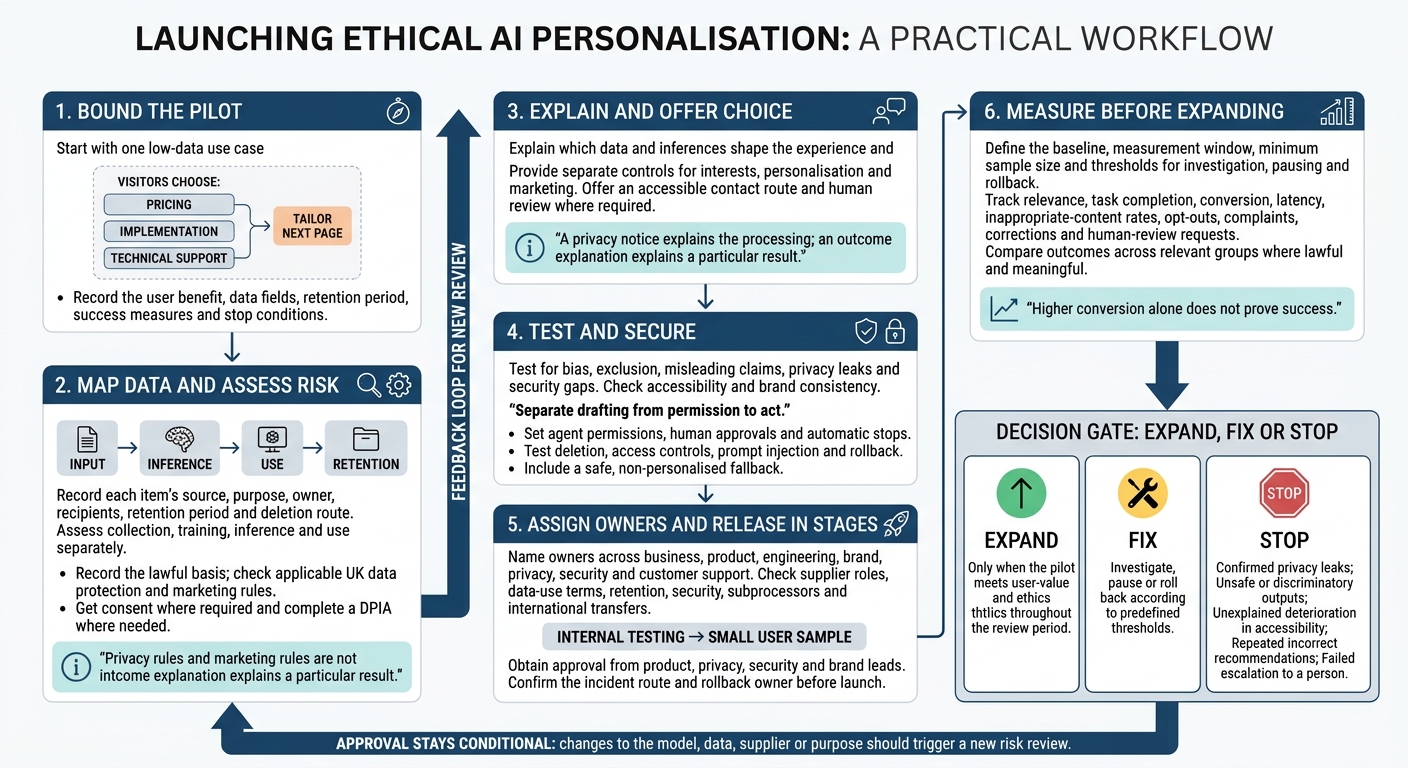
Ethical AI Personalisation: From Pilot to Launch
Use Data Lawfully and Transparently
The Data (Use and Access) Act 2025 amends the UK GDPR, Data Protection Act 2018 and PECR. Before launch, check which provisions are in force, review current ICO guidance and record the rules you apply. Then map each data item, purpose and control before personalisation goes live.
Map Data, Purposes and Lawful Bases
Treat each personalisation feature as a data flow: input, inference, use and retention. List declared preferences, purchases, browsing behaviour, customer-service records and inferred attributes. An AI-generated interest score linked to a customer is personal data, even when inferred rather than supplied. Record each item’s source, purpose, owner, recipients, retention period and deletion route.
Link each data source to the relevance, accessibility or service quality it supports. Assess collection, training, inference and use separately. Contract may apply when personalisation is necessary to deliver the requested service. Legitimate interests may support lower-risk first-party personalisation after a documented purpose, necessity and balancing test. Consent does not give blanket permission for later use.
| Activity | Data | Main risk | Lawful-basis considerations | Safeguards |
|---|---|---|---|---|
| Remembering preferences | Declared language, accessibility or product preferences | Unwanted exposure | Basis depends on context and necessity | Clear, editable preference centre |
| Recommending products | Purchase and browsing history | Intrusive profiling | Legitimate interests requires balancing; tracking may need consent | Limited first-party data use with opt-out |
| Sending tailored email or SMS | Contact details, purchases and permissions | Unwanted marketing | Check UK GDPR basis and PECR requirements | Permission and suppression records with unsubscribe controls |
| Training a model | Customer interactions and labels | Reuse or leakage | Assess training purpose, compatibility and basis | Minimise fields and restrict supplier reuse |
Limit Data and Assess Privacy Risks
Set retention and deletion rules for raw events, profiles, training datasets, logs and backups. Make sure suppliers follow them too. Pseudonymised data remains personal data, and special-category processing needs both an Article 9 condition and an Article 6 basis.
Complete a DPIA before processing likely to create high risks. Pay particular attention to systematic and extensive profiling, large-scale monitoring, novel AI processing, vulnerable audiences and automated decisions with significant effects. Keep a processing register, consent evidence and a retention schedule. Test deletion across connected systems before launch, and revisit the DPIA after material changes.
Privacy rules and marketing rules are not interchangeable.
Assess PECR requirements for cookies, similar technologies and electronic marketing. Non-essential storage or access generally needs prior consent unless an applicable exemption applies. Document any exemption you rely on; do not assume analytics or personalisation is exempt.
For the existing-customer email or SMS soft opt-in, verify a sale or sale negotiation, similar products or services, and an option to refuse marketing both at collection and in every message. Check the subscriber type and channel: website consent does not automatically authorise marketing.
Explain AI Use and Give Users Control
Clear explanations help users understand personalisation without feeling that something is hidden or manipulative. Use layered information: a short explanation beside the feature, a full privacy notice and an accessible contact route.
Explain which data and inferences shape the experience, why you use them, how long you keep them, who receives them and whether they train or evaluate models. A privacy notice explains the processing; an outcome explanation explains a particular result.
Give users separate controls for interests, personalisation and marketing. Withdrawing consent affects consent-based processing. Objection may apply to legitimate-interests processing or direct marketing. Explain applicable access, correction, erasure and other rights without promising unconditional deletion.
For solely automated decisions with legal or similarly significant effects, provide meaningful information about the logic, significance and consequences. Let users make representations and challenge decisions, with a route to human review that can change the outcome.
Once users can see and control the system, test whether the experience still feels fair and predictable.
sbb-itb-1051aa0
Build Safe and Consistent Brand Experiences
Once users can control personalisation, check that the system remains fair, safe and on-brand.
Test for Bias, Exclusion and Manipulation
Test recommendations, offers and errors across your whole audience - not just average users. Include UK English variants, mobile layouts, low bandwidth, keyboard-only use and screen readers. Check whether postcode, device or language acts as a proxy for protected characteristics. Use protected-characteristic data only where lawful and necessary. Otherwise, use justified proxy checks, and record any gaps in coverage.
| Harm | Prevention | Testing | Monitoring | Escalation |
|---|---|---|---|---|
| Exclusion | Use accessible defaults | Compare relevance and error rates between groups | Review outcome gaps | Provide a manual route |
| Proxy discrimination | Remove unjustified targeting signals | Change one proxy at a time | Review disparities | Require legal review |
| Unsupported claims | Use approved evidence | Fact-check adversarial outputs | Track unsupported claims | Withdraw affected content |
| Manipulation | Block targeting based on vulnerability, urgency or pressure | Review copy for pressure | Track complaints | Suspend the campaign |
| Privacy leakage | Restrict access | Test prompt injection and data theft attempts | Watch for unusual disclosures | Revoke access |
Do not trade informed choice for engagement. Ban targeting that exploits financial distress, illness, addiction or bereavement. Limit message frequency, and never let personalised copy hide material terms. After deployment, review outcomes at intervals matched to the potential harm.
Set Brand Rules and Agent Permissions
Keep one version-controlled brand standard for website, email and chatbot content. Cover tone, terminology, evidence, accessibility checks and consistent core promises. Include a safe, non-personalised fallback.
Separate drafting from permission to act. Define the data, tools and actions each agent can use. Set limits on spending, audience size and message frequency, with automatic stops. Require human approval for sensitive claims and any action affecting rights, finances, safety or opportunities.
Enforce these rules through access controls, logging and rollback.
Secure Systems and Track Changes
Use role-based access, multi-factor authentication and encryption. Keep customer, test and production data separate. Treat retrieved documents and customer messages as untrusted data - not instructions - and test direct and indirect prompt injection.
Version models, prompts, rules, datasets and evaluation sets. Keep restricted, time-limited audit logs of versions, actions and approvals, leaving out raw personal data unless needed.
Record known failure modes, incident owners and rollback steps. Test the emergency shut-off and last-known-good release. Re-test after material changes, and rehearse incident response at least annually.
Launch, Manage and Measure Personalisation
Once controls are in place, start with one low-risk pilot.
Pilot One Low-Data Use Case
Test a preference-based onboarding path: ask visitors to choose ‘pricing’, ‘implementation’ or ‘technical support’. Use only that preference to tailor the next page - not unrelated browsing histories or inferred sensitive traits. Before development, record the user benefit, data fields, retention period, success measures and stop conditions. Where a DPIA is required, confirm that the pilot fits its approved scope.
Use controlled test data or synthetic data, but remember: synthetic data is not automatically anonymous. Check relevance, accuracy, inclusion, accessibility and brand voice across journeys, screen sizes, assistive technologies and language variants. Include edge cases, such as incomplete preferences and conflicting answers. Test access controls, prompt or input manipulation, data leakage and logging too.
Release in stages, moving from internal testing to a small user sample, with approval from product, privacy, security and brand leads. Assign someone to handle escalations, give users a visible support route and confirm who can return the pilot to the approved non-personalised journey.
Assign Owners and Check Suppliers
Even a small pilot needs clear ownership and supplier checks.
Assign a business sponsor to oversee purpose and risk appetite, a product owner for the journey, and engineering for implementation and access controls. Brand should oversee consistency, privacy should cover data protection, and security should address threats. Customer support should handle complaints, corrections and escalation to a person. One person may hold several roles, but no role should be left unassigned.
Record the purpose, inputs, supplier, limitations, approvals, launch date, review date, incident route and rollback owner in an AI or product register.
Check suppliers before appointment to protect user trust, brand consistency and accountability. Establish whether each supplier acts as a processor or controller. Review contracts for permitted purposes, confidentiality, retention and deletion, security, incident notification, audit rights and support for access requests. Check restrictions on using customer data for model improvement or training.
Identify subprocessors, hosting locations and international transfers, including safeguards for transfers outside the UK. Repeat these checks after material changes to models, infrastructure, data use or subprocessors.
Document ownership, approvals and rollback before launch. Then review supplier access, data-use terms and transfer safeguards.
Measure User Value and Ethical Results
Before launch, define the baseline, measurement window, minimum sample size and thresholds for investigation, pausing and rollback. Track relevance, task completion, conversion, latency, inappropriate-content rates, opt-outs, complaints, corrections and human-review requests. Higher conversion alone does not prove success.
Compare outcomes across relevant groups where lawful and meaningful, without collecting sensitive attributes solely for analytics. Set critical stop conditions for confirmed privacy leaks, unsafe or discriminatory outputs, unexplained deterioration in accessibility, repeated incorrect recommendations or failed escalation to a person. Review results frequently during the pilot and after changes, then at agreed intervals.
Use those results to decide whether to expand, fix or stop the pilot.
Conclusion: Ethical Personalisation Launch Checklist
With the controls above in place, apply this final launch gate: launch only if the experience solves a real user problem, uses the least intrusive data, explains AI use clearly and keeps decisions with serious effects under human oversight.
- Lawfulness: Record the lawful basis, data used and retention limits. Get consent where required, complete a DPIA where needed and consult the ICO if high risks remain after mitigation.
- Transparency and choice: Explain what shapes the experience. Test preference settings, consent withdrawal and data rights requests, and provide human review where required.
- Safety and approval: Require documented sign-off on checks for bias, exclusion, manipulation, accessibility, security and brand.
- Accountability: Confirm named owners, supplier review, monitoring thresholds and an incident plan covering containment, rollback and required notification.
Start with one clearly bounded use case. Expand only when it meets user-value and ethics thresholds throughout the review period. Approval stays conditional: changes to the model, data, supplier or purpose should trigger a new risk review.
FAQs
How can I tell if personalisation feels intrusive?
Personalisation feels intrusive when it crosses the line from helpful to prying. Warning signs include robotic or forced interactions, or AI missing context such as British humour, sensitive topics or idiomatic expressions.
Human oversight matters when AI decisions have a major effect on access or pricing. Without it, those decisions risk being unethical and failing to comply with UK GDPR. To maintain trust, follow data minimisation: only process signals you actively use.
Can I personalise experiences without tracking users?
Yes. Personalisation doesn’t have to come at the expense of privacy. Collect and process only the signals your models need. Context such as device type, time of access and referral source can help you tailor content without tracking users’ every move.
You can also ask users about their goals at sign-up. Their answers help you shape relevant experiences around what they want to achieve, rather than their browsing behaviour.
How can a small team afford ethical AI oversight?
Small teams can keep ethical AI oversight simple by matching controls to their size and risk level. Skip lengthy manuals. Use a one-page acceptable use policy that sets out approved tools, data-handling rules and when human review is needed.
Maintain a simple risk register that records who owns each tool. Hold brief monthly or quarterly reviews, and scale human oversight to the stakes involved. This keeps governance workable without compromising ethical standards.
if (valuable) then share();