Edge AI for Energy-Saving Monitoring
Process data on-device to cut transmission energy: edge AI reduces power by filtering, adaptive sampling and compressed models.

Edge AI cuts power use mainly by cutting data transfer. Instead of sending raw sensor data to a remote server all day, the device does the first check on site and sends only alerts, short summaries, or compressed files.
If I had to boil the article down to a few points, it would be this:
- Most savings come from less transmission, not from the AI itself
- On-device filtering, adaptive sampling, and compressed models are the main ways to lower power draw
- Remote and low-signal sites gain the most, because mobile, satellite, and other long-range links use a lot of energy
- Layered setups work best: node first, gateway next, cloud last
- The main trade-offs are battery life, accuracy, latency, cost, and coverage
- UK deployments often need a mix of LoRaWAN, cellular, and satellite, plus IP65+ hardware for wet and windy sites
- In field and estate use, studies cited here report:
- 12 days on a 3,000 mAh battery with 98% inference accuracy
- image uploads cut from 500 KB to 10 KB
- building energy use cut by more than 25%
- district heat CO₂ cut by 40%
What does that mean for you? If your monitoring system runs all the time, sends lots of raw data, or sits in a hard-to-reach place, local processing will often use less power than cloud-first monitoring.
I’d frame the article in one line: process data at the lowest layer that can do the job, and only send what matters.
What research shows about energy efficiency gains
The research points to one pattern again and again: when a system needs continuous monitoring, sending raw data tends to use more energy than analysing that data on the device first. That gap becomes even clearer over cellular or satellite links.
Local filtering, adaptive sampling and compressed models
The same three methods keep showing up in the literature, and each one cuts waste in its own way.
Local filtering strips out data that does not matter before anything leaves the device. In edge AI trail cameras, this can cut false alerts by more than 90%, because the camera sends a real-time 4G alert only when the target species has been confirmed on-device.
Adaptive sampling changes how often a sensor takes readings and reports them, based on what is happening around it. At Tongji University's Jiading campus greenhouse, the system checked slow-changing variables such as temperature and humidity less often. At the same time, it predicted faster-changing variables such as solar radiation, which reduced transmissions without hurting control accuracy.
Model compression helps inference run on hardware with tight memory and compute limits. A 2025 MDPI Agriculture study introduced MFW-YOLO, a compressed YOLO11-based model for sika deer detection. It reduced parameters to 62% of the original 5.9 million and compute to 60%, while still reaching 91.9% mAP50 and 3.8 ms inference time.
Communication energy versus compute energy
Researchers keep coming back to the same trade-off: continuous raw data transmission has a high energy cost, while local AI inference often uses less energy when the device sends only alerts or anomalies. In day-to-day use, adaptive event-driven systems tend to save the most energy, as long as trigger thresholds are set with care.
The main point is straightforward: edge AI cuts energy use by deciding on the device what is worth sending. These savings show up most clearly in field deployments, where results still depend on the site, the sensor type and the available power budget.
Key studies and deployment patterns
The same energy-saving pattern shows up in different ways across remote sites, cities and building systems.
Sensor networks in urban and remote settings
In remote field sites, autonomy matters most. A solar-powered ESP32 system used local Random Forest inference and IP65 housing so it could keep running in outdoor Andean conditions. That mix of on-device inference, solar power and ruggedised packaging shows up again and again in remote deployments.
In urban sensor networks, the problem changes. Power is less of a headache; signal noise becomes the bigger issue. Dense city environments produce huge amounts of sensor data, and much of it isn't useful. Edge AI deals with that by filtering data on site and sending information only when something meaningful happens, like a pollution spike or a sound anomaly. That keeps bandwidth use down and cuts the cost of operating high-density networks across areas where connectivity can be patchy.
That local-first model doesn't stop at street level. It carries over into buildings and heat networks too.
Smart buildings, grids and event-driven monitoring
In built environments, edge AI plugs into physical assets and adjusts them in real time. London-based xWatts connects straight to on-site HVAC units, solar arrays and combined heat and power (CHP) engines. It then builds real-time digital models that drive autonomous adjustments across large mixed-use estates, including NHS hospitals and University of Cambridge college facilities.
At grid scale, Gradyent (Rotterdam) worked with Helen, one of Europe's largest energy companies, to deploy AI-driven digital twins across Helsinki's district heating network. By April 2025, the system's real-time optimisation had helped bring about the closure of a coal plant and a 40% cut in CO₂ emissions from the city's heat production. Heating and cooling systems account for nearly 50% of global final energy consumption, so this kind of grid-level edge intelligence matters a great deal.
Across all of these cases, local data leads straight to closed-loop action instead of waiting for a remote server. That means less data transmission, more autonomy, and lower energy use across very different settings.
These deployment patterns feed straight into the architecture trade-offs below.
sbb-itb-1051aa0
Architecture choices and design trade-offs
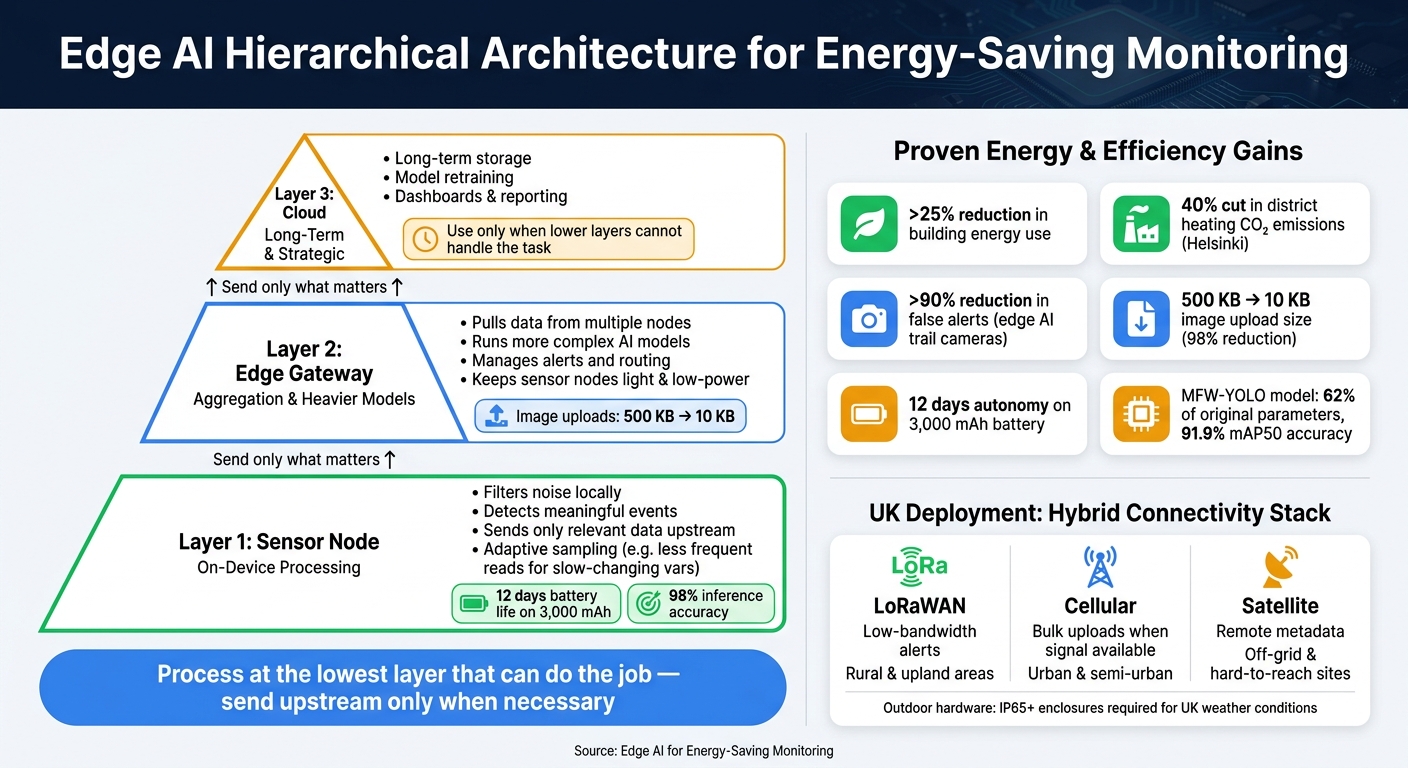
Edge AI Monitoring: 3-Layer Architecture & Energy Savings
Hierarchical edge architecture for monitoring systems
A common setup uses three layers: the sensor node, the edge gateway and the cloud. Each layer has a clear job.
The sensor node handles the first pass on-device. It filters noise, spots meaningful events and sends only the data that matters upstream. That’s where much of the saving comes from: data stays local until there’s a good reason to move it.
The middle layer, the edge gateway, pulls data from several nodes, runs heavier models and manages alerts. Giving this layer responsibility for routing and execution helps keep sensor nodes light and low-power.
At the top, cloud services deal with long-term storage, model retraining and dashboards.
The main idea is simple: process data at the lowest layer that can do the job, then move it up only when more compute or persistent storage is needed. If every layer does more than it should, the whole setup starts to drag.
Battery life, accuracy, hardware cost and coverage trade-offs
Every design decision comes with a cost. Push sampling rates up, and the system responds faster, but battery life drops. Compress data harder, and bandwidth use falls, but so does detail. In practice, the main tensions sit between energy use, accuracy, latency and hardware cost.
The practical takeaway is straightforward: optimise for system lifetime, not accuracy by itself. A system that detects events well on paper but dies too soon in the field isn’t much use.
The right balance depends on what the system needs to catch. Gateway-heavy setups fit dense urban areas or building sites, where compute is easier to provide and power limits are less strict. Node-heavy setups fit remote locations, where autonomy and low power draw matter more. Those choices shape how the system behaves once it leaves the lab.
UK deployment factors for monitoring systems
These design decisions get sharper in UK deployments, where coverage and compliance can change from one site to the next.
In the UK, architecture choices are shaped in large part by connectivity, weather and site sensitivity. Coverage can be patchy in rural and upland areas, so a hybrid model is often the most workable option:
- LoRaWAN for low-bandwidth alerts
- Satellite for remote metadata
- Cellular for bulk uploads when signal is available
Weather also matters day in, day out. Outdoor hardware should use ruggedised enclosures, usually rated IP65 or above, to handle moisture and wind.
For smart building retrofits, especially across NHS estates and university campuses, the architecture often moves away from passive monitoring and towards direct links with HVAC, solar arrays and CHP systems. Local-first processing also helps with UK data protection needs on sensitive sites such as hospitals and homes.
Conclusion: where edge AI fits in modern monitoring platforms
Across the studies, the pattern is consistent. The evidence points to one main gain: reducing data transmission. Most of the energy saving comes from cutting down what leaves the device. Process data at the lowest layer that can handle it, then send it upstream only when there’s a clear reason. That’s what keeps these systems efficient.
In practice, the architecture needs to fit the site. There isn’t one setup that works everywhere, which is why layered edge systems tend to beat cloud-first monitoring in constrained sites. The design should follow site limits, not a fixed template.
The main trade-offs are battery life, accuracy, cost and coverage. So before scaling, teams need to assess the sensing, compute and connectivity stack together, not piece by piece.
Key takeaways for decision-makers
For deployment teams, three checks matter most:
- Assess connectivity first. Patchy coverage or low-bandwidth links push more processing on-device and shape every other choice.
- Optimise for system lifetime, not just peak accuracy. A highly accurate system that drains its battery too fast has limited value in practice.
- Design the action layer early. Put the focus on on-site control for energy assets that can respond locally.
Edge AI saves energy when it cuts transmission, fits local constraints, and acts close to the source.
FAQs
When does edge AI save the most energy?
Edge AI uses the least energy when it handles data on small, purpose-built devices nearby, instead of sending everything to far-off cloud servers. That matters because local processing cuts the power spent on constant connections and long-distance data transfer.
You can push energy use down even more with low-power AI chips, sensors that switch off between readings, and energy-harvesting tech such as solar power.
What is the best setup for remote UK sites?
For remote UK sites, the best setup mixes tough, low-power edge processing with kit that can handle rough conditions. Use weather-resistant, IP-rated enclosures, along with sensors and low-power AI chips such as NVIDIA Jetson or Google Coral, so the system can classify events locally in real time.
For off-grid power and connectivity, pair solar arrays with lithium-ion batteries. Then use LoRaWAN or satellite modems to send only the key compressed alerts. Antler Digital can support the agentic workflows and AI integrations needed to keep this running well.
How do I balance battery life and accuracy?
Balance battery life and accuracy by tuning both the hardware and the software. Use low-power AI chips and lightweight pre-trained models to cut energy use without giving up strong performance.
You can trim power use even more with event-based monitoring. That means sensors wake up only when needed, instead of running all the time. Duty-cycling helps too. For example, you can switch sensors off between readings with MOSFETs, then power them back on when it’s time to sample again.
if (valuable) then share();