Top 7 Tools for API Version Management
Compare seven API versioning tools—gateways vs design tools, deployment, costs and migration steps for safe version rollouts.

I’d choose an API version management tool by what you need to control: contracts, live traffic or both. Across these 7 tools, the main split is clear: gateways route requests between versions; design tools help teams review, test and document changes.
I compare Zuplo, Kong, Google Apigee, Microsoft Azure API Management, Amazon API Gateway, Postman and SwaggerHub on version support, deployment, cost and limits. My first check? Whether /v1 and /v2 can run side by side - or whether I need a separate gateway.
Quick Comparison
| Tool | Main role | Version support | Deployment | Cost basis |
|---|---|---|---|---|
| Zuplo | Managed gateway and documentation | Version routes, policies and separate OpenAPI docs | Managed, hybrid or self-hosted | Requests and plan |
| Kong | Gateway with plugins | Version routing through paths, headers or hosts | Managed, hybrid or self-managed | Edition, plan and usage |
| Google Apigee | Enterprise API governance | Proxy revisions, policies and analytics; public versions need setup | Managed or hybrid | Usage, environments and contract |
| Azure API Management | Azure-based API control | Public versions, internal revisions and routing policies | Managed; self-hosted gateway options | Tier and usage |
| Amazon API Gateway | AWS-based traffic control | Routes, deployment snapshots and stages | AWS-managed | Requests and related AWS charges |
| Postman | Collaboration and testing | Versioned definitions, tests and documentation; no traffic routing | Hosted | Users and plan |
| SwaggerHub | Contract-first design | Versioned OpenAPI definitions and design checks; no traffic routing | Check hosting options | Users and plan |
No tool removes the need to plan migration. I’d test contract checks, version-specific documentation, traffic monitoring and rollback before choosing - and make <u>retirement ownership and deadlines</u> part of that decision.
API Version Management Tools Compared
Use this table to see which version-management tasks each tool covers - and which still need your team’s input.
| Tool | Best suited to | Version and deprecation support | Deployment model | Main limitation | Pricing approach |
|---|---|---|---|---|---|
| Zuplo | Teams wanting a managed, developer-focused gateway with little day-to-day upkeep | URL-based versions use separate OpenAPI files, routes and policies. Deprecation notices and retirement need explicit setup. | Managed cloud gateway with edge deployment. GitHub can trigger deployments; other source-control providers need CLI-based deployment. | Version maintenance remains manual. | Request-based plans, a free tier and enterprise contracts. |
| Kong | Organisations needing an extensible gateway with cloud, self-managed and hybrid options | Services, routes, plugins and declarative configuration support version routing. Retirement and consumer migration need explicit setup. | Self-managed, Kubernetes/cloud deployment or managed Konnect | Self-managed deployments need upkeep. | Free open-source gateway; hosted and enterprise pricing varies. |
| Google Apigee | Large organisations needing API proxy governance, analytics and promotion across environments | Proxy revisions support internal change control. Customer-facing versions, sunset policies, notifications and migration monitoring need separate configuration. | Google Cloud managed service, with environment and deployment considerations | Pricing and architecture can be demanding for smaller teams. | Usage and environment charges, or subscription and enterprise contracts. |
| Microsoft Azure API Management | Azure-centric enterprises needing policies, portals, identity integration and tiered capacity | API versions manage customer-facing versions; revisions handle internal change control. Sunset enforcement and migration need policies and coordination. | Azure-managed service, with options varying by tier | Pricing varies sharply by tier and capacity. | Consumption or tiered instance/capacity-unit pricing; costs vary by region and configuration. |
| Amazon API Gateway | AWS-native serverless and cloud integrations | Routes and application configuration direct traffic to versions. Deprecation notices, migration tracking and retirement need supporting processes. | AWS-managed service | Requires AWS-specific knowledge to run and maintain. | Usage-based billing, plus associated infrastructure and data transfer. |
| Postman | Collaborative API design, testing, documentation and releases | Manages versioned specifications, tests and documentation - not runtime traffic routing or retirement. | Hosted collaboration tool | No production traffic control. | Seat-, plan- or enterprise-contract pricing. |
| SwaggerHub | Contract-first OpenAPI design, governance and documentation | Manages versioned specifications and documentation, with design-time validation - not runtime testing, traffic routing or retirement. | Hosted design and governance tool | No runtime routing or consumer migration controls. | Seat-, plan- or enterprise-contract pricing. |
Compare pricing against traffic, environments and team size. Quoted totals may exclude infrastructure, data transfer, tax, support and add-ons.
sbb-itb-1051aa0
What API Version Management Covers
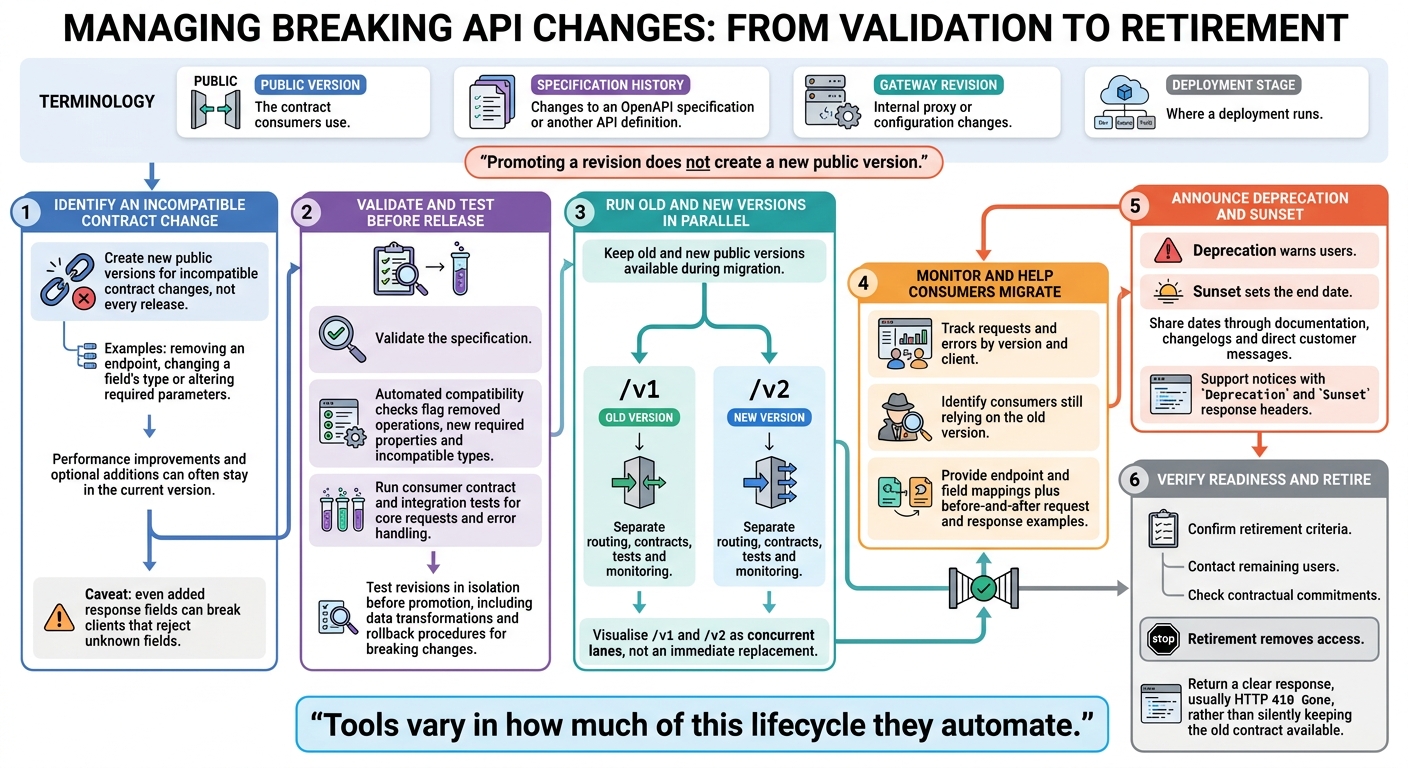
API Version Management: From Contract Change to Retirement
Public versions, revision history and deployment stages do different jobs. A public version defines the contract consumers use. Specification history records changes to an OpenAPI spec or another API definition. Gateway revisions track internal proxy or configuration changes, while deployment stages identify where they run. Promoting a revision does not create a new public version. Treat design-time versioning, runtime routing and release-stage control separately when comparing tools. Each tool in this guide covers a different part of that workflow.
Create new public versions for incompatible contract changes, not every release. Removing an endpoint, changing a field’s type or altering required parameters can break existing integrations. Performance improvements and optional additions can often stay in the current version. But even adding response fields can break clients that reject unknown fields.
Before release, validate the specification. Use automated compatibility checks to flag removed operations, new required properties and incompatible types. Run consumer contract and integration tests for core requests and error handling. Test revisions in isolation before promotion, including data transformations and rollback procedures for breaking changes.
Run old and new public versions in parallel during migration, with separate routing, contracts, tests and monitoring. Track requests and errors by version and client to see who still relies on the old version. Help each client migrate with endpoint and field mappings, plus before-and-after request and response examples.
Deprecation warns users, sunset sets the end date, and retirement removes access. Share dates through documentation, changelogs and direct customer messages, backed by Deprecation and Sunset response headers. Before shutdown, confirm retirement criteria, contact remaining users and check contractual commitments. Retirement should return a clear response, usually HTTP 410 Gone, rather than silently keeping the old contract available. The tools below vary in how much of this lifecycle they automate.
1. Zuplo
Zuplo handles the gateway side of version management, building on runtime routing and migration control. Its managed API gateway and lifecycle platform brings together authentication, policies, API keys, observability and a developer portal. That means it supports both version management and documentation.
Zuplo can front an existing backend and route /v1/orders and /v2/orders to different backends or transformation policies, letting v1 stay live while selected consumers move to v2.
These controls support staged rollouts, but your team still handles release approvals, migration communications and retirement dates. The routing layer works alongside versioned documentation in the portal.
The portal can publish separate OpenAPI docs for each version, complete with labels, base URLs and migration notes. Check your plan for custom-domain, branding and access-control features.
Zuplo supports managed, hybrid and self-hosted deployments, including private data centre and air-gapped setups. Before choosing a deployment model, confirm which supporting services stay in Zuplo’s cloud. With self-hosting, your team takes responsibility for networking, certificates and upgrades.
For an enterprise evaluation, check SSO/RBAC, auditability, private networking and support SLAs. Also check how Zuplo connects to your OpenAPI repositories, CI/CD pipeline and monitoring tools.
Zuplo’s pricing page lists Builder at US$25 per month and Enterprise from US$1,000 per month on an annual contract. Prices are in US dollars, so allow for VAT and exchange-rate changes. You get flexible routing and documentation, with the trade-off of more configuration and potentially bespoke enterprise pricing.
2. Kong
Kong gives you runtime control over API versions, not just version labels. It routes traffic by path, hostname or header, using declarative configurations stored in Git so teams can review and repeat changes. You can define routes through configuration files or Kubernetes resources.
Plugins add authentication, rate limiting, transformations and logging to routes or services. Availability depends on the Gateway edition and Konnect plan, so check the relevant documentation before settling on a design.
Handle deprecation as a workflow: publish migration guidance, monitor legacy traffic and remove the old route only once retirement criteria are met. Assign clear ownership, as Kong separates control-plane configuration from data-plane traffic handling.
Konnect manages the control plane; gateway data planes process traffic. You can run data planes in Kubernetes or other infrastructure, but check Gateway-controller compatibility. During migration, agree who owns TLS, authentication and rate limiting to avoid enforcing the same rules twice.
Konnect’s Developer Portal supports API discovery, documentation and onboarding. Check its published-API limits when choosing a plan.
Konnect Plus starts at US$25 per month plus usage. Confirm VAT and regional billing directly with Kong. With self-managed Gateway, your team takes on infrastructure and upgrades in return for more control over deployment.
3. Google Apigee
Google Apigee keeps proxy revisions separate from public versions. Promote a tested revision through environments, and use a new base path for breaking contract changes. Tracking versions, ownership and lifecycle metadata helps keep that separation clear.
API Hub catalogues versions, specifications, deployments, ownership and lifecycle metadata across Apigee and Apigee hybrid projects. Imports sync roughly every six hours. If release details need to appear straight away, update the metadata in your pipeline.
Deprecating a version does not stop its traffic. It keeps serving requests until policies or deployment changes stop it. Before shutdown, check analytics for traffic, errors, latency and consuming applications. Use the developer portal for versioned documentation and onboarding, and track public versions separately from internal revisions in analytics.
Apigee’s strengths include Google Cloud integration, policy controls and environment separation. Apigee hybrid combines a Google-managed control plane with runtimes you operate. That leaves cluster maintenance, upgrades, security and capacity planning with your team. Check supported runtime platforms before committing, and factor the workload, cost and regional footprint into your decision.
Apigee can be complex and expensive for smaller teams. Google lists these monthly prices per region: Base at US$365, Intermediate at US$1,460 and Comprehensive at US$3,431. API Analytics is priced separately at US$20 per one million API calls for eligible environments. Model your environments, regions, traffic and add-ons, then confirm UK billing, VAT, support and networking costs. Its governance controls need to justify both the price and the work involved in running it.
4. Microsoft Azure API Management
For teams already using Azure, Microsoft Azure API Management (APIM) brings versioning, revision control and routing into one managed layer. Version sets group customer-facing versions, revisions track internal changes, and policies route requests. Versions can use URL paths, query strings or HTTP headers. Each version is a separate API resource with its own operations and policies.
Use revisions for non-breaking changes. You can test a revision at ;rev={revisionNumber} before promoting it.
Policies control runtime behaviour, not contract versions. XML-based policies inspect requests, route traffic to different backends, and enforce authentication, throttling and transformations. Set shared rules centrally, then add version-specific rules where needed.
APIM supports REST, SOAP and GraphQL. For versioned AI endpoints, policies can control access, enforce quotas and route requests to backends. Check your chosen tier, region and backend before relying on specific AI capabilities.
It also connects with Microsoft Entra ID, Key Vault, Azure Monitor and Application Insights for identity, secrets and diagnostics.
The managed gateway provides an Azure-hosted runtime. With self-hosted gateways, your team takes on container operations. Microsoft documents self-hosted gateway support for Developer and Premium: Developer is for non-production use and allows one replica per deployment, while Premium carries additional self-hosted gateway charges.
Pricing depends on tier and usage. Check Microsoft’s UK pricing page for current rates and VAT, then use that model to compare APIM with the next tool based on your workload - not just feature count.
5. Amazon API Gateway
Amazon API Gateway suits AWS-native teams that need version routing, stage-based releases and rollback control. It handles version control through stages, routes and deployments, not separate public release objects. Start by choosing the API type: this determines how you route and secure each version.
Deployments take snapshots of your API configuration. Stages expose those snapshots and support rollbacks, but public versions still need explicit routing by path, host, header or query. Custom-domain mappings let you expose separate version paths through different stages.
REST and HTTP APIs route requests by path and method. WebSocket APIs use connection and message routes, including $connect and $disconnect.
Match authorisation to each API type and version. IAM suits AWS callers, while Amazon Cognito and supported OAuth 2.0/OpenID Connect approaches serve application users. REST API keys and usage plans control consumption; they do not replace authentication. Check access and throttling settings for each version separately.
When planning deprecation, pair traffic data with version tags. Use CloudWatch to monitor traffic, latency and errors for each version, and CloudTrail to audit management changes.
Running two versions side by side does not move consumers to the newer one automatically. Update SDKs and documentation, and publish retirement deadlines. Check traffic metrics for remaining v1 users before removing its route or stage. Keep access only for consumers with an approved exception.
REST and HTTP APIs charge per request, plus outbound data charges. WebSocket billing covers messages and connection minutes. AWS lists a 12-month free tier for eligible accounts, with monthly allowances of 1 million REST API calls, 1 million HTTP API calls, 1 million WebSocket messages and 750,000 WebSocket connection minutes.
6. Postman
Postman moves version management upstream, so teams can design, test and document APIs before release. Its design-time version management brings collections and API specifications into shared workspaces for team review. Role-based access control restricts who can edit them. Postman does not route production traffic.
Changelogs for collections and versioned API definitions let teams trace changes and revert to earlier versions. Supported formats include OpenAPI, GraphQL and RAML. Keep specifications, collections and documentation aligned so the version history supports accurate release notes and consumer documentation.
Use mocks and automated tests to check contract compatibility before release.
Before setting a budget, check per-user charges and plan allowances for collaboration, permissions, mocks and monitoring.
7. SwaggerHub
Where Postman supports collaboration around API artefacts, SwaggerHub manages the contract itself through design-time version control. Its central catalogue makes versioned OpenAPI definitions easy to find. Reusable domains and shared components cut schema duplication, while generated reference documentation stays linked to the specification.
Teams can review specifications before release through collaborative editing, inline comments and permissions. Shared style rules flag naming drift, missing descriptions, weak response codes and inconsistent pagination. Make approval ownership clear, and check which branching and review features your plan includes.
A separate gateway handles routing, authentication, rate limiting, observability and retirement. Deprecating a definition does not switch off the live API: SwaggerHub governs the contract, not runtime traffic.
For delivery workflows, check how SwaggerHub passes approved contracts to downstream tools. Confirm the sync direction and hand-off rules for source control, CI/CD tools and gateways.
Ask SmartBear to confirm cloud or self-hosted availability, UK data-residency terms, GBP pricing, VAT treatment and billing frequency. Also check plan limits for users, private APIs, catalogue size, SSO, governance and integrations.
Match Tools to Your API Requirements
Compare design-time tools, runtime gateways and lifecycle platforms against the same requirements.
Separate contract control from live traffic control. A specification registry manages API definitions. A runtime gateway routes requests and enforces policies. A lifecycle platform connects design, testing, publication, analytics and retirement, but coverage differs between products.
Start with the responsibilities your service cannot compromise on, then score the rest.
| Requirement | What to assess | Evidence to request |
|---|---|---|
| Contract-first version control | Version history, approvals and compatibility checks | A reviewed contract change, its audit trail and the previous definition. Check official documentation, release activity and customer reviews. |
| Runtime version routing | Path, header or query routing; backend mappings; shared security policies | Concurrent versions reaching the correct backends, with authentication and version-level monitoring intact. |
| Deprecation management | Migration guidance, consumer notices and retirement controls | A documented notice period, a live replacement and a safe process for disabling the old version. |
| Developer experience | Version-specific documentation, mocks, examples and automated tests | Credential access, working examples and pre-publication compatibility tests. |
| Deployment | Managed cloud, self-hosted or hybrid; regions and private networking | A supported hosting design and repeatable promotion of contracts, policies and configuration through environments. |
| Cost fit | Seats, requests, environments, support and data transfer | A cost estimate covering parallel versions and migration overlap, with billing currency, VAT treatment and commitments stated. |
Plan deprecation as part of running your API. Document the notice period, live replacement and migration path your contracts require.
Postman can support collaboration and testing, but it does not replace production routing. For lifecycle platforms with broader coverage, check where their built-in functions end and integrations take over.
Score each requirement as strong, partial, integration-dependent or not evidenced. Set non-negotiables first, such as private hosting or header-based routing. A high total score must not hide a missing production requirement.
Conclusion
Choose based on what you need to control: contracts, traffic or the full lifecycle. More coverage only helps if it matches your production needs.
Then put it to the test. Run one breaking-change migration from start to finish: validate the contract, update the documentation, shift traffic, check rollback and rehearse retirement. Note any manual work or extra integrations, and factor these into your decision.
FAQs
How do I choose between path-based and header-based versioning?
Path-based versioning makes the version easy to spot and bookmark. It works with standard HTTP clients and caching infrastructure, making it a good fit for public APIs or projects that need a simple setup.
Header-based versioning keeps URLs clean and follows REST principles more closely by keeping the URI focused on the resource. It gives enterprise teams more control, but requires more complex gateway logic and careful Vary header configuration to keep caching efficient.
How long should I support an old API version?
Balance technical maintenance with what users need. Many organisations follow an N-2 policy, supporting the current version and the two previous versions.
Industry standards suggest giving 6 to 12 months’ advance notice of deprecation. Grace periods typically last 3 to 8 months, depending on how complex the migration is and users’ technical requirements.
Make the retirement date clear, and keep deprecated endpoints fully functional throughout the transition so clients can migrate without disruption.
How can I migrate API versions without downtime?
Keep older and newer API versions running side by side to maintain backward compatibility. Use API gateways to shift traffic gradually, through weighted distribution or phased rollouts.
Give developers clear notice, typically 3 to 8 months in advance, and share timelines through the Deprecation and Sunset HTTP headers. Provide detailed migration guides, automated transition tools and responsive support throughout the process, so clients can migrate at their own pace.
if (valuable) then share();