AI Governance Frameworks for M&A
Robust AI governance rooted in accountability, compliance and risk management is essential to protect deal value across every stage of M&A.

AI is reshaping mergers and acquisitions (M&A), streamlining processes like deal sourcing, due diligence, and post-merger integration. However, without proper governance, AI can introduce risks such as bias, flawed valuations, and data privacy issues.
Key points to know:
- AI's role in M&A: AI helps identify targets, review documents faster (up to 60% time-saving), and standardise operations post-deal.
- Governance importance: Ensures AI supports human judgment, maintains compliance, and mitigates risks like biased outputs or legal liabilities.
- Challenges: Legacy systems, balancing compliance with innovation, and workforce readiness.
- Solutions: Clear accountability, updated NDAs, thorough due diligence, and retiring outdated systems within 90 days post-deal.
Organisations that prioritise AI governance are better equipped to manage risks and maximise value in M&A transactions.
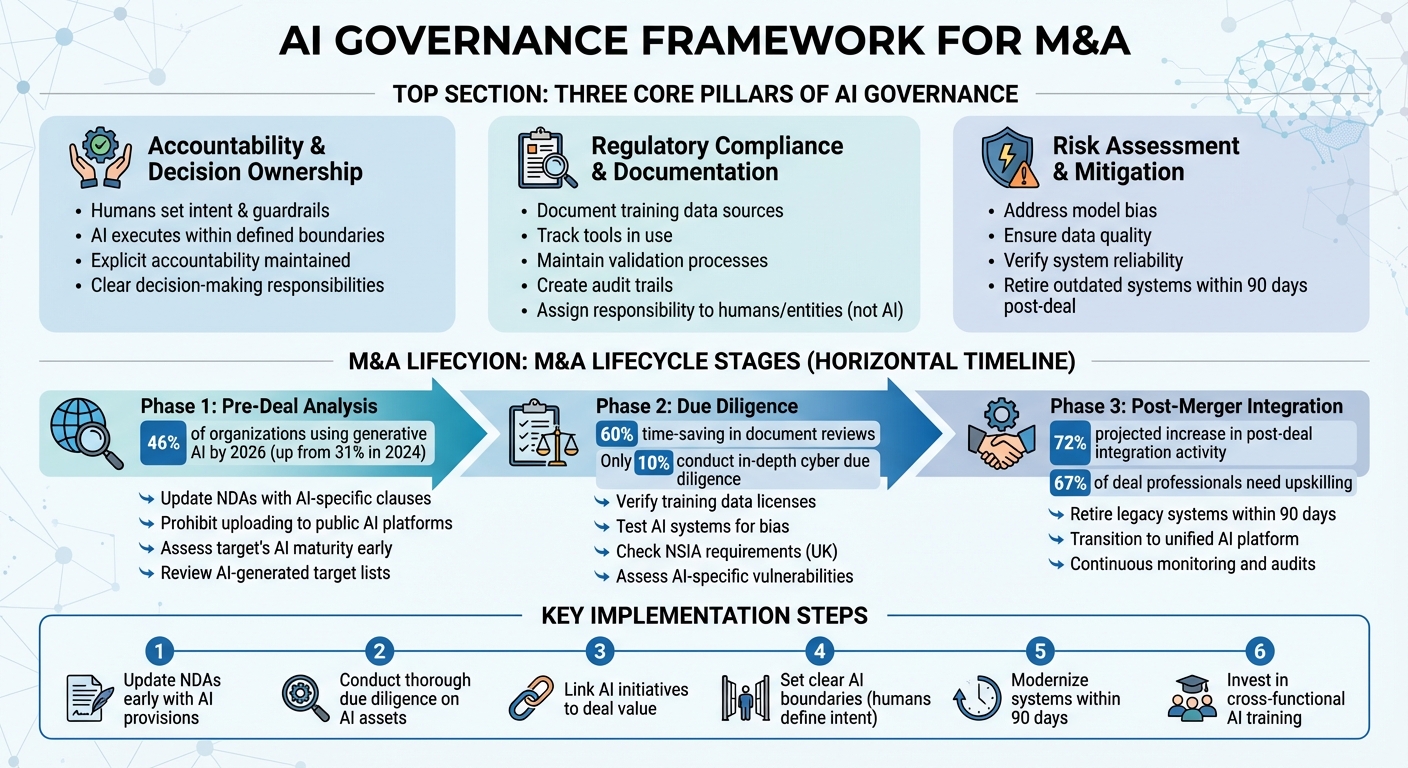
AI Governance Framework for M&A: Three Pillars and Lifecycle Implementation
Core Elements of an AI Governance Framework
Building a governance framework for AI in M&A involves three key pillars: accountability, regulatory compliance, and risk management. Each pillar addresses a crucial aspect of control, ensuring AI enhances deal quality rather than complicating it. Together, they connect strategic oversight with operational execution, forming the backbone of effective AI management in M&A.
Accountability and Decision Ownership
One essential principle is that humans must remain responsible for decisions driven by AI. As Accenture explains:
Humans set intent and guardrails; agents execute within defined boundaries; accountability remains explicit.
In practice, this means organisations must clearly define decision-making responsibilities from the outset. For example, who takes ownership when AI flags a high-risk contract clause? Who reviews and validates AI-generated valuations? Leading companies integrate these roles into their workflows, ensuring accountability is maintained as AI tools are adopted more widely. This clarity becomes even more critical as teams learn to work alongside AI, blending human judgement with machine efficiency.
Regulatory Compliance and Documentation
Regulators in jurisdictions like the US, EU, and UK now demand transparency around how AI is used in business operations. Organisations are required to document details such as training data, tools in use, and validation processes. This level of documentation isn’t just a regulatory checkbox - it’s a safeguard. Comprehensive records create an audit trail that demonstrates compliance and helps resolve disputes.
For instance, if an AI system generates biased outputs during due diligence, having detailed records of data sources and validation steps can clarify liability. Under English law, AI systems are not recognised as legal entities, meaning responsibility must be explicitly assigned to humans or corporate entities in contracts. Such meticulous documentation is crucial for creating a strong foundation for risk management.
Risk Assessment and Mitigation
AI introduces a range of risks - technical, ethical, and legal - that traditional M&A frameworks may not fully address. Governance must focus on areas like model bias, data quality, and system reliability. For example, if a target company’s AI system, trained on biased data, produces discriminatory outputs, it could expose the acquirer to regulatory fines and reputational harm.
To counter these risks, effective mitigation strategies are essential. One approach is enforcing strict technology rationalisation policies post-acquisition. By retiring outdated systems within a set timeframe, companies can avoid system fragmentation and maintain a unified, interoperable data foundation. These steps are vital for protecting the value of the deal and ensuring smooth integration after the merger.
sbb-itb-1051aa0
Applying AI Governance Across the M&A Lifecycle
AI governance isn’t something you can tick off a checklist - it’s an ongoing effort that needs to be embedded at every stage of a transaction. From identifying potential targets to post-merger integration, each phase comes with its own set of governance challenges. Organisations that treat governance as a core part of their processes, rather than an afterthought, are better equipped to navigate the complexities of mergers and acquisitions (M&A). Let’s break down how governance can be tailored to each stage of the M&A lifecycle.
Pre-Deal Analysis and Target Identification
The groundwork for governance is laid during the earliest stages of M&A. By 2026, nearly half (46%) of organisations were using generative AI for pre-deal activities, a sharp rise from 31% in 2024. While this rapid adoption offers exciting possibilities, it also introduces immediate risks around confidentiality and data security.
One way to address these risks is by updating NDAs to include AI-specific clauses. As Katten Muchin Rosenman LLP explains:
Recipients of sensitive data may use AI tools in their daily workflows, and there is a risk that confidential information could be uploaded to those systems... meaning that confidential information could theoretically be incorporated into the system.
To mitigate this, NDAs should explicitly prohibit uploading sensitive data to public or open-source AI platforms that could retain it for model training. But governance doesn’t stop at contracts - there’s also a need for human oversight. AI-generated market scans and target lists should be carefully reviewed by experienced professionals to ensure accuracy and avoid bias. Top acquirers go a step further by assessing a target’s AI maturity early on, focusing on data architecture and AI readiness as key factors in determining deal value.
Once potential targets are identified, the due diligence phase takes a deeper dive into the target’s AI systems and data practices.
Due Diligence and Risk Evaluation
AI tools can speed up document reviews by as much as 60% during due diligence, but this efficiency doesn’t eliminate the need for strong governance. At this stage, the focus shifts to verifying the target’s AI systems, ensuring data compliance, and addressing risks tied to AI-specific vulnerabilities.
One critical step is confirming that the target has the necessary licences and usage rights for its training data. Without this assurance, acquirers could inherit legal liabilities. It’s also essential to test AI systems for bias, particularly in sensitive areas like finance or HR. Surprisingly, only 10% of companies conduct in-depth cyber due diligence during M&A deals, despite the growing risks of adversarial attacks, data tampering, and model theft.
In the UK, buyers must also consider whether the target’s AI activities fall under the mandatory notification requirements of the National Security and Investment Act (NSIA). This is particularly relevant for technologies like advanced robotics, cybersecurity, or identification systems. As Morgan Lewis points out:
AI is not a substitute for judgment, but rather a force multiplier for it. Effective deployment requires a strong governance framework grounded in transparency, accountability, and human oversight.
Post-Merger Integration and Monitoring
The post-merger phase is where governance frameworks face their real test. To maintain the value created by the deal, it’s crucial to retire outdated systems quickly and transition the acquired entity to a unified, AI-driven digital platform. This approach helps prevent data silos and ensures smooth interoperability.
With post-deal integration activity projected to rise by 72%, organisations must rethink their workflows to fully embrace AI rather than simply patching old processes. Governance plays a central role here, ensuring that humans remain in charge of setting strategic goals and defining operational boundaries, while AI operates within those limits.
Sustaining the benefits of AI over the long term requires continuous monitoring. AI systems can degrade over time due to data quality issues or rapid technological changes, so regular audits of system performance, accuracy, and bias are essential. Training also becomes a priority - 67% of deal professionals believe their teams need upskilling to work effectively alongside AI tools. Building these skills ensures that organisations can adapt and thrive as AI becomes increasingly integrated into M&A processes.
Common Challenges in AI Governance for M&A
Implementing AI governance during mergers and acquisitions (M&A) is no small feat. Even well-thought-out frameworks can falter without addressing specific hurdles. By understanding these challenges, businesses can avoid costly mistakes and ensure smoother integration.
Avoiding Technical Debt
Letting acquired entities keep their legacy AI systems often leads to technical debt. A case in point occurred in March 2026, when a US healthcare platform retired all legacy systems within 90 days. This decisive move preserved a unified digital stack, enabling the company to maintain a standardised, AI-enabled platform and a consistent data foundation. As a result, they avoided technical fragmentation and sped up AI deployment across their portfolio.
To prevent a tangled web of incompatible systems that become increasingly costly and complex to manage, organisations need careful planning and discipline.
Balancing Innovation with Compliance
Finding the right balance between fostering AI innovation and adhering to regulations is a constant struggle. Leaning too heavily on innovation risks violating evolving regulations like the EU AI Act, while focusing too much on compliance can stifle the creativity that makes AI so powerful.
To navigate this, organisations should adopt governance structures that prioritise both. This means conducting bias audits, verifying training data sources, and using interim covenants to ensure AI assets don’t lose value during the M&A process. Delegating low-risk AI decisions to operational teams while reserving high-stakes matters for senior leadership can also help. These steps, combined with accountability and risk management strategies, create a governance framework that supports innovation without compromising compliance.
Building Organisational Buy-In
Getting everyone in the organisation on board with AI governance is often underestimated. It requires more than just executive approval - cross-functional collaboration is key. Teams from legal, procurement, IT, HR, compliance, and audit must all work together.
One way to achieve this is by defining a clear "AI North Star" - a set of principles that aligns AI use with the organisation's risk appetite and strategic goals. Transparency is equally important. Policies should be easy to access, audience-specific, and hosted on a centralised AI portal to reduce the risk of unauthorised AI usage.
Training is another critical element. With 67% of deal professionals stating their teams need upskilling to work effectively with AI agents, organisations must invest in building AI literacy. In the EU, this is becoming a legal requirement under the AI Act. Treating each M&A deal as an opportunity to build capabilities and embedding governance structures into reusable digital workflows can further strengthen AI governance with every transaction.
Best Practices for AI Governance in M&A
Key Takeaways for AI Governance
Successful AI governance in mergers and acquisitions (M&A) revolves around three core principles: accountability, compliance, and risk management. While AI offers incredible capabilities, human oversight remains essential - AI should support human judgement, not replace it. Transparency is also crucial, requiring clear policies on data management and well-defined decision-making responsibilities. To mitigate risks, include contractual protections like AI-specific representations, warranties, and covenants. These measures help address potential issues such as intellectual property disputes, challenges with training data, and technology performance between signing and closing. Together, these elements form the foundation for integrating AI effectively in M&A processes.
Practical Steps for Implementation
To implement effective AI governance in M&A, consider these steps:
- Update NDAs early: Incorporate provisions that limit or regulate the use of AI tools when handling sensitive data.
- Thorough due diligence: Assess training data sources, intellectual property ownership, potential biases, and the target company's susceptibility to AI-driven disruptions.
- Link AI to deal value: Tie AI-related initiatives directly to deal pricing and capital allocation, avoiding the mistake of treating them as afterthoughts.
- Set clear boundaries: Define the role of AI with humans determining intent and establishing limits, ensuring AI operates within those parameters.
- Modernise systems: Aim to replace outdated systems within 90 days, transitioning to a unified, AI-enabled digital framework to prevent inefficiencies.
- Invest in training: Build AI literacy across key departments like legal, procurement, IT, and compliance to ensure smooth integration and governance.
By following these steps, organisations can better position themselves to leverage AI's capabilities in M&A while managing associated risks.
Future Outlook for AI in M&A
As organisations refine their governance strategies, the role of AI in M&A is expected to expand from cautious trials to widespread implementation. Recent data suggests that post-deal integration and value capture through AI are projected to grow by 72%. This shift reflects a broader change in priorities, as highlighted by Accenture:
The strategic question is no longer whether AI belongs in M&A. It is whether companies will use it to reinforce legacy integration models, or deliberately redesign the enterprise around it.
With global regulatory frameworks becoming stricter, robust governance structures are no longer optional - they're essential. Establishing a strong digital foundation early in the M&A process can transform transactions into opportunities to enhance efficiency and gain a competitive edge. Increasingly, the digital core is being evaluated during due diligence, signalling its importance as a deal asset rather than an afterthought.
For organisations looking to integrate AI into their M&A strategy, collaboration with experienced digital solution providers can make a significant difference. At Antler Digital (https://antler.digital), we specialise in creating scalable, AI-powered infrastructures that streamline deal integration and support agile governance throughout the M&A lifecycle.
FAQs
Who is accountable when AI gets an M&A decision wrong?
When AI leads to an incorrect decision in mergers and acquisitions (M&A), the responsibility typically falls on the organisation using the AI. To address this, having a strong governance framework in place is crucial. Such a framework ensures clarity and human oversight, which are key to managing risks and staying compliant during the process.
What AI clauses should we add to NDAs for M&A?
Including AI-specific clauses in NDAs is a smart move for addressing risks tied to data privacy, bias, accuracy, and liability. These clauses can outline representations, warranties, and commitments related to AI systems, ensuring transparency and proper oversight. They might also impose restrictions on how AI is used and what information can be disclosed about it.
By tailoring these clauses to the context of mergers and acquisitions, businesses can promote accountability and reduce potential risks. This approach safeguards both parties, particularly when AI technologies play a critical role in the deal.
How do we assess a target’s AI risks during due diligence?
When evaluating AI risks during due diligence, it's important to focus on three main areas: AI footprint, legal compliance, and quality.
- AI Footprint: Understand how the AI systems function, how they're integrated, and what dependencies they rely on. This helps pinpoint any operational risks that could emerge.
- Legal Compliance: Check for potential legal issues, such as data rights, intellectual property ownership, and liability concerns. These can have significant implications for the business.
- Quality: Evaluate the system's reliability, scalability, and associated costs. Poor quality can lead to inefficiencies or unexpected expenses.
Having a structured governance framework in place is key to managing these risks effectively. It not only reduces the chances of unwelcome surprises but also ensures alignment with regulatory standards.
if (valuable) then share();