AI-Driven Audience Segmentation: Key Benefits
How AI-powered psychographic segmentation boosts personalisation, efficiency, scalability and marketing ROI.

AI-driven audience segmentation is transforming how businesses connect with their customers. By analysing behavioural patterns, motivations, and values, AI provides deeper insights than outdated methods based on static demographics. Here's why it matters:
- Personalisation: AI tailors marketing to individual preferences, boosting engagement and conversions.
- Efficiency: Automated processes save time, reduce costs, and minimise errors compared to manual methods.
- Real-Time Updates: AI adapts to changing customer behaviours instantly, ensuring campaigns stay relevant.
- Higher ROI: Companies using AI report up to 300% increases in ROI and significant reductions in wasted marketing spend.
- Scalability: AI handles vast datasets seamlessly, enabling businesses to manage and refine audience segments effectively.
For example, Nike and Spotify achieved massive success by aligning campaigns with customer values and behaviours, proving the power of AI in driving results. Whether you're looking to reduce churn, improve targeting, or increase sales, AI segmentation offers a smarter, data-driven approach to marketing.
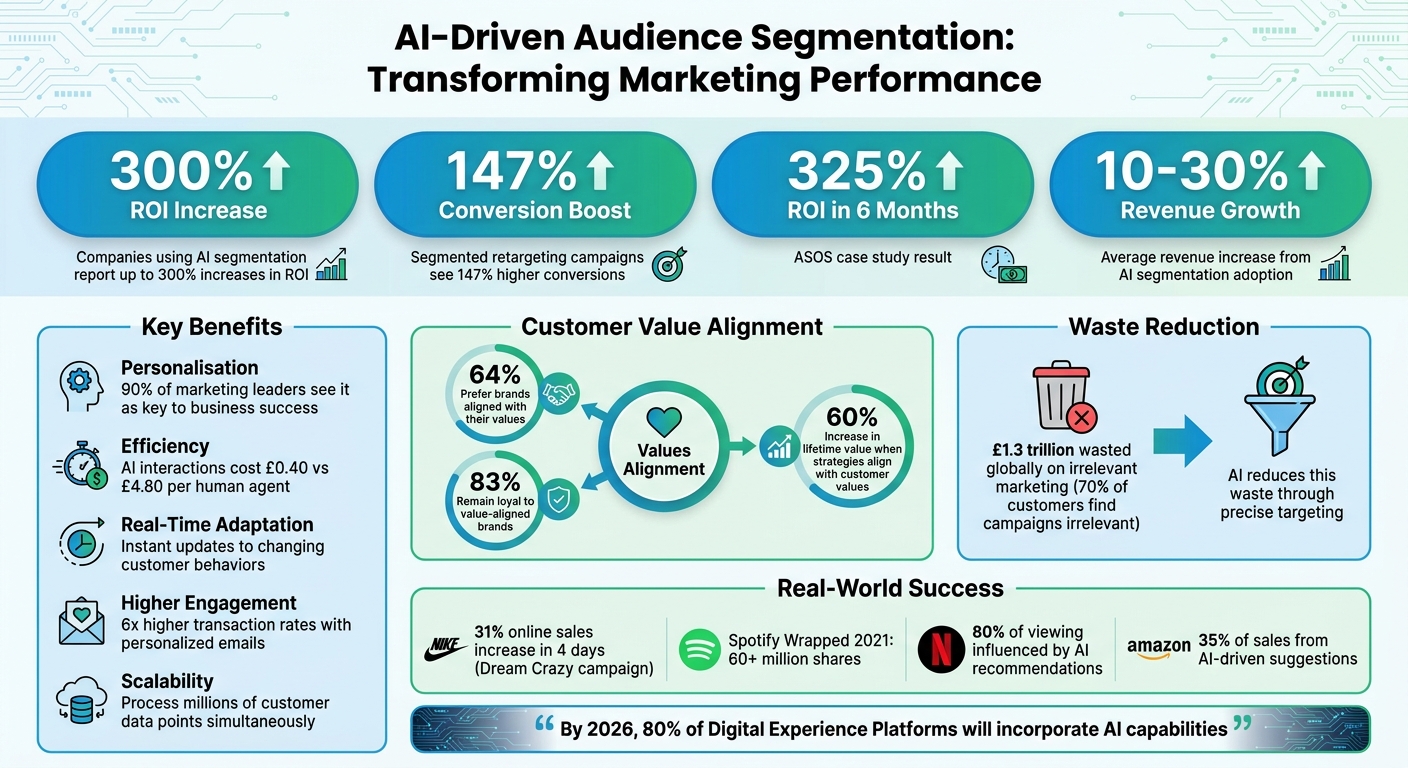
AI-Driven Audience Segmentation Benefits: Key Statistics and ROI Impact
Problems with Traditional Audience Segmentation
Before diving into AI-driven solutions, it's important to understand the limitations of traditional segmentation methods.
Static Demographics Miss the Full Picture
Traditional segmentation often assumes that customer profiles remain static over time. For instance, a woman aged 25–34 might be grouped with thousands of others who share the same demographic traits. However, her motivations, values, and purchasing triggers could be entirely different. Static factors like age, gender, and location fail to capture intent or behaviour, which are critical in today’s fast-evolving digital world. Two customers with identical demographics could have vastly different buying intentions - one might be ready to make a purchase, while the other is simply browsing.
Outdated personas are another issue, as they don't keep up with changing behaviours. A customer who once fit the "budget-conscious buyer" profile might now be interested in high-end products, but outdated segmentation would still target them with discount offers, missing the mark entirely.
Manual Processes Waste Time
While AI is reshaping audience segmentation, many businesses still rely on manual methods that are slow and inefficient. Marketers often wait days - or even weeks - for IT teams to extract data, define audience groups, and clean datasets. These outdated processes involve setting rigid rules and managing complex spreadsheets, which slows down the ability to respond to market changes. By the time a segment is ready, customer behaviours may have already shifted, leaving businesses unable to seize timely opportunities.
Manual processes also come with a higher risk of human error. Misreading behavioural data or applying incorrect parameters can lead to poorly targeted campaigns, wasting both time and budget.
Broad Categories Overlook Individual Customers
Traditional segmentation relies on fixed rules that fail to capture the complexity of today’s customer journeys. For example, a rule like "purchased in the last 30 days" might seem straightforward, but it doesn’t account for context. Was it a one-off gift purchase or the start of a recurring buying habit?.
This challenge is worsened by siloed data across platforms, which prevents businesses from getting a complete view of the customer. Consider a scenario where a customer browses products on their mobile, reads reviews on their desktop, and completes the purchase on a tablet. If these interactions aren’t connected, traditional methods treat them as separate actions, leading to fragmented marketing strategies that fail to address individual needs.
These shortcomings highlight the need for AI-driven psychographic segmentation, which overcomes these issues with advanced data analysis and real-time insights.
sbb-itb-1051aa0
How AI-Driven Psychographic Segmentation Fixes These Problems
What is Psychographic Segmentation?
Demographics tell us who customers are, but psychographic segmentation dives deeper to uncover why they make certain choices. It focuses on values, beliefs, interests, and motivations rather than just age, income, or location. This is crucial because a significant 64% of consumers prefer brands that align with their values, and 83% remain loyal to those brands. Imagine two 30-year-olds, both earning £45,000 a year. One prioritises sustainability, while the other seeks convenience. Traditional demographics would lump them together, but psychographic segmentation captures these deeper differences.
AI takes this further by analysing behaviours, motives, and passions to uncover subconscious tendencies and emotional triggers that manual methods often overlook. It customises strategies to how individuals think. In B2B, for instance, AI can differentiate between companies eager to adopt new technologies and those that prefer maintaining stability.
AI Techniques That Improve Accuracy
AI employs advanced techniques to refine segmentation accuracy. For example:
- Clustering algorithms like K-means and DBSCAN group customers based on shared behavioural and psychological traits [16–18]. These algorithms can process enormous datasets in a fraction of the time it would take a human team, revealing patterns across millions of interactions.
- Natural Language Processing (NLP) analyses language in emails, chats, and reviews to detect personality traits, tone, and motivations [18,19]. For instance, NLP can identify a "risk-averse decision-maker" by spotting cautious language in support tickets, enabling teams to adjust their messaging accordingly.
- Predictive modelling forecasts customer actions, such as identifying those likely to churn, those with high upsell potential, or free users ready to convert [17,18].
Unlike static demographic data, AI-driven segmentation evolves in real time, helping brands anticipate shifts in consumer sentiment and emerging trends. Companies adopting this approach report revenue increases of 10–30% on average. Additionally, real-time personalisation based on behaviour can boost conversion rates by 20% compared to static experiences. These methods deliver tangible results, as shown below.
Practical Applications and Results
The effectiveness of psychographic segmentation powered by AI is evident in real-world campaigns. Take Nike's "Dream Crazy" campaign in September 2018, featuring Colin Kaepernick. By aligning with customer values and aspirations rather than focusing solely on products, Nike saw a 31% increase in online sales within just four days, according to Edison Trends. Similarly, Patagonia's "Don't Buy This Jacket" campaign in November 2011 resonated with customers' moral values, achieving a 30% rise in sales while simplifying decision-making.
Another standout example is Spotify's "Wrapped" campaign in 2021. By turning user listening data into a personalised celebration of identity, it generated over 60 million shares, showing how deeply people connect with tailored experiences. These examples highlight how AI-driven psychographic segmentation can transform marketing efforts into meaningful, measurable success stories.
Key Benefits of AI-Driven Audience Segmentation
Better Personalisation and Targeting
AI takes personalisation to the next level by focusing on individual preferences rather than broad demographic groups. Instead of asking, "What does this age group prefer?", AI digs deeper to understand what a specific person might want, using factors like browsing habits, device type, and even the time of day. This approach is crucial, as nearly 90% of marketing leaders see personalisation as a key driver of business success.
What’s even more impressive is how AI adapts in real time. It can instantly recognise when someone shifts from being a "casual browser" to a "first-time buyer" or even an "at-risk subscriber" based on their behaviour. Machine learning uncovers subtle audience segments that traditional methods often miss. It doesn’t just stop there - AI can also predict future actions, such as the likelihood of churn or the next product a customer might want, enabling companies to act ahead of time.
The results speak for themselves. Segmented retargeting campaigns see a 147% boost in conversions and 76% more clicks compared to general ads. Personalised emails are even more effective, achieving six times higher transaction rates. AI-driven tools like send-time optimisation can increase open rates by 10–20%. A standout example is Spotify's "Discover Weekly" playlists, which between 2015 and 2020 led to users streaming over 2.3 billion hours of music. By grouping listeners based on their intent rather than static data, Spotify enabled 40 million users to stream over 5 billion tracks by 2016.
Higher ROI and Better Resource Use
AI not only enhances personalisation but also dramatically improves marketing efficiency and return on investment (ROI).
Globally, around £1.3 trillion is wasted on marketing campaigns that 70% of customers find irrelevant. AI cuts down this waste by fine-tuning audience targeting. Companies leveraging AI for segmentation have reported ROI increases of up to 300%. Moreover, personalisation efforts can yield five to eight times more ROI from marketing spend.
Take ASOS, for example. In 2025, the retailer partnered with SuperAGI to integrate AI-powered segmentation into their marketing. By analysing customer behaviour, the AI identified seven distinct groups, such as "Value Seekers" and "Luxury Shoppers." Within just six months, ASOS saw a 325% ROI, a 35% rise in email open rates among fashion enthusiasts, and a 40% increase in average order value for luxury shoppers.
AI also slashes operational costs by automating repetitive tasks. Instead of dedicating hours to data analysis, teams can focus on strategy. For instance, AI customer interactions cost just £0.40 compared to £4.80 per human agent. Klarna’s AI assistant handled 2.3 million conversations in one month in 2025, performing the equivalent work of 700 agents. This reduced repeat enquiries by 25% and cut average resolution times from 11 minutes to just 2 minutes. Generative AI adopters report a return of £2.96 for every £1.00 spent, with top-performing companies seeing returns as high as £8.24 per pound.
Scalability and Ongoing Improvement
AI segmentation isn’t just efficient - it scales effortlessly to handle vast amounts of data.
AI systems can process immense datasets in near real time, analysing data from millions of customers simultaneously - something manual methods simply can’t match. Unlike static audience segments, AI-driven models automatically update as new data comes in from sources like website clicks, purchase history, and social media interactions.
"Segmentation is only as good as its adaptability." - Justin Rondeau, Demand Metric
AI thrives on feedback. By integrating campaign performance metrics, it continuously refines audience definitions. This dynamic approach allows businesses to discover hidden opportunities and anticipate future behaviours, such as seasonal trends or the risk of customer churn.
The impact is massive. Around 80% of Netflix viewing is influenced by its recommendation engine, while 35% of Amazon’s sales come from AI-driven product suggestions. By 2026, it’s estimated that 80% of Digital Experience Platforms will incorporate AI capabilities, either directly or through integrations. This scalability enables small teams to manage complex audience segments effortlessly, using natural language prompts instead of laborious manual processes. It also allows businesses to expand into new channels without losing sight of a unified customer view.
Conclusion
Main Points Summary
AI-driven segmentation is reshaping how businesses connect with their audience. Instead of relying solely on static demographics, AI dives deeper, analysing behavioural patterns, values, and motivations to uncover the "why" behind customer decisions. As we’ve explored, traditional methods often miss these subtleties. By contrast, AI segmentation drives higher engagement and conversions, with personalised strategies boosting revenue by 10–30%.
The message is clear: personalisation is no longer optional. With consumer demand at an all-time high, businesses sticking to outdated manual methods risk falling behind. AI processes massive datasets in real time, detects high-intent users through countless behavioural signals, and continuously refines audience definitions. Brands aligning their strategies with customer values see a 60% increase in lifetime value and 23% stronger brand advocacy.
Getting Started with AI Segmentation
If you're ready to tap into AI segmentation, here’s where to begin.
Start with your first-party data. Conduct a thorough audit of your data systems, ensuring accurate conversion tracking and implementing server-side tracking to capture all events. Consolidate data from your CRM, website activity, and email engagement to give AI models the comprehensive input they need.
It’s crucial to focus on clear business objectives rather than segmenting for the sake of it. Identify specific goals, whether it’s reducing churn, boosting lifetime value, or improving ad spend efficiency, and design your AI strategy around these targets. Test AI-driven methods against your existing manual processes to measure their impact, and establish a review schedule - weekly for performance tweaks, monthly for segment updates, and quarterly for in-depth strategy evaluations.
How Antler Digital Can Help
Expert guidance can make all the difference when implementing AI-driven segmentation.
Antler Digital specialises in creating scalable web applications and integrating AI solutions to enhance operational efficiency for SMEs. Their expertise in custom web development and AI integrations addresses the challenges businesses face, ensuring seamless system compatibility and robust data governance.
Whether you need project-based assistance or ongoing support through an in-house team, Antler Digital offers tailored, end-to-end solutions. With experience in industries like FinTech, SaaS, and bespoke web platforms, they’re equipped to tackle the complexities of AI implementation. Visit Antler Digital to see how AI-driven segmentation can elevate your marketing efforts.
FAQs
What data do I need for AI segmentation?
To make the most of AI-driven audience segmentation, you’ll need a mix of data that digs into the psychological, behavioural, and contextual aspects of your audience. Here’s what that looks like:
- Psychographic data: This includes insights into values, interests, and attitudes - essentially, what makes your audience tick.
- Behavioural signals: Think browsing habits, search patterns, and online interactions that reveal how users behave.
- Transactional history: Purchase records and spending patterns can help you understand what your audience buys and how often.
- Contextual information: This might involve details like device usage, time of access, or location.
By combining these data types, you can create detailed audience profiles that allow for more precise targeting. However, it’s crucial to stay on top of privacy regulations. With the decline of cookies, contextual signals are becoming a key alternative for targeting users while respecting their privacy.
How does psychographic segmentation work in practice?
Psychographic segmentation focuses on grouping individuals by their values, attitudes, lifestyles, and personalities, rather than traditional demographic factors like age or income. This approach often relies on tools like surveys or AI to delve into motivations, interests, and behaviours.
By identifying traits such as risk tolerance or personal aspirations, businesses can craft strategies that feel more personal. This means tailoring messages and products in ways that emotionally connect with specific groups, leading to deeper engagement, stronger relationships, and increased brand loyalty.
How can I measure ROI from AI-driven segmentation?
To gauge the return on investment (ROI) from AI-driven segmentation, focus on tracking key performance metrics. These include conversion rates, customer engagement levels, and overall marketing performance.
Assess the financial benefits by examining how AI-powered targeting has influenced revenue growth and marketing efficiency. For instance, you can analyse whether revenue has increased due to more personalised campaigns or if marketing costs have decreased by reducing wasteful ad spend. Together, these insights provide a clear picture of the impact AI-driven segmentation has on your bottom line.
if (valuable) then share();