AI Audience Segmentation: Step-by-Step Guide
Step-by-step process to build psychographic and behavioural segments with AI, validate them and apply to messaging and journeys.
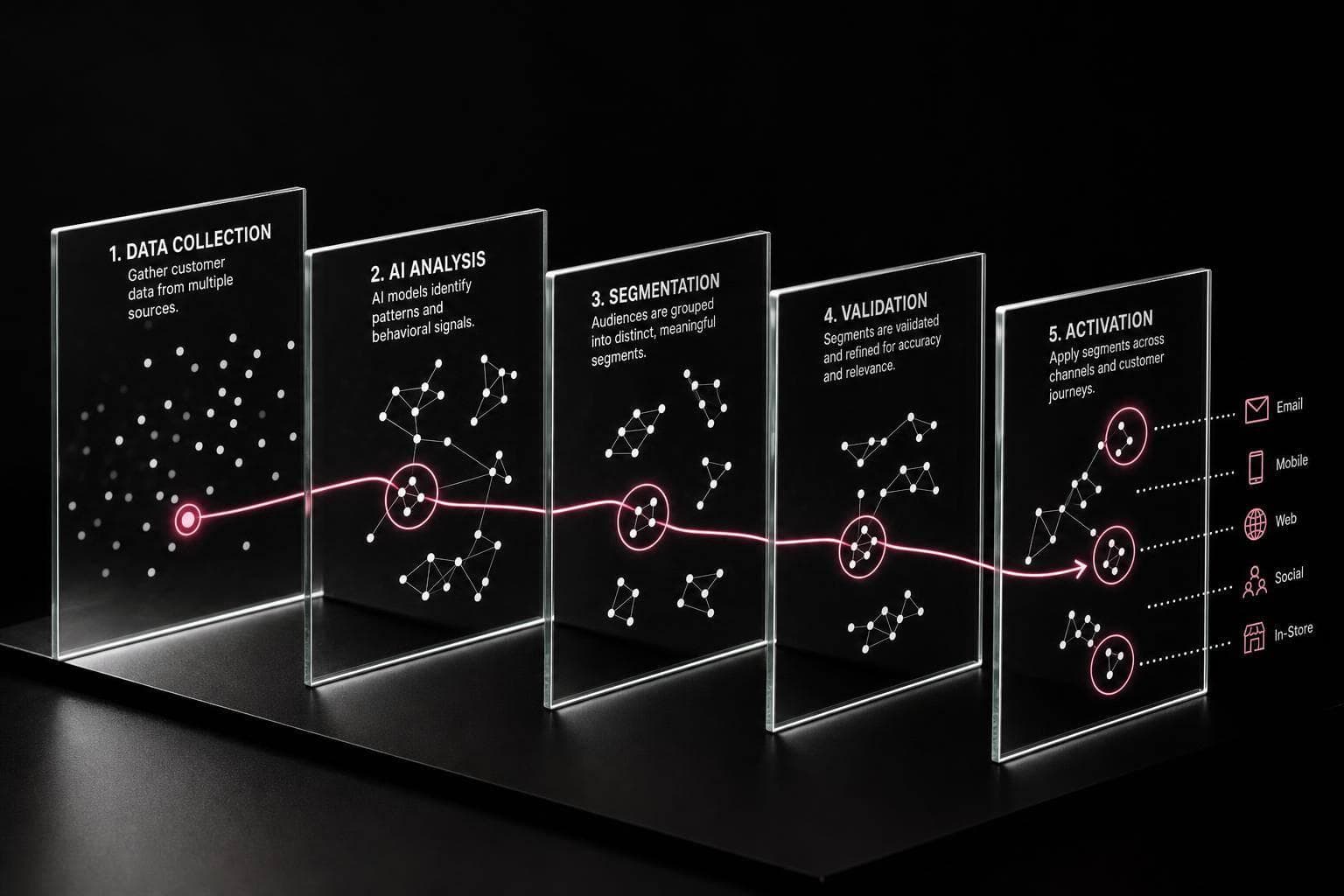
Most audience targeting fails because it stops at demographics. If I want messaging that lands, I need to group people by motives, values, language, and behaviour - not just age, income, or location.
Here’s the short version:
- Start with one goal: brand positioning, message fit, journey personalisation, lower CPA/CAC, or growth
- Set a clear metric: CTR, conversion rate, bounce rate, churn, sentiment shift, leads, or pipeline
- Use both psychographic and behavioural data: surveys, interviews, social posts, CRM, site data, and purchase history
- Clean the data first: remove duplicates, bots, spam, and mismatched labels
- Use AI to group patterns: values, interests, emotional themes, buying habits, and language
- Turn clusters into profiles: what each group cares about, what triggers action, what puts them off, and how they speak
- Test each segment before use: can I spot it, reach it, and brief it differently?
- Apply the segments to copy, visuals, media choices, landing pages, onboarding, and CRM flows
- Review them often: first outputs are rarely enough
A few numbers show why this matters. 63% of digital ad impressions hit the wrong audience. Brands using AI-led psychographic segmentation have seen 22% higher campaign engagement. One case study cited an 820% jump in cart-abandonment recovery after combining attitude data with behaviour tracking.
In other words: if I want audience segments that help me make better brand and marketing decisions, I need a process that links why people think with what they do. That’s what this guide covers.
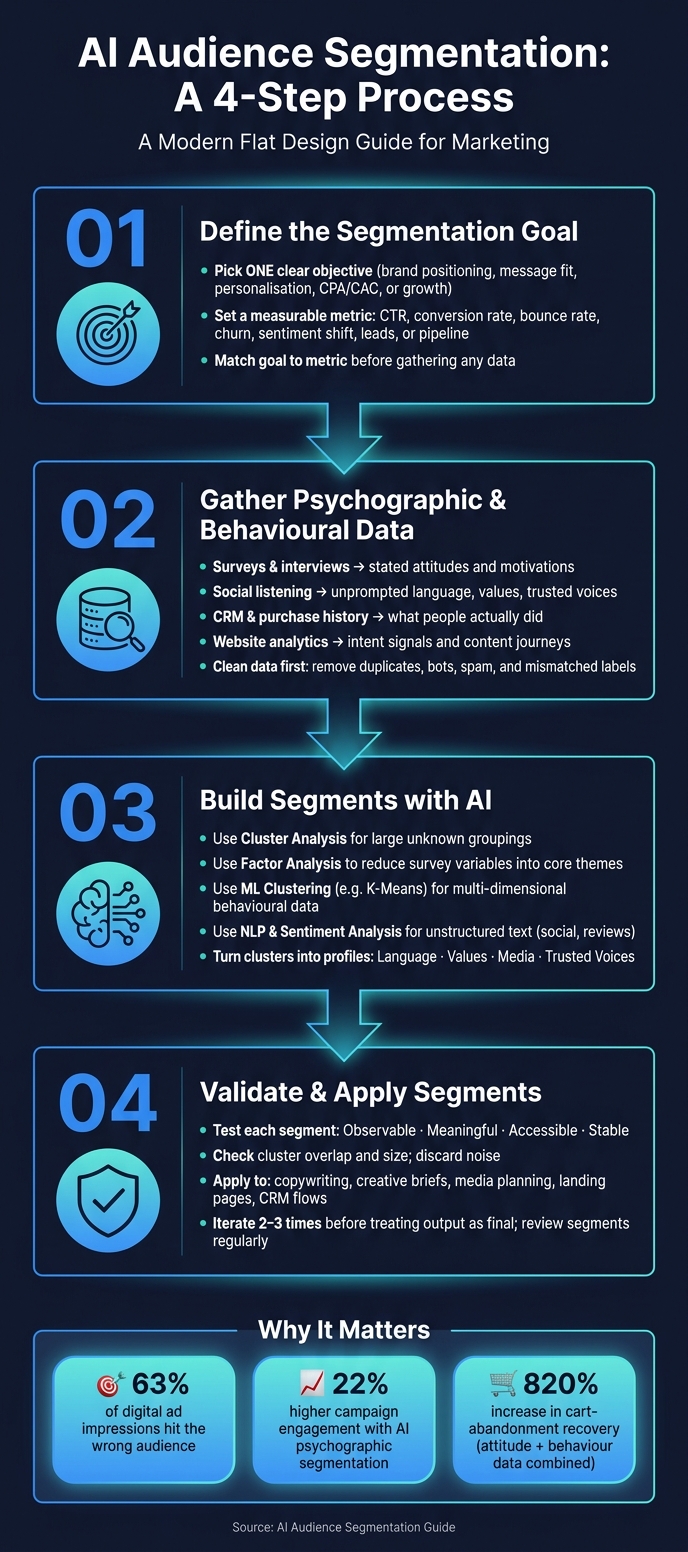
AI Audience Segmentation: 4-Step Process Guide
Step 1: Define the segmentation goal
Before you gather data or bring in an AI model, pick one clear objective. Your segmentation should support a single branding decision, not a loose aim like “understand the audience better”.
Choose the branding decision your segments will support
Choose one branding decision before you gather any data. That choice shapes how deep your segments need to be, what data you need, and how you’ll use the outcome.
The main branding aims are:
- refining brand identity
- improving message fit
- personalising site journeys or onboarding
| Segmentation Goal | Primary Focus |
|---|---|
| Refine brand identity | Cultural values, long-term affinity |
| Improve message-market fit | Creative and copy resonance |
| Personalise experiences | Behavioural triggers, user journeys |
Pick the use case your team needs next: brand positioning, campaign messaging, or journey optimisation.
Once that goal is set, define the metric that will show whether it worked.
Set measurable success criteria
Define success in concrete terms before you gather any data.
Skip vague targets like “improve engagement”. Tie success to a specific outcome you can measure. For message-market fit, that might be click-through rate or conversion rate. For personalising the experience, it could be bounce rate, onboarding completion, or churn. If your aim is to cut acquisition costs, set a target CPA or CAC in £ and compare it against your current benchmark.
| Segmentation Goal | Primary Metric | Branding Outcome |
|---|---|---|
| Refine brand identity | Sentiment shift / brand affinity | Stronger cultural resonance |
| Improve message-market fit | Engagement rate / CTR | Higher creative relevance |
| Personalise experience | Bounce rate / conversion rate | Improved user journey |
| Reduce acquisition costs | CPA / CAC | More efficient media spend |
| Drive growth | Qualified leads / pipeline growth | Higher-intent audience targeting |
Next, gather the psychographic and behavioural data that supports that goal.
sbb-itb-1051aa0
Step 2: Gather psychographic and behavioural data
Once your goal and success metrics are set, the next move is to gather the right data. The key is simple: collect sources that show motivation as well as behaviour. And don’t pull in everything just because you can. Use only the sources that help with the branding choice you set in Step 1.
A good way to handle this is to start with data that shows why people think or feel a certain way, then check it against what they actually did.
Collect signals from surveys, interviews and social listening
Surveys and interviews give you direct access to stated attitudes, lifestyle preferences and motivations. They’re useful when you want people to tell you, in their own words, what matters to them. Structured surveys with Likert scales can also help put numbers on beliefs that are otherwise hard to measure. That said, self-reported answers can be biased, so it’s smart not to treat them as the whole story.
Social listening helps you pick up unprompted language, values, and the sources and influencers people trust. That matters because people often speak more freely in public spaces than they do in a survey. It can also show community membership and context that structured research may miss.
It’s worth looking past public social data too. Support tickets, app reviews, and community forums such as Discord servers often surface anxieties or frustrations that neat survey forms never catch. AI and NLP tools can scan this unstructured feedback at scale and spot recurring emotional themes.
Combine CRM, website and purchase behaviour data
Psychographic signals on their own only tell part of the story. When you pair them with behavioural data - purchase history, content engagement patterns, product usage, page journeys, and conversion paths - you get a much clearer view of both motive and action.
Put another way:
- Surveys and social listening help explain why
- CRM and web analytics show what people did
Bring these sources together into one dataset so each profile links stated intent with actual behaviour.
| Data Source | Type of Insight | Role in Dataset |
|---|---|---|
| Social listening | Unstructured (values, language) | Discovery layer |
| CRM / purchase history | Structured (history, value) | Validation layer |
| Surveys / interviews | Stated (attitudes, motivations) | Depth and context |
| Website analytics | Behavioural (journeys, content) | Intent signalling |
Perfora combined sustainability survey data with behavioural tracking and achieved an 820% increase in cart-abandonment recovery rates.
Prepare your data for analysis
Clean data matters more than having more data. If your inputs are messy, your model can build false clusters instead of useful audience segments. Remove duplicates, bot traffic, syndicated content, and spam before you start clustering.
Then standardise field names across systems, check for missing values, and keep labels consistent. Small naming gaps can cause big problems. If one platform calls contacts “leads” and another calls them “prospects”, your AI may not connect them properly. That’s one reason psychographic models often fail: the segments look interesting on paper, but they aren’t usable in practice.
Joining CRM, web analytics, and AI workflows into one pipeline can be technically demanding. So before moving to analysis, make sure your data is clean, standardised, and brought together in one place.
Step 3: Build psychographic segments with AI
With clean, combined data ready, use AI to spot the psychographic patterns that matter for the branding decision from Step 1. Your Step 1 goal should guide this part. It tells you which signals to look for and what kind of segment will help.
Identify patterns in values, motivations and interests
The model looks across social signals, CRM records, survey responses and behaviour to find recurring mixes of language, values and actions. For example, it might spot a cluster that uses urgency-driven language around sustainability, browses late at night and buys on impulse. That’s a psychographic pattern, not a demographic one.
Brands using AI-powered psychographic segmentation have seen an average 22% increase in campaign engagement compared with demographic-only approaches.
AI can also infer broad personality traits from customer language, which helps predict how a segment may respond to copy.
Choose the right analysis method for your dataset
Pick the method based on your data and branding goal. Here are the most practical options:
| Method | Best For | Required Inputs | Branding Output |
|---|---|---|---|
| Cluster Analysis | Large datasets where groupings are unknown | Behavioural data (clicks, purchases), social signals | Distinct audience communities with shared interests |
| Factor Analysis | Reducing survey variables into core themes | Structured survey data (Likert scales), attitudinal data | Core drivers or values (e.g. "Status" vs. "Durability") |
| ML Clustering (e.g. K-Means) | Multi-dimensional behavioural data | CRM data, web interactions, app usage | Smaller behaviour-led segments for dynamic creative optimisation |
| NLP & Sentiment Analysis | Unstructured text from social media or reviews | Social posts, forum discussions, customer reviews | Emotional triggers, specific vocabulary and the "why" behind actions |
Set business rules before you model anything. Decide what a useful segment must do for your branding goal, not just what the maths can produce. Then refine the clusters until they match your segment criteria.
Once the method is clear, the next job is turning clusters into profiles your team can actually use.
Turn model outputs into clear segment profiles
Translate each cluster into a profile that’s easy to act on. A usable profile covers four layers:
- Language: the phrases that segment uses again and again
- Values: the signals that matter to them
- Media: what they consume more than other groups
- Trusted voices: the creators and sources they rely on
Give each segment a clear name based on its main motivation. Nike’s psychographic segmentation identified motivational types such as achievement-oriented runners and wellness-focused runners, contributing to a 23% year-on-year increase in digital sales.
For each profile, record the segment’s core motivation, likely objections, preferred message style, and content or experience preferences. Before a segment goes anywhere near a campaign, check it against four criteria. It must be Observable (identifiable at scale), Meaningful (behaves differently from others), Accessible (reachable through your channels) and Stable (consistent over time).
Then test each segment for distinctiveness and actionability before using it in messaging or customer journeys. Next, check whether each segment is distinct, reachable and stable.
Step 4: Validate segments and apply them to brand strategy
Check that each segment is distinct and actionable
Before you use any segment, pressure-test it. The goal here is simple: make sure each one is usable in the real world, not just a neat pattern in a spreadsheet.
Validate every segment against four checks: Observable, Meaningful, Accessible and Stable. This ties the profiles from Step 3 to something your team can actually use.
Start with cluster overlap. If clusters heavily overlap, that's usually a sign the data wasn't segmentable on the dimensions you chose. In that case, don't force a cleaner-looking output. Go back and revisit the inputs.
Then look at cluster size. Very large clusters can hide smaller groups inside them. Very small clusters may just be noise.
Only stable segments should move forward.
A quick way to test actionability is to ask:
- What does this segment care about?
- What triggers action?
- What message is most likely to land?
- What puts them off?
If you can't clearly answer those four points - motivation, trigger, preferred message and likely objection - the segment isn't ready.
"If two segments cannot be briefed differently (different messaging angles, different visual treatment, different tone), they are not meaningfully different segments." - Alex Bryson, Head of Content Marketing, Pulsar Group
Apply segments to messaging, creative direction and user journeys
Once a segment passes validation, the next step is to turn it into brand decisions.
The table below shows how the main attributes of a psychographic segment connect to day-to-day brand work:
| Segment Attribute | What It Tells You | Where to Apply It |
|---|---|---|
| Values | Core beliefs, such as sustainability or status | Brand positioning and "why us" messaging |
| Motivations | Psychological triggers, such as urgency or efficiency | Primary messaging angle and tone |
| Language/Lexicon | Specific words, phrases and cultural references | Copywriting and brand voice guidelines |
| Preferred Media | Disproportionately consumed channels and creators | Media planning and influencer partnerships |
| User Journey | Preferred channels and interaction frequency | Website UX and CRM automation paths |
This is where segmentation stops being theory and starts shaping work. Use these mappings to build briefs, journeys and channel rules.
In practice, that means writing a separate brief for each segment. Spell out the tone, proof points and creative direction for that group, instead of tweaking one master brief and hoping it fits everyone.
For digital journeys, segment logic can also shape page structure and CRM flows. New leads enriched with segment data can be automatically assigned to the right segment for tailored engagement. That helps keep the experience aligned across touchpoints.
Conclusion: Keep segmentation iterative and tied to business outcomes
A lot of segmentation projects go wrong for one reason: teams treat the first model output as final.
That's a mistake.
Plan to iterate two or three times before your clusters are both statistically coherent and useful for brand and marketing decisions. Segments also change over time, so it's worth setting a review rhythm that fits your category.
Most of all, tie each refresh back to the business goal you set at the start. Segmentation matters only if it leads to better decisions and better results - whether that's stronger engagement, more conversions or steadier brand consistency.
FAQs
How much data do I need to start?
You don’t need a huge amount of data to get started. But for accurate AI-driven segmentation, you do need at least two distinct data sources:
- one behavioural source, such as CRM or web analytics
- one stated-preference source, such as surveys or brand trackers
Think of it as using both what people do and what they say. If you rely on only one, the picture can be a bit lopsided.
Start with good data hygiene. Remove duplicates, standardise formats, and fill in missing fields. Then put your attention on your highest-value customer segments first.
How often should I refresh my segments?
Move beyond periodic manual refreshes and treat segmentation as a continuous, living system. With AI-powered workflows, segment membership should update in real time as customer behaviour shifts.
Set clear triggers, such as search queries, basket additions, or content engagement, so customers are reassigned automatically. Then review performance every quarter to check the model and spot new behaviour-based clusters.
What tools are best for AI segmentation?
The best approach is to bring data from sources like CRMs, website analytics, and social media into one system. That gives you a single view of what people do, what they care about, and how those patterns shift over time.
For psychographic segmentation, the most useful tools rely on NLP to read unstructured data such as reviews, forum discussions, and social interactions. That matters because people don’t always spell out their preferences in a form field. More often, they reveal them in comments, complaints, and casual conversation.
Antler Digital builds scalable web applications and custom AI integrations to help SMEs automate this work. The goal is simple: move from manual, static lists to dynamic, real-time segmentation.
if (valuable) then share();