Agentic Workflows: Low-Code Tools for SMEs
How SMEs use low-code agentic workflows to automate leads, invoices and support with human oversight and measurable ROI.
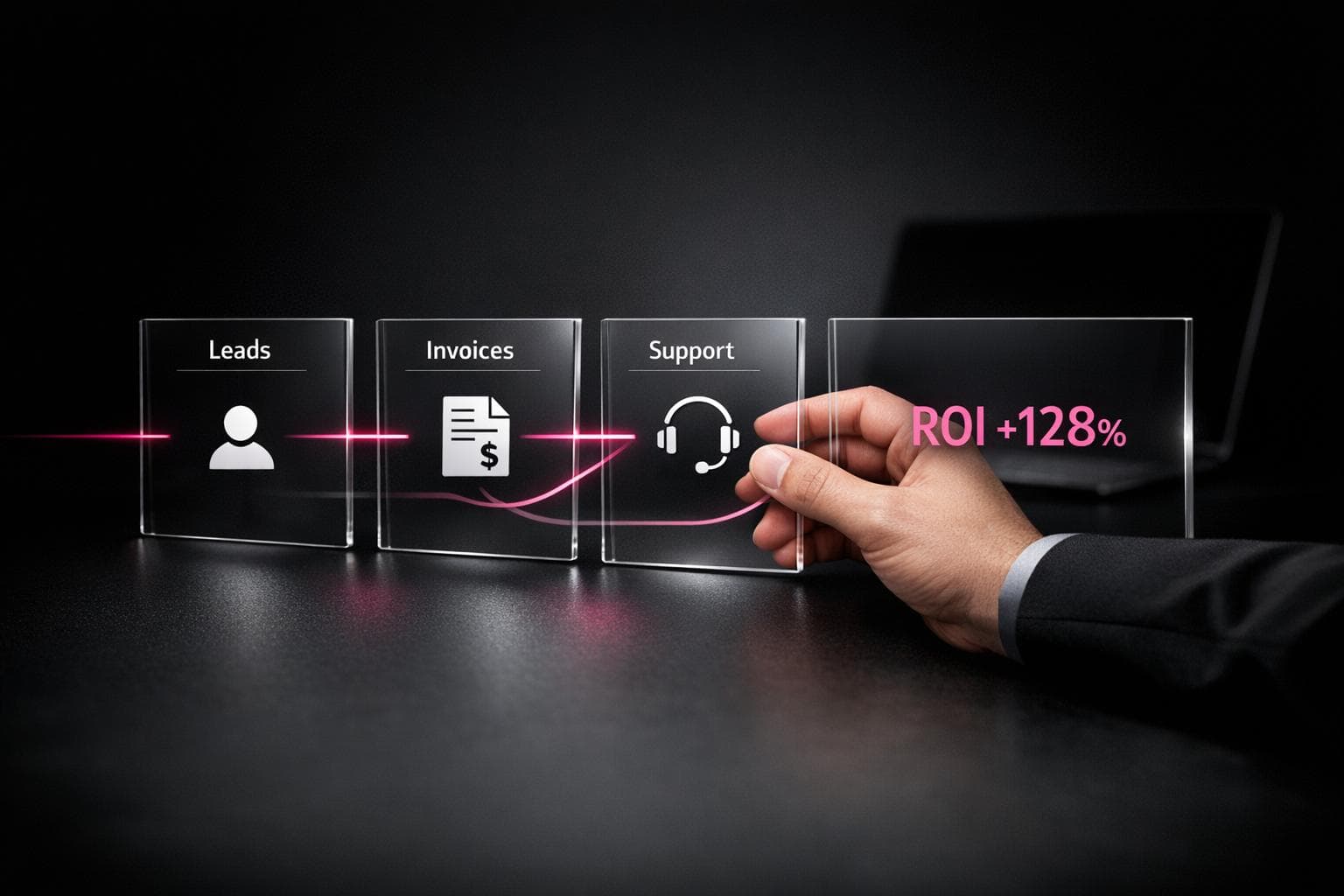
Agentic workflows combine AI reasoning with automation to handle complex, unstructured tasks that traditional systems can't manage. Designed for small and medium-sized enterprises (SMEs), these workflows use low-code platforms to simplify deployment, reduce costs, and improve efficiency. Here's what you need to know:
- Core Components: They rely on a reasoning engine (AI model), a toolbox (APIs for actions), and a state manager (memory for context).
- Low-Code Accessibility: Non-technical users can create workflows using visual tools, saving time and bypassing the need for developers.
- Key Benefits: Faster lead response (under 60 seconds), automated invoice processing, and significant cost savings (up to 90% compared to hiring staff).
- Implementation Challenges: Integration issues and poorly mapped processes can derail projects. Careful planning and human oversight are essential.
- SME Use Cases: From HR onboarding to customer support, agentic workflows reduce manual effort and improve productivity.
These tools empower SMEs to automate critical processes affordably, delivering measurable results within weeks. By focusing on small, manageable tasks and integrating human review, businesses can confidently adopt AI-driven workflows without overwhelming their teams.
Core Components of Low-Code Agentic Workflows
For SMEs, these components are critical to creating scalable and efficient agentic workflows.
Reasoning Engines and Automation Orchestration
At the centre of any agentic workflow is a reasoning engine - an AI model like Claude Opus 4.7. This engine acts as the decision-making hub, handling tasks that can't be hardcoded, such as classification, anomaly detection, and contextual routing. Unlike systems with unpredictable loops, the reasoning engine operates within a fixed framework managed by an orchestrator.
The orchestrator acts as the control layer, directing the sequence of tasks and involving the AI only when judgement is necessary. This hybrid model offers quicker deployment and reduced costs compared to fully autonomous systems, while avoiding the delays and unpredictable failures often associated with them.
Modern orchestrators use strategies like dividing tasks into specialised sub-agents or running parallel agents to speed up processing. In 2025, Anthropic introduced the Claude Agent SDK to support these design patterns natively. For workflows that run over extended periods, incorporating checkpoints at each step allows the system to recover from failures without having to start from scratch.
Next, let’s look at how user-friendly interfaces make these workflows accessible to non-technical users.
User Interfaces for Workflow Interaction
Low-code platforms offer visual, node-based builders and natural language commands, making it easier for non-technical users to configure triggers, logic, and integrations.
The effectiveness of these interfaces is evident in real-world use cases. In January 2026, Anthropic introduced Claude Cowork as a research preview. This tool enabled users in fields like marketing and finance to direct an agent to autonomously read, edit, and organise files across integrated tools such as Slack and Figma. Similarly, Claude Code, designed for developers, achieved a £1 billion run-rate revenue within six months of its launch by automating the "plan-read-edit-run" process through an intuitive terminal-based interface.
Building on these advancements, the Model Context Protocol has transformed enterprise integration.
Enterprise Integration with Model Context Protocol (MCP)
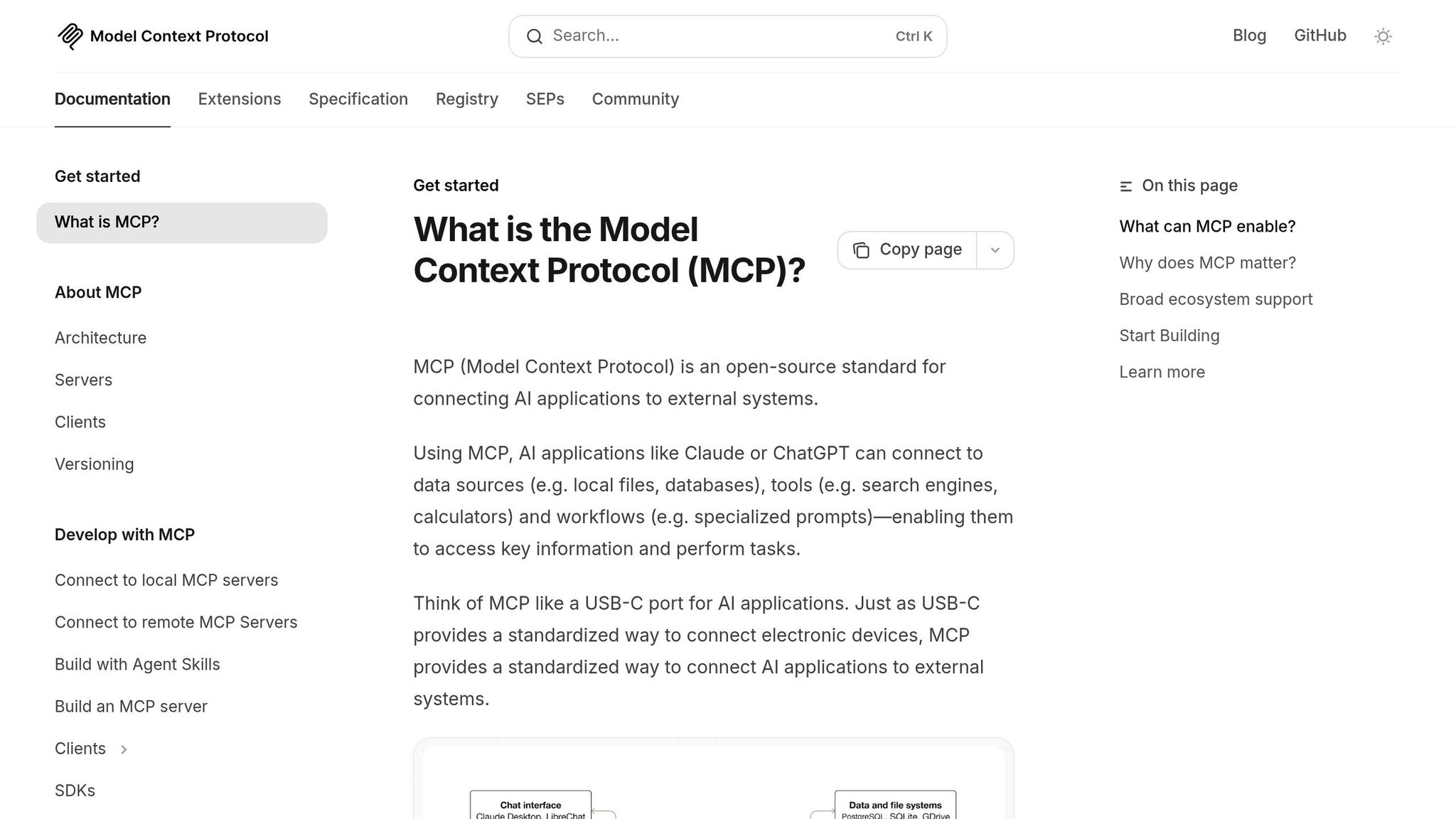
Introduced by Anthropic in November 2024, the Model Context Protocol (MCP) has set the standard for linking AI models with external tools and enterprise systems. Often referred to as the "USB-C of AI applications", MCP functions as a universal adapter, eliminating the need for custom-coded integrations.
MCP simplifies integration by converting what was once an M × N problem - where every model required custom integration with every tool - into an M + N model. This means a tool only needs to be implemented once as an MCP server to become instantly compatible with all MCP-compliant clients. As the Claude Lab team explains:
"Implement a tool once as an MCP server, and it works with Claude - or any other MCP-compatible client - right away".
sbb-itb-1051aa0
How to Design Agentic Workflows for SMEs
An agentic workflow combines structured processes with AI reasoning at specific decision points, like classification or review. Unlike fully autonomous AI agents, these workflows rely on human oversight for critical tasks. Stefan Finch, Founder of Graph Digital, highlights a crucial aspect:
"The pre‐build diagnostic - not the build itself - is where the commercial risk lives".
Before committing to building a workflow, assess whether a new employee could follow the process using a checklist, relying on AI for specific tasks only. If the answer is yes, the process is a good candidate for an agentic workflow. This step is essential for mapping business processes accurately before automation begins.
Mapping Business Processes for Automation
Low-code platforms can help SMEs quickly pinpoint and automate key processes. Start by focusing on tasks that require significant manual effort but carry low risks. These are typically processes that take over five hours weekly, involve multiple applications, and tolerate occasional non-critical errors. Examples include invoice reconciliation, lead enrichment, and support ticket triage.
To evaluate potential workflows, use a suitability score. Rate each process from one to five across three areas: Data Accessibility (availability of APIs), Process Consistency (level of standardisation), and Impact of Failure (risk level). A total score of 12 or higher suggests the process is a strong candidate for automation.
Once you’ve identified a suitable workflow, apply the Brain-Toolbox-State Manager framework to integrate it with tools like Xero or HubSpot. Juliet Edjere, a No-code Professional, underscores the importance of preparation:
"Documentation is now code for AI agents. If your internal documentation is garbage, your AI agent will be garbage".
Centralise your Standard Operating Procedures (SOPs) into searchable vector databases before attempting automation. A typical agentic workflow involves four steps:
- Centralise: Collect all relevant documents (PDFs, Notion, Docs) into a vector database.
- Intake: Use an LLM to categorise unstructured data by priority and intent.
- Gate: Queue drafted responses for human review.
- Execute: Allow the agent to close tickets and update CRM or ERP systems.
Human oversight should be integrated into critical decision points to minimise risks.
Adding Human-in-the-Loop Models
For SMEs, a semi-autonomous model works best. In this setup, AI agents handle routine tasks (about 80%), while humans approve high-stakes or sensitive decisions. Start with 'shadow mode,' where agents suggest actions for human review. This allows you to refine the workflow based on real-world feedback.
Set clear automation thresholds. For example, process invoices under £500 automatically, but require manual review for larger amounts. To avoid bottlenecks, establish Service Level Agreements (SLAs) for human tasks. If no action is taken within 24 hours, the system can reroute the task or trigger an escalation.
Grant full autonomy only after the agent achieves a consistent approval rate of over 95% for at least two weeks. By 2025, 73% of small and medium businesses using AI agents reported noticeable productivity improvements within 90 days.
Building for Scalability and Governance
Document key aspects like allowed agent actions, data residency, and human review processes on a single page. The Ai Consultancy offers this simple guideline:
"The agent drafts, the human sends. That rule can be loosened as confidence accumulates, not before".
Low-code platforms can simplify scalability by enabling modular architecture. Instead of creating monolithic systems, plug agents into existing data structures using SQL or JSON schemas. Before scaling, audit your setup for clean APIs and proper documentation. Agents relying on undocumented practices or brittle screen-scraping methods often fail in production.
Introduce circuit breakers to maintain control over costs and performance. For example, set per-run budgets and token caps to keep expenses predictable as the system scales. Use 'golden sets' of 30 to 100 real-world test cases to ensure new versions meet quality standards before deployment. According to Gartner, over 40% of agentic AI projects may be abandoned before production by 2027 due to governance and cost issues.
Antler Digital's Low-Code Agentic Solutions
Antler Digital focuses on creating low-code, agentic workflow solutions tailored specifically for SMEs, aligning with their budgets and technical needs.
Custom Workflow Solutions for SMEs
Rather than relying on generic, off-the-shelf products, Antler Digital develops customised workflows that cater to the unique requirements of SMEs. These solutions are delivered through various approaches, including project-based development, in-house team support, or full-service technical management. Jeremy Taylor, CTO of Wiserfunding, shared his experience:
"The team at Antler Digital was able to take our complex ideas and turn them into a functional and user-friendly SaaS app. They brilliantly handle the frontend of our fintech both with design and development".
Their integration process follows a structured 90-day roadmap divided into four phases:
- Audit & Select (Weeks 1–2)
- Pilot (Weeks 3–4)
- Expand & Refine (Weeks 5–8)
- Production & Scale (Weeks 9–12).
Antler Digital often recommends Level 3 semi-autonomous agents to handle routine tasks efficiently. This phased approach minimises risks and delivers noticeable efficiency improvements within the first quarter.
These tailored solutions have been successfully implemented across a wide range of industries.
Industries and Expertise
Antler Digital's expertise extends to sectors such as FinTech, Crypto, SaaS, and environmental platforms. Their track record includes notable projects like:
- Wiserfunding: Since 2023, Antler Digital has managed the frontend of their risk management platform. This collaboration, led by CEO Gabriele Sabato and CTO Jeremy Taylor, resulted in a SaaS app that advanced Wiserfunding's fintech capabilities.
- SportsIcon: They developed a Sports NFT platform on the Flow blockchain, overcoming blockchain-specific challenges to create a scalable web application. COO Alexi Yovanoff and CTO Riku Sarkinen praised their ability to deliver under complex conditions.
-
DeZaan: Between 2024 and 2026, Antler Digital upgraded their core website using a Jamstack approach. General Manager Nick Morss highlighted their success:
"upgraded and improved our core website as well as built out entire new sections of the site with the state of the art Jamstack approach".
Their technical stack - featuring tools like Next.js, React, and TypeScript - ensures that new agents integrate seamlessly with existing systems, prioritising speed, reliability, and security. They also excel in adapting legacy systems, whether by taking over ongoing projects or rebuilding outdated platforms to enhance functionality without disrupting operations.
Pricing and Service Plans
Antler Digital’s pricing strategy is designed with SME budgets in mind, focusing on affordability and value.
They offer custom quotes based on the scope of the project and the engagement model. While rates vary, typical SME AI stacks in 2026 range from £150 to £380 per month, often replacing the need for two or three traditional hires.
For SMEs with existing tech teams, Antler Digital provides team augmentation to address specific gaps. For businesses without in-house expertise, full-service technical management is recommended. Initial integrations often focus on high-impact workflows like lead follow-up, invoice processing, or support triage, delivering quick and measurable returns.
Benefits of Agentic Workflows for SMEs
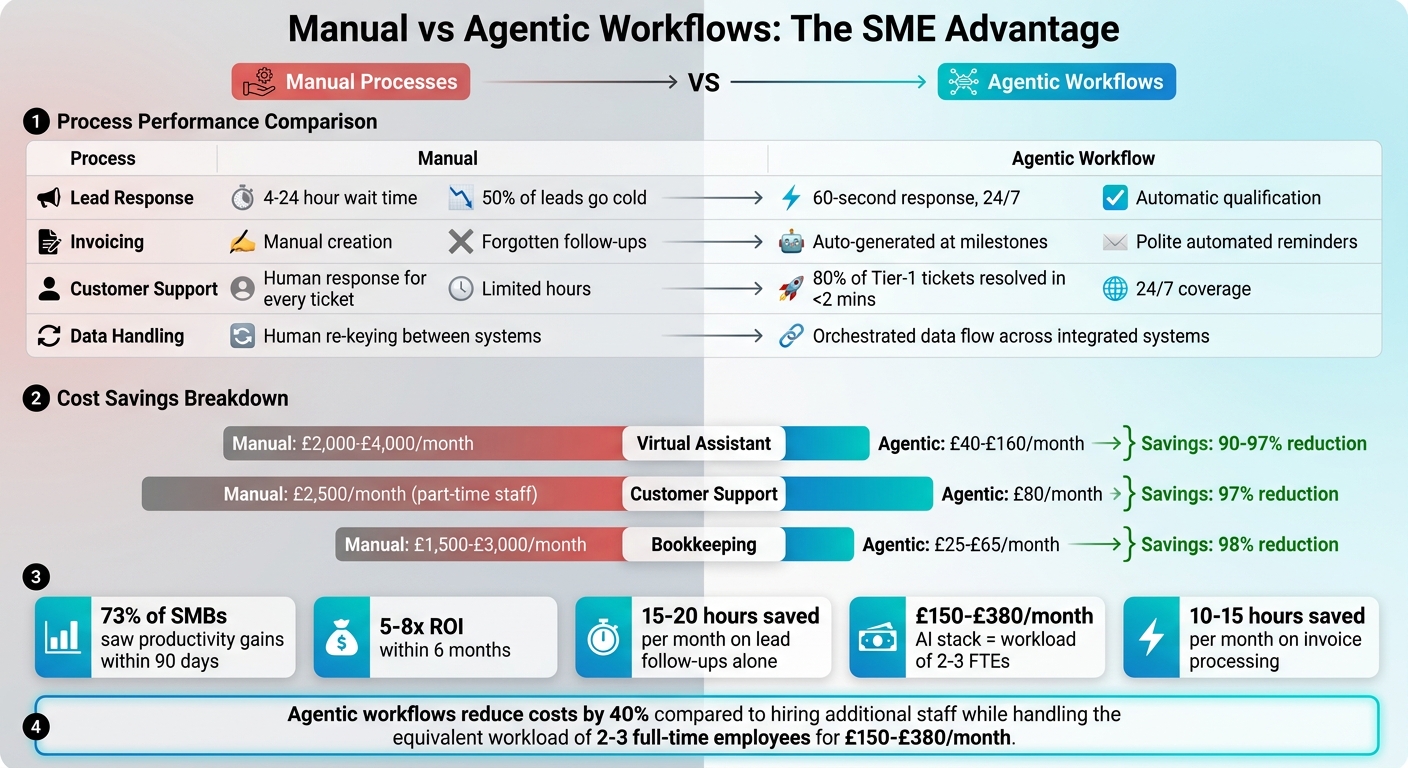
Manual vs Agentic Workflows: Cost and Efficiency Comparison for SMEs
Improved Efficiency in HR and Finance
Agentic workflows streamline HR and finance operations by eliminating time-consuming manual tasks. In HR, these workflows break down complex processes, such as onboarding, into smaller, manageable tasks like setting up IT credentials, payroll, and ordering equipment. Tasks are sequenced based on dependencies while monitoring for potential delays, removing the need for HR teams to chase other departments or track missing paperwork.
In finance, agentic workflows manage the entire accounts receivable process. They generate invoices automatically at key project milestones, send reminders at intervals (e.g., 7, 14, and 30 days), and reconcile payments in real-time. This approach saves SMEs 10–15 hours per month on invoice processing alone. Unlike traditional automation, which relies on rigid "if-then" rules, agentic workflows use reasoning to handle exceptions, reducing the need for employees to manually bridge gaps between disconnected systems. These improvements go beyond just saving time - they contribute to measurable financial benefits.
Productivity and Cost Savings Metrics
SMEs implementing agentic workflows report a 5–8x return on investment (ROI) within six months, with AI agents reducing costs by 40% compared to hiring additional staff. For example, an AI stack costing £150–£380 per month can manage the workload equivalent to 2–3 full-time employees.
In terms of productivity, 73% of SMBs experienced noticeable gains within 90 days. Customer support benefited significantly, with 80% of tier-1 tickets resolved in under two minutes. Automating lead follow-ups alone saves an estimated 15–20 hours per month. As one industry expert explained:
"It's not about replacing your team. It's about amplifying what your existing people can do... Your sales rep doesn't need to spend two hours a day on follow-up emails when an AI agent handles that automatically".
These advancements are particularly important for SMEs grappling with integration challenges, as previously discussed. The table below highlights the stark differences between traditional manual processes and agentic workflows.
Manual vs Agentic Workflows Comparison
The contrast between manual and agentic workflows is striking:
| Process | Manual | Agentic Workflow |
|---|---|---|
| Lead Response | 4–24 hour wait time; 50% of leads go cold | 60-second response, 24/7; automatic qualification |
| Invoicing | Manual creation; forgotten follow-ups | Auto-generated at milestones; polite automated reminders |
| Customer Support | Human response for every ticket; limited hours | 80% of Tier-1 tickets resolved in <2 mins; 24/7 coverage |
| Data Handling | "Human middleware" re-keying data between systems | Orchestrated data flow across integrated systems |
The cost savings are equally compelling. For instance, a virtual assistant role costing £2,000–£4,000 per month can be replaced by an AI agent for just £40–£160 per month, representing a 90–97% reduction. Similarly, customer support functions costing £2,500 monthly for part-time staff can be handled by agents for approximately £80 per month, while bookkeeping expenses drop from £1,500–£3,000 to just £25–£65 monthly.
Next Steps for SMEs
Key Takeaways
Agentic workflows are reshaping how SMEs operate by automating tasks that manual systems struggle to manage. By 2025, 73% of SMEs using AI agents reported noticeable productivity improvements within just 90 days. With implementation costs ranging from £150 to £380 per month, these systems can handle workloads equivalent to 2–3 full-time employees.
The journey to success starts with process mapping, not picking tools. Stefan Finch, Founder of Graph Digital, highlights this crucial step:
"Processes that feel too complex for a workflow are almost never actually too complex. They are incompletely mapped".
Focus on mapping out high-impact processes first - think lead follow-ups, invoice handling, or HR onboarding. Conduct a 90-day pilot to shift from manual methods to automated decision-making, cutting response times from hours to under 60 seconds.
Planning is key. Maintain human oversight for critical decisions, document agent workflows as meticulously as you would code, and avoid automating processes that are already flawed. Gartner predicts over 40% of agentic AI projects could be abandoned by 2027 due to cost and governance challenges, underscoring the need for careful management.
Getting Started with Antler Digital
With these insights in mind, SMEs can take confident steps forward.
Antler Digital specialises in creating agentic workflows tailored to the specific needs of SMEs. Their process starts with a detailed diagnostic to map out current workflows, identify decision points, and determine the best solutions. Completing this diagnostic phase before implementation helps avoid unnecessary risks and unexpected costs.
Antler Digital’s smart assistants can save up to 168 admin hours weekly while keeping human oversight intact - all for a fixed monthly fee. Every solution includes compliance checks and sovereignty audits to ensure data stays within the UK, aligning with GDPR and local labour laws. Whether you need help with project-based implementation, in-house team integration, or full-service technical management, Antler Digital can turn administrative challenges into an advantage. Visit antler.digital to see how agentic workflows can elevate your team’s output.
FAQs
What’s the difference between an agentic workflow and a fully autonomous AI agent?
An agentic workflow incorporates AI into certain decision points within a clearly defined and predictable process. This might include tasks like classification or spotting anomalies. On the other hand, a fully autonomous AI agent functions independently, tackling unstructured tasks by adapting and making decisions without set steps or human guidance.
The main distinction: agentic workflows prioritise control and consistency, whereas autonomous agents are designed to manage complex and unpredictable situations with little to no human involvement.
How do I choose the first SME process to automate with a low-code agent?
To get started, focus on tasks that are repetitive, frequent, and consume significant time - things like invoicing or customer support. These are often the quickest wins when it comes to automation. Choose processes that match your business goals and can deliver clear benefits, such as cutting down on time spent or reducing mistakes. Start small with a simple task to build confidence and refine the approach, then expand and optimise your workflows for greater impact.
How can we ensure data security and GDPR compliance when agents use our tools?
To protect sensitive information and comply with UK regulations like the GDPR and the upcoming Data (Use and Access) Act 2025, businesses need to prioritise strong data protection practices.
Here’s how SMEs can safeguard their workflows:
- Integrate privacy controls into workflows: Build processes with data protection in mind from the start, ensuring compliance is part of everyday operations.
- Encrypt and limit access to data: Use encryption to secure data and implement strict access controls so only authorised personnel can view or handle sensitive information.
- Regularly update processes: Stay ahead of vulnerabilities by reviewing and improving security measures to address emerging risks.
By implementing these steps, businesses can create secure workflows that align with UK data protection laws and maintain trust with their customers.
if (valuable) then share();