How Agentic Systems Improve Error Recovery Over RPA
When to use RPA or agentic systems for safer, auditable error recovery across diagnosis, retries, state, validation and escalation.

I’d use RPA for fixed recovery steps and agentic systems when choosing the next safe step needs context. If a £1,250 invoice submission times out, check whether it reached the ledger before retrying. No response does not mean nothing happened.
I compare both approaches across five areas: diagnosis, recovery choices, state, validation and escalation. Agents can assess unfamiliar failures and revise a plan, but <u>they must not bypass controls</u>. Both approaches need duplicate checks, retry limits, logs and approval for high-risk actions.
Quick Comparison
| Recovery area | RPA | Agentic systems |
|---|---|---|
| Diagnosis | Matches failures to preset rules | Assesses logs, records and context |
| Recovery choices | Follows configured branches | Selects or revises an approved plan |
| State | Resumes from checked checkpoints | Uses stored business state, not memory alone |
| Validation | Applies defined checks | Can request extra checks within policy |
| Escalation | Routes failures to set queues | Summarises uncertainty and proposes a next step |
My starting point: keep repeatable actions rule-based, use agents where judgement helps, and test both against the same failures. Measure successful recoveries, time, duplicate actions, human review and total cost - not just whether a retry ran.
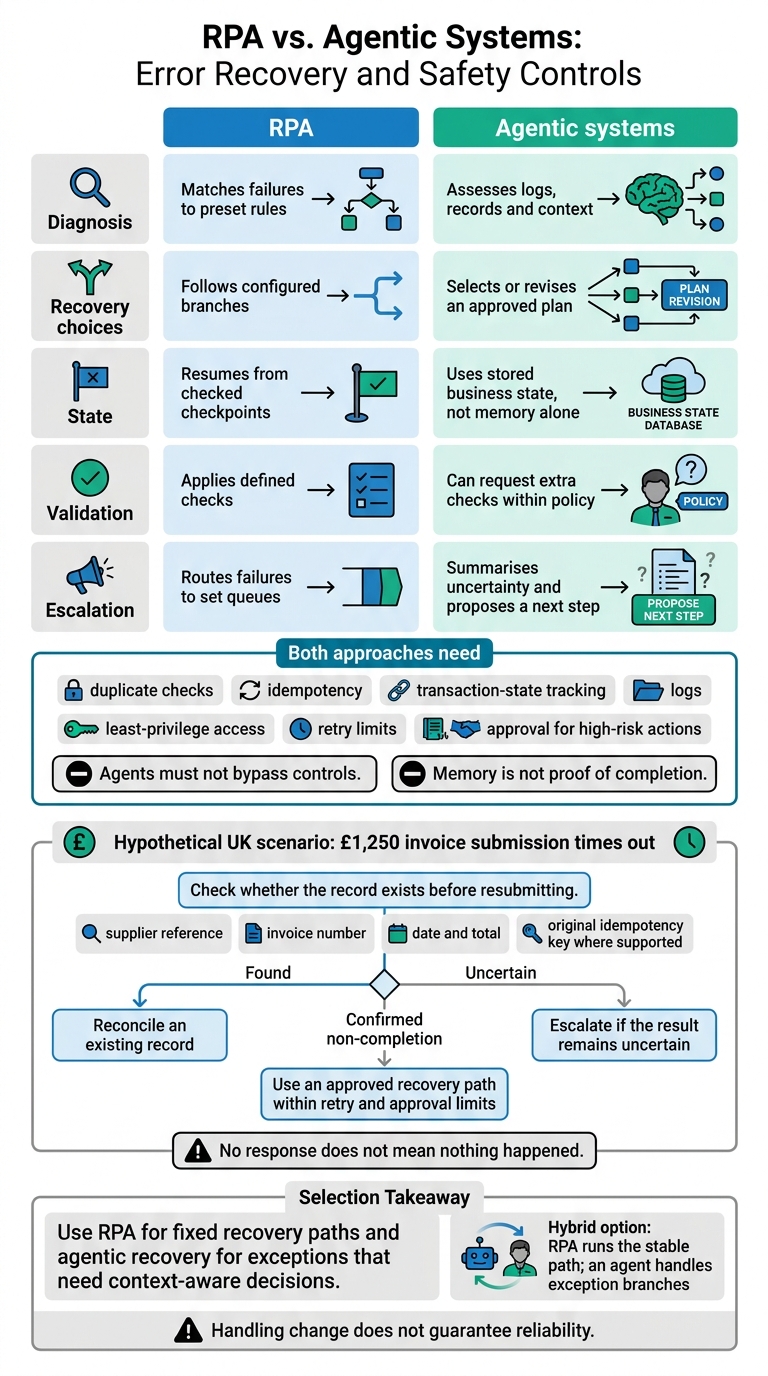
RPA vs Agentic Systems: Safe Error Recovery
1. RPA
Failure diagnosis
RPA detects failures through predefined signals: failed selectors, timeouts, invalid input formats or validation checks returning false. It then classifies each event using predefined rules. Record the case ID, activity, timestamp, application, exception, retry count, input reference and last successful step.
Recovery decisions
After classifying the failure, the workflow can choose only from approved recovery branches: retry, delay, reopen the application, run a recovery step, skip the record or stop.
Use specific handlers for known failures, rather than a broad rule to ignore errors and continue. Skip a record only if the action is non-critical and later checks confirm that the process remains valid.
State and validation
After recovery, RPA must re-check the business state before moving on. Save checkpoints at confirmed business milestones, including the source item ID, status, external reference and completion time.
On restart, compare the checkpoint with the application’s current state. Then check the recovered result against explicit criteria:
A matching record count, a balanced monetary amount or an approved amount.
A finished command does not prove success.
Escalation and auditability
If recovery cannot confirm a valid outcome, the workflow must escalate. Send rule failures, exhausted retries and uncertain outcomes to the support team when predefined recovery rules offer no further action.
Keep incident reporting separate from execution control: logging an error does not stop the workflow. Record the workflow version, error category, recovery action, result and escalation path. Test each branch before deployment.
sbb-itb-1051aa0
2. Agentic Systems
Failure diagnosis
RPA matches failures to known exceptions. An agent can instead weigh several signals - the failed step, error text, input data, current state and recent history - to infer the likely cause. Limit diagnosis to approved data sources and logged evidence, because external content can carry prompt-injection risk.
Recovery decisions
An agent can change its plan as new evidence arrives. But every recovery path needs success criteria, retry caps, time limits, cost caps and stop conditions. Independently check each proposed action’s tool, arguments, target resource and permissions. Pause high-impact actions for approval when risk exceeds the threshold.
State and validation
Keep business state separate from the agent’s working context. Memory is not proof of completion. Before execution, validate identity, tool, arguments, target resource, rules and expected side effects.
After execution, check the response schema, changed fields, transaction status and whether the intended state was reached. A valid response can still be wrong, so rely on business invariants and idempotency controls - not just the agent’s interpretation.
Escalation and auditability
Pause when evidence conflicts, retries run out, permissions are missing or the next action is irreversible. Escalate with the unresolved question, supporting evidence and fixes already attempted, especially when the failure is ambiguous and the next safe step is unclear.
Don’t just record the failed step. Link plan revisions, permission decisions, tool calls and approvals with one correlation ID. Store tamper-resistant logs outside the agent’s control, without credentials or sensitive values.
Comparing Recovery in Practice
The difference is easier to see when the same invoice fails in several ways.
Hypothetical UK scenario: a supplier submits a £1,250 invoice. Compare three failure conditions: an ambiguous submission response, invalid VAT data or total mismatches, and a temporarily unavailable accounting service.
Diagnosing Failures
A timeout leaves you unsure whether the submission went through. Even a successful API response can post the invoice to the wrong supplier. Deterministic supplier-reference checks can catch that second error. Check any agent diagnosis against supplier master data and the ledger.
| Recovery dimension | RPA | Agentic system | Practical implication |
|---|---|---|---|
| Root-cause assessment | Uses predefined exception mappings | Suggests the likely failure type from submission history | Check diagnoses against supplier references, VAT data, totals and ledger entries |
| Unexpected conditions | Stops or routes to an exception queue | Can suggest an authorised recovery path or ask for clarification | Require escalation when evidence is incomplete or the consequences are material |
When the outcome is unclear, the next choice is whether to retry, wait or save a draft.
Retries, Fallbacks and Revised Plans
When the service is unavailable, retrying and saving a validated draft are different recovery choices. RPA follows configured branches. An agent can choose from authorised options based on service status and invoice priority. Both use bounded retries - not unlimited attempts.
| Recovery dimension | RPA | Agentic system | Practical implication |
|---|---|---|---|
| Retry strategy | Uses configured attempt counts and delays | Selects an authorised retry policy based on invoice context | Keep maximum attempts and time limits non-negotiable |
| Circuit breaker | Stops calls until the service recovers | Stops calls until the service recovers | Leave the invoice pending during the outage |
| Fallback and degradation | Saves a draft or queues the invoice if configured | Chooses an approved fallback based on invoice context | Continue VAT and total validation while submission remains blocked |
| Failure reporting | Produces standard error codes and queue records | Produces an evidence summary and proposed next action | Make reports reviewable without exposing private model reasoning |
A timed-out submission needs confirmation before any repeat action.
Saving State and Preventing Duplicates
If the £1,250 submission times out, check whether the record exists before resubmitting. Use the supplier reference, invoice number, date and total, plus the original idempotency key where supported. Reconcile an existing record; escalate if the result remains uncertain. A draft correction is reversible, but a posted change or possible duplicate payment needs human review.
| Recovery dimension | RPA | Agentic system | Practical implication |
|---|---|---|---|
| State and resumption | Stores checkpoints and resumes from validated state | Stores checkpoints and resumes from validated state | Confirm the invoice’s ledger status before resuming; agent memory is not a transactional record |
| Intermediate validation | Checks fields at configured stages | Can request extra checks within policy | Revalidate changed VAT data and totals before proceeding |
| Duplicate prevention | Uses reference checks or idempotency logic when implemented | Combines those controls with contextual reconciliation | Check whether the record exists before retrying a timed-out submission |
| Partial completion | Uses approved compensation steps for partial completion | Uses approved compensation steps for partial completion | Separate draft corrections from posted changes or possible duplicate payments |
If an action could post, pay or alter records, recovery also becomes an approval issue.
Escalation, Approvals and Audit Logs
For this invoice, the exception package should retain completed steps, identifiers, evidence, unresolved questions and proposed actions. Require human approval for high-impact or irreversible actions. Use least-privilege tools and enforce time, cost and retry limits. Protect logs with access controls, redaction and retention rules.
| Recovery dimension | RPA | Agentic system | Practical implication |
|---|---|---|---|
| Escalation triggers | Routes configured invoice exceptions to named queues | Can identify combinations of uncertainty, risk and policy limits | Escalate uncertain ledger status or possible duplicate payment |
| Approval handover | Sends a standard task with predefined fields | Builds an exception package with evidence, unresolved questions and a proposed action | Include supplier reference, invoice number, VAT data, total and ledger status |
| Audit trail | Records submission steps, statuses and accounting responses | Also records tool selection and decision summaries | Link the invoice’s submission attempts to the approval outcome |
| Safe replay | Re-runs a controlled process or test case | Replays the invoice payload and identifiers in a sandbox without side effects | Prevent replay from posting or paying a real invoice |
Recovery Strengths and Limits
Handling change does not guarantee reliability. RPA is easier to verify when recovery paths are fixed. Agents can handle unfamiliar failures, but both their diagnosis and actions need testing.
Each approach has costs across diagnosis, recovery choices, state, validation and escalation as processes change.
| Approach | Recovery strengths | Recovery limitations | Operational trade-offs |
|---|---|---|---|
| RPA | Predictable handling of known exceptions, with testable, auditable branches. | Changes to screens, data formats and business rules can break recovery paths. | Less variation in behaviour, but more maintenance as applications change and branches multiply. |
| Agentic systems | Context-aware diagnosis across records and tools; flexible recovery when predefined branches fail. | Misinterpretations, unsuitable tool choices and inconsistent behaviour can cause new failures. | Variable latency, model and tool costs, plus broader testing and monitoring needs. |
Measure cost and latency per completed recovery, not per model call. Count retries, tool use and human review. Track p50 and p95 latency alongside recovery success and human-correction rates.
Run each agent test case five to ten times. Record consistency rather than picking the best result. Test missing context, conflicting records, misleading instructions and unavailable tools. Assess the tool actions, not just the final response.
Turn incidents into regression tests. Record the trigger, contributing conditions, recovery decision and business impact. Update the relevant branch, prompt, policy or tool configuration in a versioned release, then re-test related cases. For agents, assess diagnosis and execution separately. For RPA, check that the revised branch has not introduced duplicate processing.
Conclusion: Choosing a Recovery Approach
Choose based on risk, process stability and how much exceptions vary - not novelty. Agentic systems help when similar failures call for different responses, but they must stay within fixed authority and policy limits.
Compare the options across five areas: process stability, exception variability, action risk, approval requirements and audit needs.
| Workflow characteristic | Deterministic RPA | Agentic recovery | Hybrid design |
|---|---|---|---|
| Process stability | Best for stable, rule-based workflows with predictable screens, fields and outcomes | Better suited to changing workflows or inputs where diagnosis requires interpretation | RPA runs the stable path; an agent handles exception branches |
| Exception variability | Works well when failure categories and responses can be listed in advance | Better suited to causes that vary by context and require evidence-based replanning | An agent classifies exceptions; RPA runs approved, repeatable remedies |
| Risk level | Suits low-risk, reversible actions with strict validation | Suitable only within explicit authority, tool and policy limits | Keeps high-risk execution deterministic and uses agent reasoning selectively |
| Approval requirements | Uses predefined approvals and exception queues | Uses risk-tiered approval based on evidence and the proposed action | Requires human approval when an agent proposes a non-standard action or one with serious consequences |
| Audit needs | Records rules, inputs, retries and outcomes | Records evidence, tool calls, decisions, approvals and outcomes - not opaque summaries | Keeps workflow logs and agent decision records linked through shared transaction IDs |
Use RPA for fixed recovery paths and agentic recovery for exceptions that need context-aware decisions.
Both approaches need duplicate checks, idempotency, transaction-state tracking, least-privilege access and safe escalation. Financial or legal actions still require approval.
Pilot representative failures against the RPA baseline, including timeouts, expired sessions, malformed data, partial writes and duplicate events. Measure recovery success, recovery time, human intervention, duplicate actions and cost per recovered case. Include staff and monitoring costs.
FAQs
How can I add agentic recovery to existing RPA workflows?
Keep your existing automation, and add agentic error detection and stateful recovery around each step. Use structured logging, health checks and real-time tracing to find root causes. Handle failures with retries, exponential backoff and circuit breakers. Add checkpoints with rollback or compensating actions so the process can resume from the last valid point.
Apply data correction and validation before and after each step’s inputs and outputs. Route high-stakes failures to people for approval, using runbooks to guide the response.
Which recovery tasks should I automate first?
Focus on routine, easily reversible workflows where automation can deliver the biggest efficiency gains. Data pipeline validation, resource rebalancing and service retries are good places to start.
Choose one critical workflow this week, and add behaviour tracing and automated regression tests. As you scale, automate fixes for common issues. Keep people in control of high-stakes decisions involving financial transactions, compliance or customer trust, where nuanced judgement matters.
How do I know agentic recovery is worth the cost?
Track recoverability: use structured logging and telemetry to spot issues early. Automate local recovery to minimise downtime and manual work, and pass high-stakes errors to people.
Set Recovery Time Objectives (RTOs) based on how critical each service is. Monitor incident impact to assess the value of recovery efforts: downtime can cost small businesses up to £6,400 an hour. Use feedback loops to make future incidents less frequent and shorten recovery times.
if (valuable) then share();