Agentic AI in Predictive Workflow Optimisation
Agentic AI that plans, acts and learns to optimise workflows, cut downtime, reduce costs and boost operational efficiency across industries.

Agentic AI is reshaping how workflows are managed by combining decision-making with action-taking capabilities. Unlike systems that only predict outcomes, agentic AI can autonomously plan, execute, and adjust tasks, making it ideal for streamlining complex processes. When paired with predictive workflow optimisation, it addresses inefficiencies caused by unexpected deviations and reduces manual intervention.
Key Takeaways:
- Agentic AI: Handles multi-step processes autonomously, interacting with systems and APIs to achieve goals.
- Predictive Workflow Optimisation: Uses data to identify bottlenecks and route tasks efficiently.
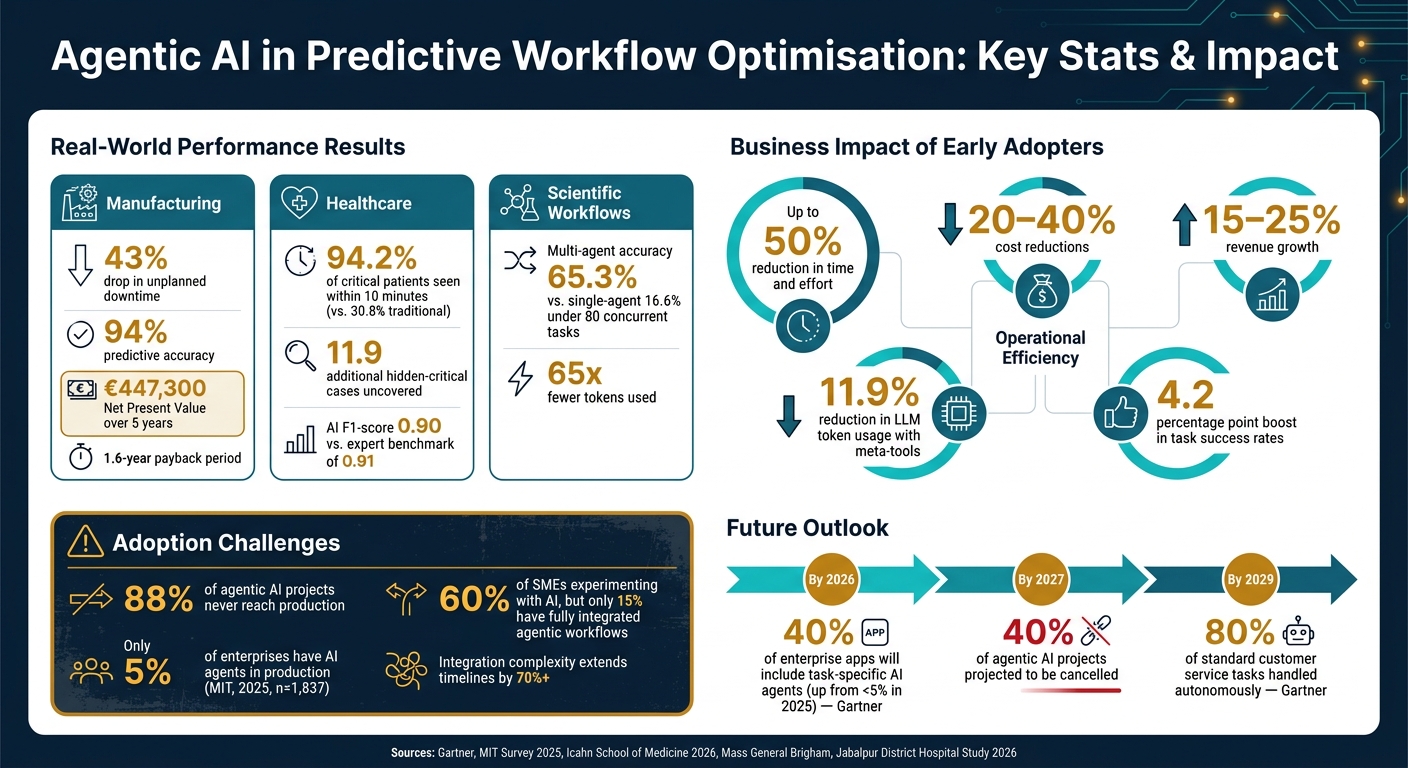
- Combined Benefits: Early adopters report up to 50% reductions in time and effort, with significant cost savings and productivity boosts.
Real-World Examples:
- Manufacturing: Reduced equipment downtime by 43% and achieved a €447,300 net present value over five years.
- Healthcare: Improved patient prioritisation accuracy, uncovering critical cases and reducing response times.
- Scientific Workflows: Multi-agent systems maintained 65.3% accuracy under heavy workloads, compared to 16.6% for single-agent setups.
Challenges:
- Complexity: 88% of agentic AI projects fail to reach production due to integration and context management issues.
- Infrastructure Needs: Requires robust context layers, memory systems, and orchestration tools for effective deployment.
Future Outlook:
By 2029, agentic AI could autonomously handle 80% of customer service tasks. For SMEs, starting with a single repetitive task and scaling gradually offers a practical path to adoption.
Agentic AI isn't just about advanced technology - its success lies in how well it integrates into workflows to deliver measurable improvements.
Agentic AI in Predictive Workflow Optimisation: Key Stats & Impact
Core Features of Agentic AI in Workflow Optimisation
Key Properties of Agentic AI Workflows
Agentic AI workflows follow a structured process with four essential phases, making them highly effective for predictive optimisation.
The journey begins with perception, where the system gathers information from its environment. This could include anything from sensor readings to healthcare records. The next phase is reasoning and planning, where the system breaks down a larger goal into smaller, achievable tasks. As Pankaj Negi, an AI researcher at Tungsten Automation, explains:
"Agentic AI Planning Pattern follows the same idea [as the human brain], and it mimics the idea of reasoning, planning, and problem solving which is all done in the frontal lobe."
The third phase, action, sees the agent interacting with external systems through APIs to complete tasks and advance the workflow. Finally, the cycle is completed with learning and feedback, where the system evaluates its performance and makes adjustments for future improvements. This iterative process sets agentic AI apart from traditional static automation systems.
These phases form the foundation for designing robust predictive workflow systems.
Architecture Patterns for Predictive Workflow Optimisation
The architecture of an agentic AI system plays a vital role in predictive optimisation. Currently, three main patterns dominate production use, each suited to specific workflow requirements:
| Pattern | How It Works | Best For |
|---|---|---|
| DAG-Based | Follows fixed, sequential steps with a centralised state | Batch pipelines, ML training, ETL processes |
| Event-Driven | Agents respond to events via a shared bus (e.g., Kafka) | Real-time processing, threat detection |
| Actor Model | Independent agents communicate through message-passing | Complex, distributed workflows with state |
For instance, Elastic implemented a real-time threat detection system using an event-driven architecture based on Kafka. Specialist agents, such as those for network analysis and threat intelligence, processed security events in parallel and combined their findings for automated responses. On the other hand, Uber used LangGraph for reasoning and Temporal for durable execution, ensuring long-running workflows, like code migration, could withstand infrastructure failures without losing progress.
Durable execution has become a critical feature in modern AI systems. As the VP of App Infrastructure at OpenAI emphasised:
"Durable Execution is a core requirement for modern AI systems… as AI systems become more complex and long-running, durability is as important as performance."
Gartner predicts that by the end of 2026, 40% of enterprise applications will incorporate task-specific AI agents, a significant leap from under 5% in 2025. This underscores the importance of making scalable architectural decisions now.
Connecting Agentic AI to Existing Systems
Agentic AI systems are designed to integrate effectively with existing enterprise infrastructure, supporting predictive optimisation in areas like resource management, production control, and service workflows.
One effective integration method is the sidecar pattern, where an agent attaches to an existing system, such as a CRM or ERP, to observe and enhance data without altering the core infrastructure. This modular approach allows businesses to adopt agentic AI incrementally.
Standardised protocols further streamline this integration. The Model Context Protocol (MCP) provides unified access to tools, APIs, and file systems, while the Agent2Agent (A2A) protocol facilitates structured communication and delegation between agents.
"The safest enterprise agent is rarely a single 'super agent.' In production, a set of smaller specialist agents with constrained permissions... is usually easier to test, audit, and scale." – Bot365
This modular and adaptable design makes agentic AI an appealing tool for improving predictive workflows while maintaining system flexibility and scalability.
sbb-itb-1051aa0
How Agentic AI Affects Operational Efficiency
Manufacturing: Predictive Maintenance and Production
A ceramic manufacturer recently implemented an agentic AI framework that leverages federated learning and edge computing to analyse real-time sensor and vibration data from its equipment. The results were impressive: 94% predictive accuracy, a 43% drop in unplanned downtime, and a 67% reduction in false positives. By moving from reactive alerts to autonomous, closed-loop responses, the company sped up maintenance cycles by more than 40%.
Financially, the framework delivered a Net Present Value of €447,300 over five years, with a payback period of just 1.6 years.
"Agentic AI provides both conceptual and practical pathways for transitioning from reactive monitoring to resilient, autonomous, and human-centered industrial intelligence."
These advancements highlight how agentic AI can transform manufacturing processes, offering insights that could also benefit other sectors, such as healthcare.
Healthcare: Improving Clinical Workflows
In March 2026, a district hospital in Jabalpur, Madhya Pradesh, tested an agentic AI framework using a discrete-event simulation with 368 synthetic patients. The system integrated voice-based multilingual symptom capture with LLM-powered severity prediction to prioritise clinical urgency in real time. This method uncovered 11.9 additional hidden-critical cases and ensured 94.2% of critical patients were seen within 10 minutes, compared to just 30.8% under the traditional first-come-first-served model.
At Mass General Brigham, researchers developed a fully automated multi-agent workflow using LLaMA 3 8B to analyse 3,338 clinical notes for signs of cognitive decline. The system achieved an F1-score of 0.90 and a specificity of 1.00, closely matching the expert benchmark of 0.91. Remarkably, expert reviews confirmed that the AI system correctly identified 44% of cases previously labelled as false negatives.
These healthcare examples demonstrate the potential of agentic AI to streamline clinical workflows and improve patient outcomes, setting the stage for its use in other analytical fields.
Scientific and Analytical Workflows
In data-heavy environments, system design plays a critical role. A March 2026 study at the Icahn School of Medicine at Mount Sinai compared multi-agent orchestration with single-agent systems for tasks like retrieval, extraction, and dosing using GPT-4.1-mini. When managing 80 concurrent tasks, single-agent systems saw their accuracy plummet to 16.6%, while the multi-agent setup maintained an accuracy of 65.3%, all while using 65 times fewer tokens.
Lead author Mahmud Omar explained:
"Delegating tasks to individual workers insulates the model from context interference, maintaining high accuracy even under concurrent loads."
These findings underline the efficiency of multi-agent systems in handling complex, simultaneous tasks, further showcasing the versatility of agentic AI across industries.
Design and Infrastructure for Agentic AI Workflows
Data and Infrastructure Requirements
Agentic AI often struggles to move beyond the experimental stage due to the challenges of integration. Research from January 2026 highlights this issue, revealing that 88% of AI agent projects never make it to production. The complexity of integrating these systems into real-world environments can extend project timelines by 70% or more, primarily due to edge cases and integration hurdles. Similarly, a 2025 MIT survey of 1,837 enterprises found that just 5% had AI agents operating in production.
The main barrier? Infrastructure. For an agentic system to be production-ready, it must include five critical layers: context management, tools, memory, guardrails, and orchestration. Missing even one of these layers can derail progress.
Among these, memory design deserves special attention. Instead of simply storing raw conversation history, systems should use structured state data - such as IDs, timestamps, and statuses - organised into session, task, entity, and audit memories. To keep agents grounded and minimise the risk of LLM hallucinations, integrating real-time data feeds and Retrieval-Augmented Generation (RAG) is essential. High-performance platforms like Redis are often employed for their ability to handle vast numbers of small reads and writes, offering sub-millisecond latency for tasks like vector search and semantic caching.
Principles for Designing Agentic AI Workflows
With the right infrastructure in place, effective process design becomes the next critical step for agent decision-making. One key insight from production deployments is that process mapping must come before model selection. As Stefan Finch, Founder of Graph Digital, puts it:
"Processes that feel too complex for a workflow are almost never actually too complex. They are incompletely mapped."
Once processes are fully mapped, deterministic orchestration should be used to maintain control, while decision-making is delegated to specialised agents. Specialisation is key. Instead of relying on a single agent to handle every task, systems benefit from deploying smaller, specialised agents with limited permissions and clear handoffs. As Precision Data Partners aptly noted:
"A constrained agent is a predictable agent."
Human oversight is another crucial component. At critical decision points - such as approving payments or making contract changes - human checkpoints should be integrated. Additionally, every reasoning step, tool call, and state mutation must be logged with unique trace IDs, ensuring the system remains auditable and debuggable. These design principles enhance both predictability and efficiency in agent workflows.
The Role of Scalable Web Applications
Once infrastructure and design are optimised, scalable web applications become the backbone for integrating agentic workflows. These workflows often face bottlenecks not in model computation but in coordination tasks like memory lookups, retrieval, caching, and orchestration. A well-designed web application serves as the critical tool layer, enabling agents to interact with external systems seamlessly. It handles essentials like authentication, rate limiting, and error management, allowing the agent to focus on reasoning rather than technical intricacies.
This is where firms like Antler Digital step in. By creating modern, scalable web applications with built-in agentic workflows and AI capabilities, they empower small and medium-sized enterprises (SMEs) to access robust architectures typically reserved for larger organisations. This approach not only boosts operational efficiency but also helps reduce the projected 40% cancellation rate of agentic AI projects by 2027. By serving as a stable intelligence layer, these applications ensure agents operate safely and effectively, bridging the gap between ambition and execution.
Conclusion and Future Outlook
Key Takeaways
Agentic AI is reshaping predictive workflow optimisation, setting new standards for efficiency. It has moved beyond theory to become a practical tool that transforms workflows. Early adopters have reported impressive results, including 20–40% cost reductions and 15–25% revenue growth, thanks to more effective lead qualification and faster outreach efforts.
The major shift lies in moving away from rigid automation towards goal-driven systems. As Tyler Thompson from Teraflow.ai explains:
"The human role shifts from designing workflows to defining boundaries: establishing what the agent is permitted to do, what outcomes constitute success, and when human intervention is required."
The true impact of agentic AI doesn't come from the complexity of the models but from how well they are integrated into actual processes. Patrícia Salgado Oliveira highlights this point:
"Agentic AI becomes genuinely transformative not through model sophistication but through workflow embedding, outcome‑based measurement, and continuous evolution."
These tangible benefits pave the way for further advancements in workflow optimisation.
Future Research and Applications
Looking ahead, research suggests even broader applications for agentic AI are on the horizon. The potential is immense. Gartner predicts that by 2029, 80% of standard customer service tasks could be handled autonomously by agentic AI systems. Additionally, a study from EPFL's AWO framework, published in early 2026, showed that consolidating recurring tool sequences into "meta-tools" can cut LLM token usage by 11.9% and boost task success rates by 4.2 percentage points. These improvements are expected to multiply as the technology evolves.
For small and medium-sized enterprises (SMEs), the journey is just beginning. While 60% of SMEs are experimenting with AI, only 15% have fully integrated agentic workflows into their operations. This gap represents a major opportunity. The most effective starting point is to focus on a single high-volume, repetitive task. Build a robust context layer, run agents alongside staff in a pilot phase, and then gradually scale. Companies like Antler Digital are already helping SMEs transition from experimentation to full-scale implementation, creating the infrastructure needed to integrate and scale agentic AI solutions.
FAQs
How is agentic AI different from predictive analytics?
Agentic AI and predictive analytics serve different purposes and operate on distinct levels of capability. Predictive analytics focuses on forecasting future outcomes by analysing data trends. It’s a powerful tool for supporting decision-making, though it often relies on human oversight to interpret and act on its insights.
Agentic AI, on the other hand, takes things further. It doesn’t just predict; it reasons, plans, and acts independently to achieve specific goals. It adapts to changes in real time and manages tasks autonomously, eliminating the need for constant human intervention. While predictive analytics tells you what might happen, agentic AI steps in to handle workflows directly, cutting down on manual work and streamlining operations.
What do we need to run agentic AI safely in production?
To ensure the safe deployment of agentic AI in production, several key practices are essential. Explicit orchestration provides a structured framework for AI processes, reducing the risk of unexpected outcomes. Establishing clear data contracts ensures that data flows are predictable and aligned with expectations. Adding memory layers allows the system to retain and utilise relevant information over time, improving its performance. Finally, implementing robust observability makes it easier to monitor the system, identify emergent behaviours, and address potential failures promptly and effectively. These steps work together to create a more controlled and reliable AI environment.
Where should an SME start with agentic workflow optimisation?
Small and medium-sized enterprises (SMEs) should start by pinpointing repetitive, time-consuming tasks that are prone to errors. Lay out the workflows for these tasks, then narrow it down to the top three candidates for automation. Once identified, run a 90-day pilot programme to test and fine-tune the process. Prioritise low-risk, high-impact automations by using tools your team is already comfortable with to achieve quick results. This step-by-step method allows businesses to gradually introduce agentic AI, boosting efficiency while keeping risks and costs under control.
if (valuable) then share();